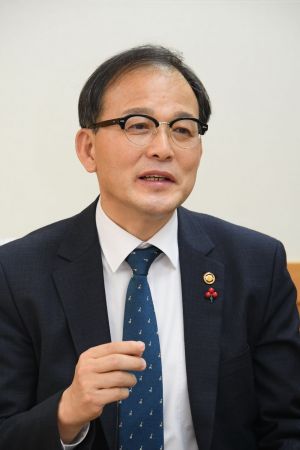
[Asia Economy (Daejeon) Reporter Jeong Il-woong] “Carbon neutrality is no longer an option but a necessity in the international community, and these days, enhancing the value and functions of forests is more important than ever for achieving carbon neutrality.”
On the 20th, this was the key message delivered by Park Jong-ho, the Commissioner of the Korea Forest Service. On the same day, Commissioner Park held a briefing at the Government Complex Daejeon and announced the ‘2050 Carbon Neutrality Forest Sector Promotion Strategy (Draft).’
The core of the promotion strategy is to plant 3 billion trees over the next 30 years to increase the forest carbon absorption capacity to 34 million tons by 2050.
To achieve this, the Korea Forest Service has set four major policy directions: ▲strengthening forest carbon absorption capacity through generational replacement of trees ▲expanding new carbon sinks in North Korea and overseas ▲expanding the use of timber and forest biomass ▲preserving and restoring forest carbon sinks.
Commissioner Park stated, “As of 2018, the domestic forest carbon absorption amount was 45.6 million tons, offsetting 6.3% of the national total emissions (730 million tons),” but he also forecasted, “However, as aging (trees over 30 years old) rapidly progresses in forests planted intensively during the reforestation campaigns of the 1970s and 1980s, the carbon absorption amount in 2050 will decrease to 14 million tons (about 70% of the current level).”
In response, the Korea Forest Service plans to enhance forest health through generational replacement of aging trees and adjust the ‘harvest age’ according to the function and management purpose of trees as resources.
Additionally, they plan to select ‘carbon cycling forests’ that prioritize carbon absorption and develop optimal harvesting models. They aim to expand afforestation of species with excellent carbon absorption capacity and environmental adaptability, such as Korean pine and lily tree, and establish a stable supply system for superior seeds and seedlings.
The Korea Forest Service also plans to expand new carbon sink areas. The basic plan is to increase urban forests such as fine dust blocking forests, urban wind corridors, and indoor/outdoor gardens throughout domestic cities, while also promoting the expansion of new carbon sinks in North Korea and overseas.
Commissioner Park said, “The Korea Forest Service will, through inter-Korean forest cooperation projects considering international circumstances, afforest and restore the devastated forests in North Korea and link this to securing carbon sinks for our country.” He added, “We plan to implement a 2.5 million hectare REDD+ project in Asia, Africa, and Latin America to secure 5 million tons of overseas carbon reduction annually,” outlining his vision.
REDD+ is a system that allows developed countries leading restoration efforts to secure carbon emission rights in exchange for restoring and conserving forests in developing countries. This was newly included in Article 5 of the 2015 Paris Agreement.
Furthermore, the Korea Forest Service plans to expand the use of timber and forest biomass, recognized as carbon storage under the Climate Change Convention, and preserve forest carbon sinks by restoring damaged forest areas such as the Baekdudaegan mountain range and the Demilitarized Zone (DMZ), which have caused biodiversity loss and reduced carbon absorption capacity.
Commissioner Park emphasized, “Forests are representative carbon sinks and will play a key role in achieving carbon neutrality by 2050,” and added, “The Korea Forest Service plans to finalize the carbon absorption targets and detailed implementation plans through the promotion strategy by the third quarter of this year and proceed with execution.”
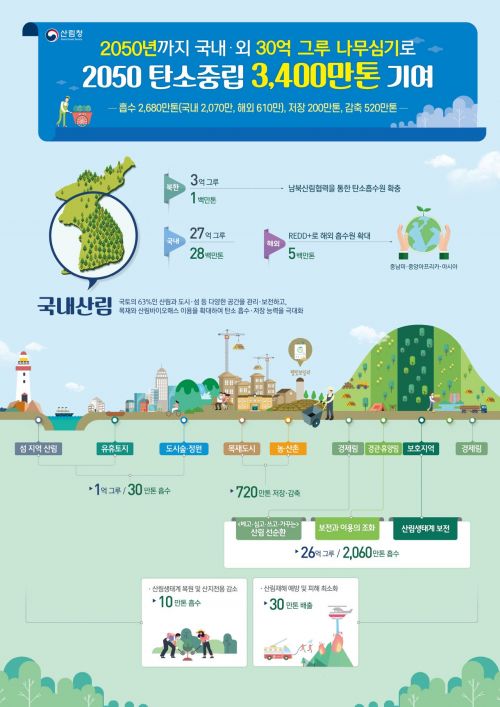 The Korea Forest Service plans to plant 3 billion trees by 2050 through the "2050 Carbon Neutrality Forest Sector Promotion Strategy." The Korea Forest Service aims to increase carbon absorption through forests to 34 million tons. Photo by Korea Forest Service
© The Asia Business Daily(www.asiae.co.kr). All rights reserved.
![Clutching a Stolen Dior Bag, Saying "I Hate Being Poor but Real"... The Grotesque Con of a "Human Knockoff" [Slate]](https://cwcontent.asiae.co.kr/asiaresize/183/2026021902243444107_1771435474.jpg)

















