Submission of Policy Proposal to the Ministry of Foreign Affairs and the Ministry of Economy and Finance
[Asia Economy Reporter Kim Heung-soon] The Federation of Korean Industries (FKI) announced on the 20th that it has submitted the "Korea-Taiwan Trade and Investment Activation Policy Proposal," which mainly includes agreements on double taxation avoidance, investment protection with Taiwan, and the lifting of the ban on Korean-flagged vessels operating on the Japan-Taiwan shipping route, to the Ministry of Foreign Affairs and the Ministry of Strategy and Finance.
The FKI explained that the proposal was made due to Taiwan's increasing strategic importance, highlighted by Google's establishment of a $100 million data center in Taiwan last year and the rekindling of discussions on a free trade agreement (FTA) between the United States and Taiwan.
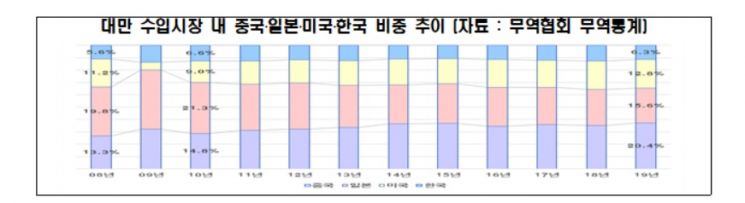
According to the FKI, China signed the Economic Cooperation Framework Agreement (ECFA) with Taiwan in 2010, and Japan concluded investment protection and double taxation avoidance agreements with Taiwan in 2011 and 2015 respectively, maintaining a market share of over 15% in Taiwan's import market, ranked 18th globally. In contrast, South Korea's share in Taiwan's import market has remained at around 6% since 2010.
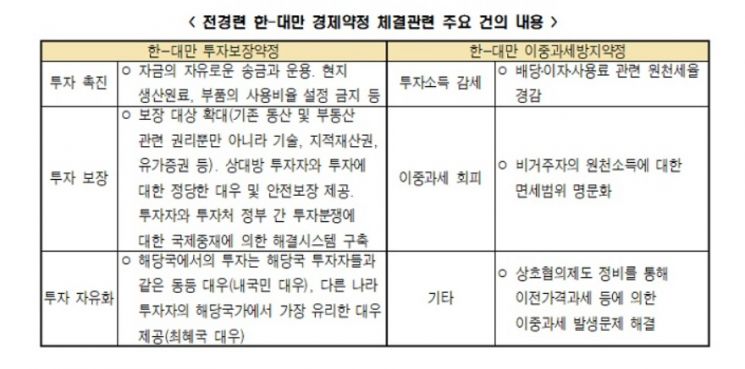
In this policy proposal, the FKI stated that an investment protection agreement promoting mutual investment and investment liberalization, as well as a double taxation avoidance agreement for reducing taxes on investment income, should be concluded with Taiwan within the first half of this year. It also requested the government to make efforts to resolve restrictions imposed by Taiwan on Korean shipping companies' activities.
Since severing diplomatic ties with South Korea in 1992, the Taiwanese government has banned Korean shipping companies from operating on the Taiwan-Japan route. Korean shipping companies are still unable to handle the collection and shipment of import and export cargo between Taiwan and Japan. The FKI explained that using third-country flagged vessels for cargo transport in such cases incurs additional costs and may lead to liability issues in the event of unforeseen accidents.
Furthermore, Korean vessels are explicitly excluded from participating in bids for import cargo by government-invested institutions such as Taiwan Power Company, forcing Korean shipping companies to pay a commission (1.25%) to Taiwanese shipping companies and purchase transportation rights when handling such cargo.
On the other hand, after signing the ECFA in 2010, China eliminated tariffs on key Taiwanese export items, and its market share in Taiwan's import market rose from 14.8% in 2010 to 20.4% in 2019.
Kim Bong-man, head of the FKI's International Cooperation Office, said, "Following the US-China trade war and the global economic crisis caused by the novel coronavirus disease (COVID-19), protectionist measures by emerging countries such as China, India, and ASEAN are increasing." He added, "Domestic trade authorities should expedite the conclusion of economic agreements with Taiwan within the first half of this year to support exports."
© The Asia Business Daily(www.asiae.co.kr). All rights reserved.


















