Busan City Completes Phase 1... 20 Billion KRW Invested for Total 39.71km in 3 Phases by 2022
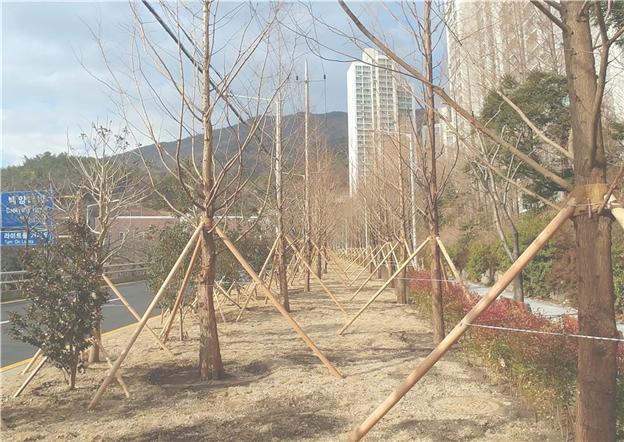
[Asia Economy Yeongnam Reporting Headquarters Reporter Kim Yong-woo] The first phase of the "Urban Wind Path Forest" project, promoted by Busan City to reduce fine dust and alleviate the heat island effect, has been completed.
Busan City (Acting Mayor Byun Seong-wan) announced on the 19th that it recently completed the first phase of the entire project, creating urban wind path forests in four locations including Gwanmundo-ro.
A wind path forest is a forest that connects outer urban forests with inner city forests to promote air circulation.
The "Urban Wind Path Forest" project aims to create street forests, key green spaces, and connecting forests within the city to reduce fine dust, alleviate urban heat islands, and improve street landscapes.
In Busan, green corridors are being established along Gwanmundo-ro, Gamcheon-ro, Gangbyeon-daero, and Dadae-ro. After about two months of construction starting from the end of October last year, the first phase was completed. The budget for the first phase was approximately 4.29 billion KRW.
The four completed sites are ▲ Gwanmundo-ro Urban Wind Path Forest from Baekyang Tunnel turnaround to Dangam-dong Ilsuite area ▲ from Kosin University Hospital to National Sports Center ▲ from Sasang Gamjeon Intersection to Hakjang No.1 Bridge area ▲ and from Sinpyeong Jangnim Industrial Complex Intersection to Eulsukdo Intersection to Dadaepo Station section.
Busan City connected urban green corridors and installed new sidewalks to ensure pedestrian safety, while also planting street trees and street flower beds to provide shade, improve scenery, and prevent safety accidents.
Additionally, the road width was reduced to create multi-layered tree belts, and more trees were planted to reduce noise and fine dust. Pruning, shrub removal, and transplantation work were carried out to improve the growth environment.
Byun Seong-wan, Acting Mayor of Busan, said, "The Urban Wind Path Forest is an 'Environmental Forest' selected for the Korea Forest Service's fine dust reduction living SOC contest, and it will play a significant role in creating a pleasant green city."
Busan City plans to invest a total of 20 billion KRW (10 billion KRW national funds, 10 billion KRW city funds) in three phases by 2022 to create urban wind path forests over 39.71 km in 22 areas.
© The Asia Business Daily(www.asiae.co.kr). All rights reserved.

















