Announcement of 'Special Supply Measures' Before Lunar New Year
Plan for 'Bold' Development and Discovery of New Housing Sites
Existing Regulatory Frameworks Such as Capital Gains Tax Remain Unchanged
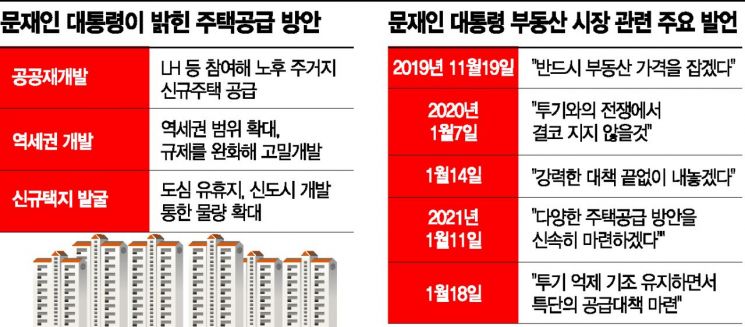
[Asia Economy Reporter Moon Jiwon] Market attention is focused on the government's housing supply plan, which is set for implementation 'before the Lunar New Year holiday.' Since President Moon Jae-in mentioned a "special measure" at a level "beyond expectations" during his New Year's press conference on the 18th, the possibility of presenting a supply target that exceeds the market's initial expectations has increased. Accordingly, it is anticipated that this supply plan will present a 'record-breaking' volume of at least 200,000 housing units, including the 132,000 units in Seoul and the metropolitan area announced in last year's August 4 supply plan.
However, many opinions suggest that the measures revealed by President Moon at the New Year's press conference are not new, having been mentioned several times before, and most will inevitably take a long time until occupancy, making it difficult to immediately stabilize the market. Above all, since the existing regulatory framework, such as the strengthening of capital gains tax, will remain unchanged, there are concerns that it will not be able to change the market's flow.
Expansion of Urban Supply, Success Depends on Incentives
According to the government and real estate industry on the 19th, the government's supply plan revealed through President Moon's New Year's press conference the previous day can be summarized as ▲ public redevelopment ▲ development around subway stations ▲ discovery of new housing sites. On the surface, this aligns with the existing supply expansion framework previously announced by Land, Infrastructure and Transport Minister Byeon Chang-heum.
In the case of public redevelopment, the project has entered the main track, with the government selecting eight pilot project sites in Seoul on the 15th. The Korea Land and Housing Corporation (LH) plans to designate these areas as redevelopment zones by the end of the year. Since 70 districts participated in the public contest, there is analysis that there is room to expand the target areas through screening and thus increase the supply volume further.
Development around subway stations is also being prepared mainly by the Ministry of Land, Infrastructure and Transport and the Seoul Metropolitan Government. The plan is to significantly relax regulations in low-density development areas such as downtown Seoul subway station areas and low-rise residential zones to increase apartment supply. The government's passage of the revision to the Enforcement Decree of the National Land Planning and Utilization Act at the Cabinet meeting on the same day, allowing the floor area ratio around subway stations to be raised from the existing 500% to up to 700%, is a strategic move to support this plan. The issue lies in balancing incentives and the recovery of development gains. Since the government still insists on thorough recovery of development profits, market reactions may fall short of expectations.
 President Moon Jae-in is answering reporters' questions at the New Year's press conference held at the Blue House Chunuchu-gwan on the 18th. (Photo by Yonhap News)
Will Additional Housing Sites Be Supplied?
The key issue is whether 'bold' new housing site development will occur. The government already announced a supply plan of '300,000 housing units in the metropolitan area,' including the 3rd phase new towns in March 2018, and in August last year, through the 'Plan to Expand Housing Supply in the Seoul Metropolitan Area,' it revealed plans to supply 33,000 units in places such as the Taereung Golf Course in Nowon-gu, Seoul, and idle land at the Gwacheon Government Complex in Gyeonggi Province. The newly announced supply volume at that time reached 132,000 units.
Therefore, the core of the "beyond expectations" supply may be the acquisition of additional large-scale housing sites. The Ministry of Land, Infrastructure and Transport also held a joint briefing with related agencies the previous day, emphasizing that "while doing our best to ensure that already announced new housing sites are supplied in a timely manner, we will continuously discover new housing sites so that additional housing supply is always possible," raising the possibility of expanding the designation of 3rd phase new towns.
Ahn Myung-sook, head of the Real Estate Investment Support Center at Woori Bank, explained, "There may be market expectations that a groundbreaking plan will emerge with better locations and faster supply speed than the 3rd phase new towns," adding, "Although there are concerns that public redevelopment may take a long time, since new housing units will be supplied, some psychological stability is expected."
Concerns Over Policy Effectiveness Diminished by Drawing a Line on Deregulation
However, since President Moon stated that "existing speculative suppression policies will be maintained," it is difficult to expect measures such as easing capital gains tax or loan regulations. Regarding questions about easing loan regulations, President Moon showed little interest, saying, "It is difficult to answer specialized parts."
The market continues to worry that as long as the phenomenon of withholding listings due to the heavy capital gains tax on multiple homeowners persists, the shortage of circulating supply in the market will not be easily resolved. Moreover, it is pointed out that this withholding phenomenon will worsen due to non-taxation for single homeowners and the residency obligation for reconstruction occupancy rights. Professor Kwon Dae-jung of the Department of Real Estate at Myongji University diagnosed, "The measures may give hope to the homeless, but it is difficult to help stabilize the market immediately."
© The Asia Business Daily(www.asiae.co.kr). All rights reserved.
![Clutching a Stolen Dior Bag, Saying "I Hate Being Poor but Real"... The Grotesque Con of a "Human Knockoff" [Slate]](https://cwcontent.asiae.co.kr/asiaresize/183/2026021902243444107_1771435474.jpg)

















