After the 2019 Planned Blackout Crisis
Increasing Shares of Renewable, Thermal, and Imports
Rapid Growth in Solar Power Generation
First Wind Power Plant Also Underway
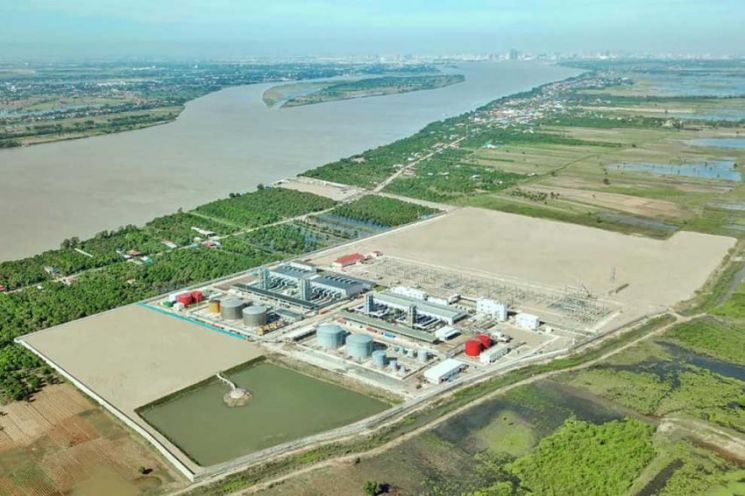
[Asia Economy Phnom Penh Correspondent An Gil-hyun] With Cambodia recently starting the operation of a 400-megawatt (MW) class heavy oil power plant, the likelihood of planned blackouts that occurred in 2019 reoccurring has decreased. Cambodia, which was mainly reliant on hydropower, has recently significantly increased its supply of renewable energy such as solar and wind power.
After the planned blackouts in 2019, the Cambodian government invested $380 million to prevent recurrence by starting construction of emergency power plants and importing German and Finnish heavy oil generators, each with a capacity of 200 MW. Construction was undertaken by a Chinese company.
Originally scheduled for completion in mid-last year, the completion was delayed due to COVID-19 restricting the entry and exit of construction company technicians. Since heavy oil is more expensive compared to other power sources, Cambodia Electricity Authority (EdC) explained that the plants will operate partially under normal circumstances and fully when power is insufficient.
The planned blackouts in 2019, which lasted about two months with six hours each in the morning and afternoon on weekdays excluding holidays and Sundays, were the first occurrence since the founding of the current Kingdom of Cambodia in 1993. The primary cause was a sharp drop in hydropower plant operation rates due to drought.
That year, dry season hydropower generation decreased by as much as 66% compared to the rainy season. As climate change worsened, the planned blackouts became a turning point for Cambodia’s power policy, which was centered on hydropower. As a result, the share of hydropower stalled while the shares of renewable, thermal, and imported power significantly increased.
According to the Electricity Authority of Cambodia (EAC), Cambodia’s total power supply capacity last year was 3,897 MW, with domestic generation (2,916 MW) and power imports (980 MW) accounting for 68.1% and 31.9%, respectively. Although the share of imported power once surged to 60%, it fell to 14.5% in 2018 due to increases in hydropower and thermal power plants, then rose again to 32% at the end of last year, double that of 2018.
As of the end of last year, hydropower still accounted for an overwhelming 45.57% of domestic generation capacity, but the share of solar power generation (236.8 MW) jumped to 8.12%. Considering that Cambodia’s only solar power plant in 2017 was a 10 MW mini power plant, this is a remarkable leap.
Additionally, four solar power plants totaling 170 MW, approved at the end of 2019, have completed about 90% of construction and are scheduled to start operation soon, so the share of solar power generation is expected to continue increasing.
Not only solar power but also in the southern region of Kampot, the French company Blue Circle is promoting Cambodia’s first wind power plant (Phase 1: 80 MW). Currently, negotiations on the power purchase price with the state-owned power company are underway, and construction will begin once negotiations are completed.
According to Blue Circle, which has been conducting wind power feasibility studies since 2018, Cambodia’s wind power potential is estimated at 500 MW, indicating plans beyond just the first phase. The price Blue Circle proposed to the state-owned power company is $0.0685 per kilowatt-hour, while the power purchase prices of solar power plants built across Cambodia in recent years range from $0.07 to $0.076 per kilowatt-hour.
© The Asia Business Daily(www.asiae.co.kr). All rights reserved.
![Clutching a Stolen Dior Bag, Saying "I Hate Being Poor but Real"... The Grotesque Con of a "Human Knockoff" [Slate]](https://cwcontent.asiae.co.kr/asiaresize/183/2026021902243444107_1771435474.jpg)
















