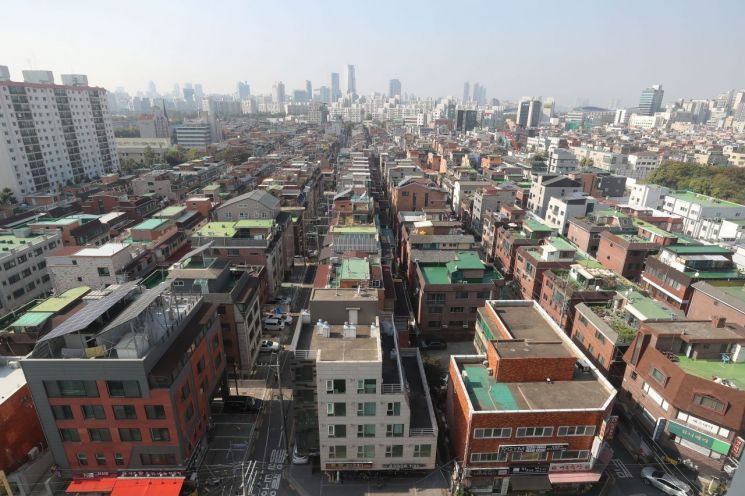
[Asia Economy Reporter Moon Jiwon] The amendment to the Enforcement Decree of the "National Land Planning and Utilization Act" (hereinafter referred to as the National Land Planning Act), which allows the floor area ratio in urban railway station areas to be increased up to 700%, has passed the Cabinet meeting. There is growing anticipation that housing supply could significantly increase if the floor area ratio around station areas, currently averaging about 160%, is relaxed to 700%.
The Ministry of Land, Infrastructure and Transport announced on the 19th that the partial amendment to the Enforcement Decree of the National Land Planning Act containing this content was approved at the Cabinet meeting.
Currently, under the National Land Planning Act, there is a development type within district unit plans that allows mixed-use development combining residential and commercial functions in station areas, but it can only be designated in quasi-residential, quasi-industrial, and commercial zones, and cannot be applied to general residential zones. Also, under current laws, the floor area ratio in general residential zones can only be relaxed up to 400-500% through district unit plans, limiting high-density development to increase housing supply.
Accordingly, the government revised the enforcement decree to include general residential zones as eligible areas for designation as mixed-use development district unit plan zones in station areas, and when changing general residential zones to quasi-residential zones through district unit plans, the floor area ratio can be relaxed up to 700%. Additionally, to facilitate increasing the floor area ratio in quasi-residential zones without issues regarding sunlight rights regulations, height restrictions for securing daylight under the Building Act can be relaxed up to twice the current limit.
However, a certain ratio, determined by local ordinances within the range of the land value increase due to the floor area ratio relaxation, must be donated as public rental housing. This system will be implemented three months after the promulgation of the amendment, and until then, local governments such as Seoul must reflect the delegated matters from the enforcement decree into their ordinances.
The government also prepared measures to encourage local governments to establish growth management plans in planned management areas.
Planned management areas, which account for about 11% of the total national land area, allow both housing and factories to be located, resulting in mixed-use phenomena where factories increase in residential areas. Because of this, there have been many complaints mainly from village residents in these areas regarding health rights violations due to environmental pollution and lack of infrastructure such as roads.
Although the government introduced the growth management plan system in 2014 to prevent indiscriminate development in non-urban areas, it was not activated due to the structure allowing local governments to decide arbitrarily whether to establish such plans. Therefore, the government has stipulated that in planned management areas, factory and manufacturing site locations will only be permitted if local governments have pre-established growth management plans. Since it may take time for local governments to establish these plans, a grace period ranging from a minimum of 3 years to a maximum of 7 years will be applied differentially from the date of promulgation.
Choi Imrak, Director of Urban Policy at the Ministry of Land, Infrastructure and Transport, said, "This amendment is expected to expand housing supply around station areas and reduce indiscriminate development in non-urban areas," and added, "We will cooperate with local governments and others to achieve results as soon as possible."
© The Asia Business Daily(www.asiae.co.kr). All rights reserved.
![Clutching a Stolen Dior Bag, Saying "I Hate Being Poor but Real"... The Grotesque Con of a "Human Knockoff" [Slate]](https://cwcontent.asiae.co.kr/asiaresize/183/2026021902243444107_1771435474.jpg)
















