"Financial Support and Other Measures Must Follow to Maintain the Ecosystem"
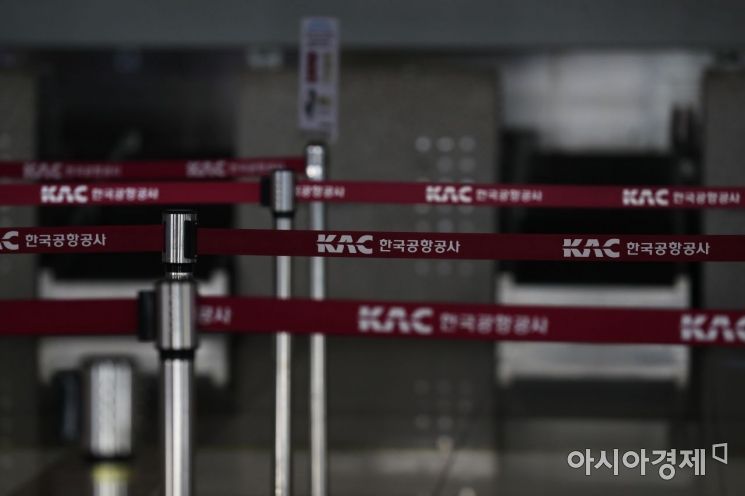 On the 14th, amid the ongoing COVID-19 pandemic, the international terminal at Gimpo International Airport in Gangseo-gu, Seoul, is deserted. Photo by Mun Ho-nam munonam@
[Asia Economy Reporter Yu Je-hoon] The aviation industry has fallen into a state of panic as the novel coronavirus disease (COVID-19) crisis has continued for a year. This is because the entire related industrial sector, as well as the aviation industry, is shaken by an unprecedented blow with passenger numbers dropping by more than 80%. Industry insiders appeal that support must continue to maintain the industrial ecosystem, as it is expected to take at least 2 to 3 more years until demand recovers.
According to the Financial Supervisory Service's electronic disclosure system on the 18th, the combined cumulative sales of six listed airlines as of the third quarter of last year amounted to 9.6354 trillion won, with an operating loss of 779 billion won. Compared to the third quarter of 2019, sales decreased by 45%, and operating profit turned into a significant deficit.
Fortunately, thanks to the government's paid and unpaid leave employment retention subsidies, a mass unemployment crisis did not occur, but job insecurity remains. The Korea Air Transport Association estimates that as of this month, about 22,000 employees, or approximately 60% of the total 38,000 workers in the aviation industry, are on paid or unpaid leave. Due to the system's nature, which limits leave to 180 days, it is inevitable that those on paid leave will have to switch to unpaid leave in the second half of this year. This crisis is not limited to airlines alone. Ground handling companies, travel agencies, duty-free shops, and food and beverage outlets within airport terminals have also experienced employment hardships over the past year. For example, duty-free operations at Gimpo International Airport's international terminal have been suspended since last year, and about 25% of shops at Incheon International Airport have closed due to contract expirations, terminations, or temporary closures.
It is difficult to expect a turnaround this year as well. Despite the development of COVID-19 vaccines, the emergence of variant viruses has led to strengthened entry restrictions by various countries. The Korea Transport Institute (KOTI) has analyzed that the recovery point for air travel demand will be as early as next year or as late as mid-2023. In particular, domestic airlines are expected to face significant financial burdens this year due to the structural reorganization involving the merger and acquisition (M&A) of Korean Air and Asiana Airlines. Korean Air alone had borrowings nearing 5 trillion won that must be repaid or refinanced within one year as of the end of the third quarter last year.
Professor Heo Hee-young of Korea Aerospace University said, "The International Air Transport Association (IATA) expects air travel demand to increase by about 50% compared to the previous year, improving the situation, but the Korean aviation market will continue to face difficulties due to the low proportion of domestic flights." He added, "It is necessary to consider establishing a separate financial support program for low-cost carriers (LCCs), which are currently not eligible for the Period Industry Stabilization Fund (PISF), and to reform the employment retention subsidy system, which is limited to 180 days."
© The Asia Business Daily(www.asiae.co.kr). All rights reserved.

















