‘Joint Agreement for the Establishment and Operation of the Korea Garden Culture Center’
[Muan=Asia Economy Honam Reporting Headquarters Reporter Yoon Jamin] Jeonnam Province and the Korea Forest Service have joined hands to establish the ‘Korean Garden Culture Center’ for integrated garden management, industry promotion, and globalization of Korean gardens.
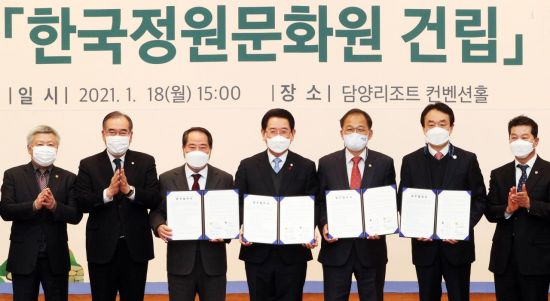
On the 18th, the province announced that it signed a ‘Business Agreement for Joint Promotion of the Establishment and Operation of the Korean Garden Culture Center’ with the Korea Forest Service, Damyang County, and the Korea Arboretum Management Institute at Damyang Resort.
The signing ceremony was attended by Kim Young-rok, Governor of Jeonnam Province; Park Jong-ho, Administrator of the Korea Forest Service; Choi Hyung-sik, Mayor of Damyang County; Kim Yong-ha, Chairman of the Korea Arboretum Management Institute; Lee Gae-ho, Chairman of the Agriculture, Forestry, Oceans and Fisheries Committee; Jeollanam-do Assembly members Park Jong-won and Kim Ki-sung; Kim Jung-oh, Chairman of Damyang County Council; and Damyang County Council member Kim Hyun-dong, who pledged cooperation.
Through this agreement, each institution agreed to focus on securing funds for the establishment and operation of the Korean Garden Culture Center, supporting personnel and permits, promptly executing land sales and purchases, and revitalizing operations.
The National Korean Garden Culture Center, to be built on a 7-hectare site within the Bamboo Ecological Park in Geumseong-ri, Geumseong-myeon, Damyang County, has a total project cost of 19.6 billion KRW, including 13.6 billion KRW from the national government, 2.4 billion KRW from the province, and 3.6 billion KRW from the county. Land acquisition and design are to be completed by next year, with the goal of opening in 2023.
The center will include a garden research building, classrooms, greenhouses, test plots, practice fields, and exhibition gardens, serving functions such as garden industrialization and professional workforce training.
A feasibility study conducted by the Korea Forest Service projects an economic ripple effect of 31.7 billion KRW, including 23.2 billion KRW in production inducement and 8.5 billion KRW in added value, along with the creation of approximately 170 jobs upon the establishment of the Korean Garden Culture Center.
The province plans to maintain close cooperation with the agreement institutions to develop the National Korean Garden Culture Center not only as a specialized institution for fostering the garden industry but also as a resource for garden eco-tourism.
Governor Kim Young-rok of Jeonnam Province stated, “Jeonnam possesses various Korean gardens, including the three major villa gardens: Soswaewon, Baegundong Garden, and Yun Seon-do’s Garden. With these garden resources and the establishment of the Korean Garden Culture Center, there will be a synergistic effect to globalize Korean gardens.”
© The Asia Business Daily(www.asiae.co.kr). All rights reserved.

















