UNIST Professor Jeong Hong-sik's Team Develops Learning Method for Artificial Neural Networks Based on Phase-Change Memory Memristors
Joint Research with Tsinghua University, China ... Paper Published in International Journal 'Nature Communications
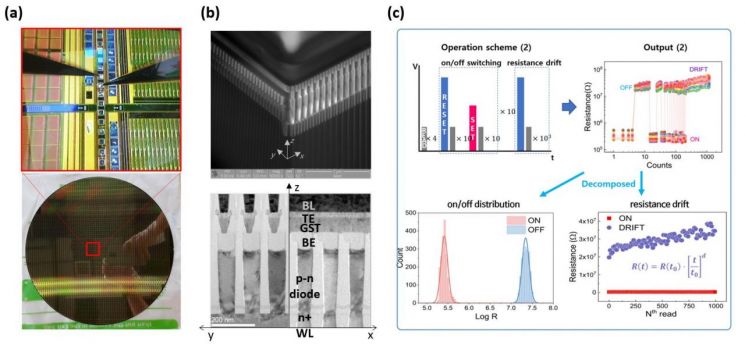 Research figure showing phase-change memory device and the resistance change characteristics of this device.
[Asia Economy Yeongnam Reporting Headquarters, Reporter Kim Yong-woo] A new technology that enhances the learning ability of artificial intelligence (artificial neural networks) has emerged, attracting attention.
A research team led by Professor Jeong Hong-sik of the Department of Materials Science and Engineering at Ulsan National Institute of Science and Technology (UNIST, President Lee Yong-hoon) and researchers from Tsinghua University in China developed a new learning method that improves the learning ability of artificial neural networks by exploiting the instability of artificial neural network chips.
Artificial neural network chips are future technology that implements the brain's neurons and synapses on semiconductor chips.
The research team created a memristor (memory semiconductor + resistor) array based on phase-change memory semiconductors (P-RAM) capable of operating like artificial neural network chips to demonstrate the improvement effect of the learning method.
This learning method uses the spontaneous increase in electrical resistance of the information storage material (phase-change material), allowing learning ability enhancement without additional power consumption.
Professor Jeong Hong-sik explained, “This research presents a new paradigm in the development of artificial neural network chips by devising an approach that enhances learning ability by utilizing the instability of semiconductor devices, rather than minimizing it.”
Professor Jeong joined UNIST in 2019 and is leading the task force for establishing a graduate school for semiconductor materials and components.
Using artificial neural network chips allows simultaneous computation and memory tasks with low energy consumption, similar to the human brain. However, a disadvantage is that artificial neural network chips, which physically integrate numerous devices, contain errors.
Existing artificial neural network learning methods assume perfect artificial neural network chips without errors, resulting in reduced learning ability.
Professor Jeong’s research team developed a phase-change memory-based memristor artificial neural network learning method, inspired by the fact that the actual human brain does not require near-perfect operation.
This learning method incorporates the ‘resistance drift phenomenon’ (increase in electrical resistance) of phase-change materials within memory semiconductors into the learning process. During learning, the information update pattern is recorded as an increase in electrical resistance in the memristor acting as a synapse, enabling the synapse to additionally learn the correlation between its changing pattern and the learning data.
The research team demonstrated through experiments classifying handwritten digits 0 to 9 that the developed learning method improves learning ability by about 3%.
For the difficult-to-classify digit 8, accuracy improved even more significantly. The synapse update pattern changes differentially according to the difficulty of handwriting classification, resulting in enhanced learning ability.

First author Research Assistant Professor Lim Dong-hyuk explained, “In the case of the relatively easy-to-classify digit 1, synapse updates occurred frequently, which is very interesting as it closely resembles decision confidence observed in animal experiments in neurobiology.”
The research team expects this study to serve as a catalyst for AI-based convergence research linking two recent hot topics in artificial intelligence: ‘development of artificial neural network chips’ and ‘implementation of brain neural functions through artificial neural networks.’
This research, conducted jointly with Professor Luping Shi of Tsinghua University in China, was published online on January 12 in the international journal Nature Communications.
The research was supported by the Nano Materials Source Project of the National Research Foundation of Korea, UNIST’s Future Leading Specialized Project, and the Graduate School of Artificial Intelligence program.
© The Asia Business Daily(www.asiae.co.kr). All rights reserved.
![Clutching a Stolen Dior Bag, Saying "I Hate Being Poor but Real"... The Grotesque Con of a "Human Knockoff" [Slate]](https://cwcontent.asiae.co.kr/asiaresize/183/2026021902243444107_1771435474.jpg)












