Reduction of Additional Interest Rate on Insurance Policy Loans
Industry: "High Rates... More for Livelihood than Speculation"
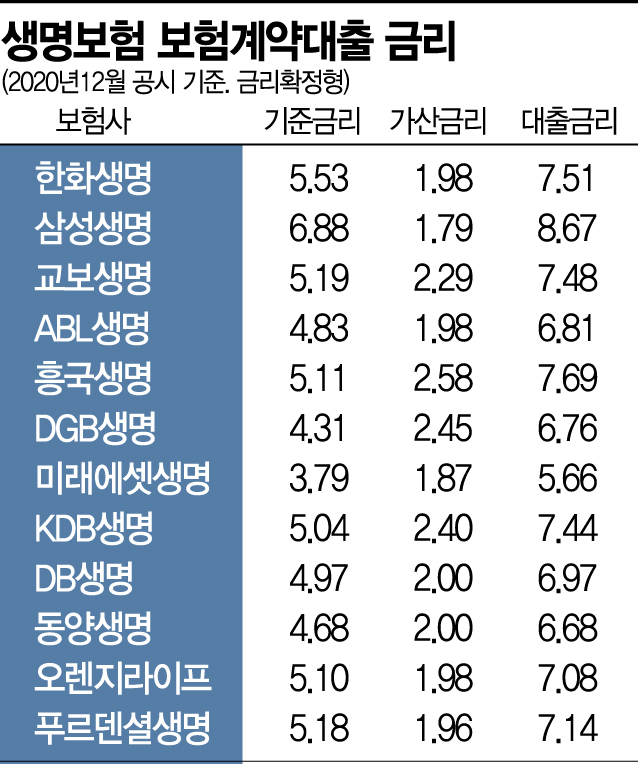
[Asia Economy Reporter Oh Hyung-gil] As concerns over overheating in the stock market grow and financial authorities tighten credit loan regulations in the banking sector, insurance companies are consecutively lowering interest rates on insurance policy loans (contract loans). Although this is explained as a trend of interest rate reductions given the controversy over high interest rates in the 7-8% range despite the 'zero interest rate' environment, the insurance industry is also being advised to be cautious of the 'debt investment (debt-financed investment)' craze.
According to the insurance industry on the 18th, since the beginning of the new year, KDB, Heungkuk, and DGB Life Insurance have lowered the additional interest rates on fixed-rate insurance policy loans. Last month, six life insurance companies including Kyobo, Prudential, Chubb Life, Orange Life, and IBK Pension Insurance saw a decline in the average additional interest rates on fixed-rate contract loans compared to the previous month.
KDB Life Insurance reduced the additional interest rate on fixed-rate insurance policy loans from 2.44% per annum to 1.99%, a decrease of 0.45 percentage points, while Heungkuk Life and DGB Life also lowered their rates from 2.6% and 2.3% respectively to 1.99%.
Kyobo Life Insurance's average additional interest rate on fixed-rate insurance policy loans last month was 2.29%, down 0.26 percentage points from 2.55% the previous month, and Chubb Life also dropped 0.31 percentage points to 1.99% from 2.30%. IBK Pension Insurance recorded a slight decrease of 0.02 percentage points to 1.37%. Prudential Life Insurance decreased by 0.01 percentage points to 1.96% from 1.97%, and Orange Life also fell by 0.01 percentage points to around 1.98%.
Insurance policy loans are a system that allows borrowing within the surrender value of the insurance policy. While the contract is maintained, loans can be utilized, but the interest rates are relatively high compared to banks. However, since the loan screening is not stringent, policyholders who need urgent funds often use this instead of bank loans.
The interest rate on insurance policy loans is determined by adding an additional interest rate to the base rate, and as the additional interest rate falls, the loan interest rate is also decreasing. In January last year, the average fixed-rate loan interest rate among 23 life insurers was 6.72%, but it has been on a downward trend, reaching 6.55% last month.
Financial authorities have been promoting the reduction of insurance policy loan interest rates by life insurers under the pretext of supporting the low-income economy. They induced interest rate cuts by removing the interest rate fluctuation risk item from the additional interest rate calculation factors and reducing the opportunity cost of reserve liquidity funds.
However, there are concerns that loan demand may surge due to the reduction in insurance policy loan interest rates amid a rapid increase in insurance sector loans, especially mortgage loans. As of the end of September last year, the outstanding mortgage loan balance of life insurers was 48.1865 trillion KRW, an 11.4% increase compared to 43.2629 trillion KRW at the end of January.
While financial authorities tightened bank loans last year, they encouraged interest rate reductions on insurance company loans. Discussions to include contract loans in the Debt Service Ratio (DSR) calculation were also scrapped.
Especially this year, signs of overheating have appeared, such as bank credit loans increasing by about 2 trillion KRW in just half a month, prompting financial authorities to manage total loan volumes in the banking sector on a monthly basis and strengthen regulations.
An insurance industry official said, "Since insurance policy loans have high interest rates, they are mainly used for living expenses rather than speculation, so cases of using them for debt-financed investment are rare," but added, "As interest rates decrease, inquiries from customers who find bank loans difficult are increasing."
© The Asia Business Daily(www.asiae.co.kr). All rights reserved.


















