The news that e-commerce company Coupang will be listed on the U.S. Nasdaq market struck the market at the beginning of the year. Coupang's corporate value is mentioned to be around $30 billion (approximately 32 trillion KRW). If it were to be listed on the KOSPI, it would immediately rank within the top 10 in market capitalization. Coupang has been aggressively increasing its market share every year. The market share, which was in the 7% range in 2017, more than doubled last year. This is why many investors are drooling. Along with Coupang's listing news, companies related to Coupang are also gaining attention. The logistics business partner Dongbang and the partner company of 'Coupang Play,' KTH, are the main players. Will these companies also benefit from Coupang's halo effect?
[Asia Economy Reporter Yoo Hyun-seok] KTH has been recognized externally this year as a content supplier for Coupang's online video service (OTT) 'Coupang Play.' Internally, it is also a significant turning point as it is preparing for a merger with KT Mhouse. Through this merger, KTH aims to leap forward as a digital commerce specialized company.
◆ KTH, Focused More on Commerce than Content = KTH was established on December 12, 1991. It was the first in Korea to open the T-commerce channel 'K Shopping.' Currently, it operates affiliate malls with Gmarket, 11st, Coupang, and others. It also provides content such as movies, videos, and education primarily based on smart devices like IPTV, smart TVs, and tablet PCs. Additionally, it operates ICT-based platform and solution construction and operation businesses utilizing KT Group's network infrastructure, such as the call ringtone service 'Ringo.' It entered the KOSDAQ market in 1999.
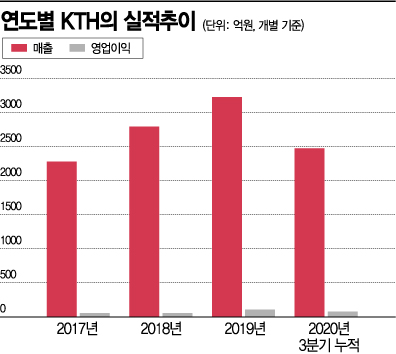
The business is broadly divided into three categories: commerce, content, and ICT. As of the third quarter of last year, commerce accounted for the largest share at 64.9%, followed by ICT (23.9%) and content (11.1%). In the third quarter of last year, sales and operating profit were 85.2 billion KRW and 3 billion KRW, respectively. Sales increased by 6.2% compared to the previous quarter, while operating profit decreased by 25.3%. Looking in detail, the commerce sector recorded sales of 56.6 billion KRW and operating profit of 3.4 billion KRW. ICT achieved sales and operating profit of 20.6 billion KRW and 2.4 billion KRW, respectively, while content had sales of 8.1 billion KRW but an operating loss of 2.8 billion KRW.
Commerce drove sales growth. Thanks to product lineups for holidays like Chuseok and the expansion of daily necessities such as masks, sales increased by 9.1% compared to the previous quarter, setting a quarterly sales record. ICT also grew by 5.6% during the same period due to expanded orders for group strategy projects centered on big data and media platforms.
The content distribution business, specializing in film distribution investment and secondary rights distribution, continues to operate at a loss. This is attributed to delays in film releases and poor distribution performance due to the impact of COVID-19.
However, the business itself holds competitiveness. It owns about 15,000 copyrights. Recently, this has become more prominent as it supplies content to Coupang. A company official said, "We supply not only Coupang but also most domestic OTT companies," adding, "It is meaningful in terms of channel expansion in the business of distributing online digital content after theatrical release."
◆ Merger of KTH and KT Mhouse = This year, KTH is preparing for a new start. Last year, KTH announced a merger with KT Mhouse, a subsidiary of KT. The surviving entity after the merger will be KTH, with a merger ratio of approximately 1 to 13.3. For each share of KT Mhouse, 13.3 new shares of KTH will be allocated. The merger is planned to be completed by July after regulatory corporate merger reviews and shareholder meetings.
KT Mhouse is a company engaged in new media advertising agency services and solution production, including mobile and online advertising. It was established on November 25, 2004. Its main businesses are commerce and advertising. The commerce business providing mobile gift certificate services is divided into B2B (business-to-business) and B2C (business-to-consumer). Through the B2B channel, it offers the online purchase service 'Giftishow Biz Service,' and through the B2C channel, it provides gift certificate services via the 'Giftishow APP.'
Its performance has been steadily growing. In 2017, it recorded operating revenue of 24.3 billion KRW and operating profit of 5.2 billion KRW, and in 2019, operating revenue of 33.4 billion KRW and operating profit of 7.5 billion KRW. In the third quarter of last year, it achieved sales of 31.5 billion KRW and operating profit of 6.8 billion KRW.
KTH has strengths in the T-commerce business. KT Mhouse holds advantages in the mobile coupon field. By combining the commerce businesses of both companies, they aim to leap forward as KT Group's digital commerce specialized company. Although the home shopping industry has recently enjoyed a boom due to COVID-19, two years ago, the outlook was not bright due to declining TV viewership, domestic demand stagnation, and competition among different industries. In other words, for KTH, this merger represents a new opportunity for revenue generation.
A company official explained, "We plan to maintain existing businesses such as commerce, ICT, and content," adding, "We expect various synergies from the merger this year and plan to establish strategies for new businesses."
© The Asia Business Daily(www.asiae.co.kr). All rights reserved.
![Clutching a Stolen Dior Bag, Saying "I Hate Being Poor but Real"... The Grotesque Con of a "Human Knockoff" [Slate]](https://cwcontent.asiae.co.kr/asiaresize/183/2026021902243444107_1771435474.jpg)
















