Up for 9 Consecutive Months Compared to Previous Month... Chile Ranks First
[Asia Economy Reporter Kim Eun-byeol] Among the 32 member countries tracked by the Organisation for Economic Co-operation and Development (OECD) for the Composite Leading Indicator (CLI) rankings, South Korea ranked 2nd for two consecutive months. Chile took the 1st place. Since the CLI predicts economic trends 6 to 9 months ahead, this ranking indicates a more positive outlook compared to other member countries. Analysts attribute the recent unstoppable stock price surge as a factor driving up the CLI.
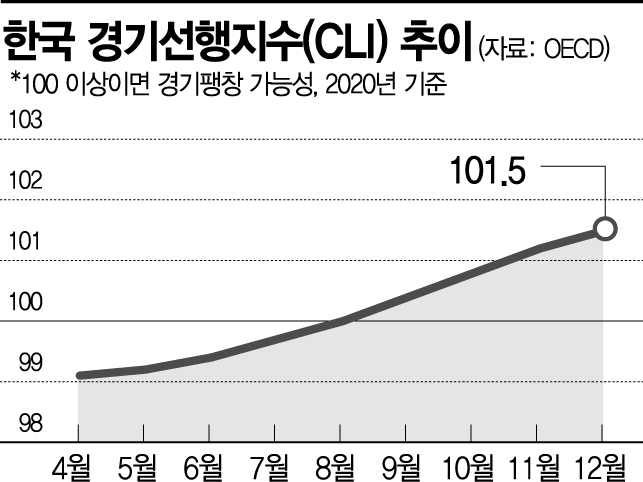
According to the OECD on the 18th, South Korea's CLI in December last year was 101.5, up 0.31 points from the previous month (101.2). This is the highest level for South Korea since August 2017 (101.6), marking a 3 year and 4 month high.
The CLI is an indicator used to forecast future economic directions. A value above 100 suggests growth above the long-term trend, while below 100 indicates growth below the trend. When the CLI is above 100 and rising, it is interpreted as entering the expansion phase within the economic cycle (trough → recovery → expansion → peak → slowdown → contraction → trough).
South Korea's CLI had previously lagged behind the OECD average. However, since April last year, when the global impact of COVID-19 was felt, it has maintained a top-tier position. It has risen for nine consecutive months compared to the previous month, and since August last year, it has stayed above the baseline of 100 for five consecutive months.
The rise in South Korea's CLI is mainly attributed to the sharp increase in stock prices such as the KOSPI. Stock prices are one of the indicators used to evaluate the CLI. The notably stronger stock price rise compared to other countries has pushed the CLI higher. The KOSPI index rose from 2600 at the end of November to surpass 3000 in early this month, recording a 16.5% increase during this period, the highest among the G20 (Group of Twenty) countries.
Additionally, the recovery in exports has improved manufacturing business outlooks, and expectations of economic recovery have caused long-term bond prices to fall (bond yields to rise), widening the gap between short- and long-term interest rates, which is also cited as a reason.
The OECD composes the CLI with slightly different components for each country. For South Korea, it is calculated based on six indicators: KOSPI stock prices, manufacturing business outlook, manufacturing inventory volume index, manufacturing inventory cycle indicator, short- and long-term interest rate spread, and net trade conditions.
The average CLI for OECD member countries was 99.4 last month, a slight increase of 0.1 points from November (99.3). The sluggish COVID-19 recovery in European countries is the cause. The European CLI stood at 98.7, still below 100.
© The Asia Business Daily(www.asiae.co.kr). All rights reserved.

















