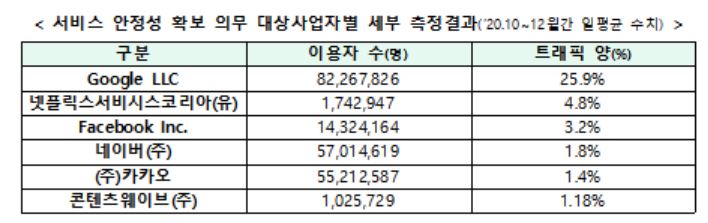
[Asia Economy Reporter Seulgina Cho] Six companies, including Google, Facebook, Netflix, Naver, Kakao, and Wave, have been named as the so-called 'Netflix Free Riding Prevention Law' target operators, which impose obligations to maintain the quality of domestic communication networks on global content providers (CPs) such as Netflix and YouTube (Google) that generate massive traffic but do not properly pay network usage fees in Korea. The final target operators will be confirmed in early February.
On the 18th, the Ministry of Science and ICT announced the '2021 mandatory target operators' under the amended Telecommunications Business Act, which was enforced on December 10 last year to ensure the stability of major value-added communication services. The target operators are Google LLC, Facebook Inc, Netflix Services Korea (Ltd.), Naver Corporation, Kakao Corporation, and Content Wave Corporation, totaling six companies.
All are operators with an average daily user count of over 1 million during the three months of the previous year (October to December 2020) and whose domestic traffic volume accounts for more than 1% of the total. In particular, the domestic traffic share of overseas CPs such as Google (25.9%), Netflix (4.8%), and Facebook (3.2%), which have been embroiled in free-riding controversies, reached 34%.
The traffic shares of Naver and Kakao were 1.8% and 1.4%, respectively. Content Wave, which provides Korea's representative online video service (OTT) Wave, accounted for 1.18%. Wave was not included in the estimated applicable targets by the Ministry of Science and ICT at the time of the legislative notice of the enforcement decree in September last year but has been included this time. The target companies change annually and are publicly announced.
Among them, the operators without domestic offices for user protection are Google LLC and Facebook Inc, which designated Transcosmos Korea Corporation and Privacy Agent Korea Corporation as their domestic agents, respectively. In the case of Netflix, Netflix Services Korea (Ltd.), its domestic office, directly performs user protection duties.
The Ministry of Science and ICT notified each company of the designation results on the 12th. After collecting opinions from the operators, the target operators will be finalized in early February. In addition, to enhance the specificity and transparency of the measures to ensure the stability of value-added communication services regulated by law, detailed guidelines will be prepared this year by gathering industry opinions.
The amended enforcement decree revised last year includes provisions requiring operators to ▲ multiplex servers, ▲ secure essential server capacity, and ▲ optimize content transmission volume so that users can receive stable services regardless of their usage environment. The Minister of Science and ICT may request the submission of related data from target operators if telecommunication service failures are deemed to have occurred. It also stipulates that target CPs must consult with related operators, including period telecommunication operators, if necessary. For example, in cases where there are reasons that significantly affect service stability, such as the traffic route change case that escalated into a lawsuit between Facebook and the Korea Communications Commission, prior notice must be given to the contracted telecommunication company. However, the effectiveness of the law is questioned as the fine for violations is only 20 million KRW.
The Ministry of Science and ICT stated, “Through last year's amendment of the Telecommunications Business Act, a system has been established to enable large value-added communication operators to provide convenient and stable services to users, thereby offering stronger protection to users.” It added, “This year, we will actively utilize the established system to further enhance the stability of major value-added communication services closely related to people's lives and improve satisfaction in handling user demands, minimizing inconvenience in service use for the public.”
© The Asia Business Daily(www.asiae.co.kr). All rights reserved.
![Clutching a Stolen Dior Bag, Saying "I Hate Being Poor but Real"... The Grotesque Con of a "Human Knockoff" [Slate]](https://cwcontent.asiae.co.kr/asiaresize/183/2026021902243444107_1771435474.jpg)
















