"Still Going Up" "This Is the Peak"
Dual Investments by Retail Investors
KOSPI Net Buying of 9.8 Trillion KRW
Samsung Electronics Down 3%, Hyundai Motor Down 10%
Inverse 2X ETF Up 4.9%
Buying Intensity Weaker Than Early This Year
[Asia Economy Reporter Oh Ju-yeon] Last week, the KOSPI, which had risen to the 3260 level during the session, slipped while threatening even the 3000 level, leaving individual investors who belatedly jumped into the stock market intoxicated by the rally with a gloomy outlook. This is because most of the stocks that individuals bought during the second week of January, when the index fluctuated within a narrow range before falling, plummeted. The only stock that rose was the 'KODEX 200 Futures Inverse 2X Exchange Traded Fund (ETF),' which profits when the index falls.
According to the Korea Exchange on the 18th, the KOSPI reached an all-time high of 3266.23 during the session on the 11th but closed down 5.52% from the weekly session high at 3085.90 on the 15th. On that day, the KOSPI also fell 1.91% to 3027.10 as of 9:04 a.m. compared to the previous trading day.
From November last year to January this year, the index rose nearly 1000 points from 2300 to 3200, prompting voices in the securities industry to warn of overheating due to the steep rise in a short period. However, the 'FOMO syndrome (Fear Of Missing Out),' which refers to the feeling of being left out in an unusual bull market, spread, and individuals were busy jumping on the running horse. Additionally, the term 'Byeorakgeoji' (meaning suddenly becoming poor due to a sharp rise in housing prices), a self-deprecating expression used by those excluded from the real estate rise, began to appear in the securities industry as well. Worried about missing another opportunity, individual investors bought stocks worth 11.5462 trillion won in the KOSPI market alone since the beginning of the year. Including net purchases of 2.4794 trillion won in the KOSDAQ market, they scooped up stocks worth about 14 trillion won in just over two weeks since the start of the year.
Purchases were especially concentrated during the second week of January when the KOSPI fell from 3266 to 3085. Individual investors, who saw the market fluctuating above the 3000 level as a buying opportunity at the bottom, bought stocks worth 9.8 trillion won in the KOSPI market last week, pouring in nearly 10 trillion won. This is 5.6 times the scale of the previous week’s purchases (1.7459 trillion won).
However, the stocks that individuals bought during this period all recorded negative weekly returns.
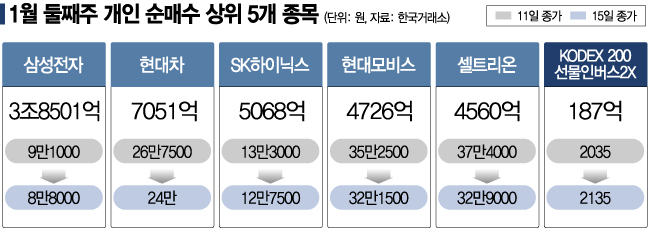
In the second week of January, individuals net purchased Samsung Electronics and Samsung Electronics Preferred Shares worth 3.8501 trillion won and 830.1 billion won, respectively, concentrating about half (47.76%) of their KOSPI purchases in these stocks. They also invested 705.1 billion won, 506.8 billion won, and 472.6 billion won in Hyundai Motor, SK Hynix, and Hyundai Mobis, respectively.
However, these stocks initially rose early in the week but then all declined, suggesting that individuals who jumped in late are likely incurring losses.
Samsung Electronics’ stock price rose to 96,800 won during the session on the 11th but fell 9.09% to 88,000 won on the 15th. On that day, it dropped further to 85,800 won during the session, down 11.36% from the peak.
Hyundai Motor, whose stock price surged earlier in the month due to rumors of collaboration with Apple, also fell 10.28% from 267,500 won to 240,000 won during the same period. Considering it reached 289,000 won during the session on the 11th, this represents a 16.96% decline from the weekly high.
Celltrion, the fifth most net purchased stock by individuals, saw its stock price slip despite the announcement of Phase 2 clinical trial results for its self-developed COVID-19 antibody treatment 'Rekkironaju' (CT-P59) on the 13th. The results showed a 3.4-day reduction in clinical recovery time and a 54% decrease in the rate of severe cases among mild patients. However, profit-taking sales flooded the market, causing the stock price to fall 12.0% from the closing price of 374,000 won on the 11th to 329,000 won on the 15th. As of 9:55 a.m. on that day, Celltrion’s stock price rebounded, trading at 344,500 won, up 4.71% from the previous trading day, but it remains about 7% lower compared to early last week.
The only stock among those bought by individuals that rose in price was the KODEX 200 Futures Inverse 2X ETF, which increased 4.91% from 2,035 won to 2,135 won during the same period.
The KODEX 200 Futures Inverse 2X is a product structured to profit when the index falls. During last year’s rising market, individuals bought nearly 4 trillion won worth of this ETF and suffered significant losses.
Since the beginning of this year, individuals have continued a net buying trend in inverse products, but on the 14th and 15th, they net sold about 18 billion won and 14 billion won, respectively, resulting in a cumulative net purchase of only 18.7 billion won last week.
© The Asia Business Daily(www.asiae.co.kr). All rights reserved.
![Clutching a Stolen Dior Bag, Saying "I Hate Being Poor but Real"... The Grotesque Con of a "Human Knockoff" [Slate]](https://cwcontent.asiae.co.kr/asiaresize/183/2026021902243444107_1771435474.jpg)
















