Analysis of Air Pollutant Emissions in December Last Year
Targeting 137 Large-Scale Emission Sites with TMS Installed
Approximately Twice as High Levels Compared to Non-Participating Agreement Sites
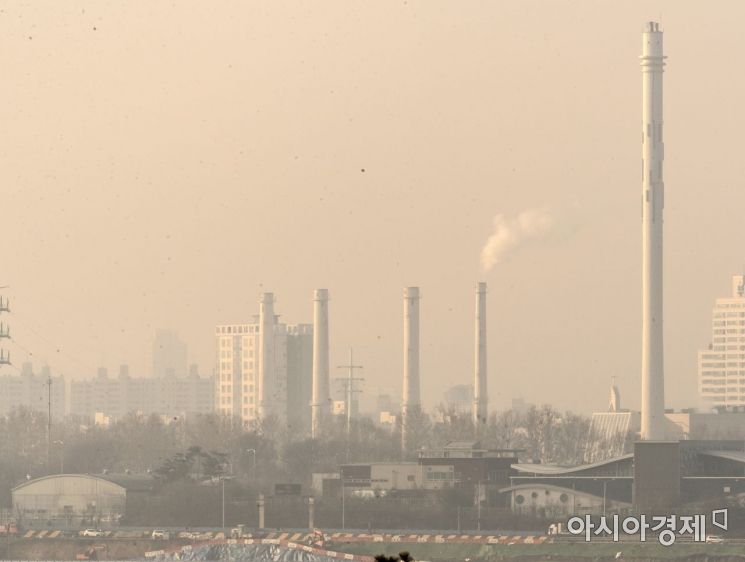
[Asia Economy Reporter Kim Bo-kyung] The Ministry of Environment announced that it reduced air pollutant emissions by 25.3% in December last year compared to the previous year through voluntary agreements with workplaces.
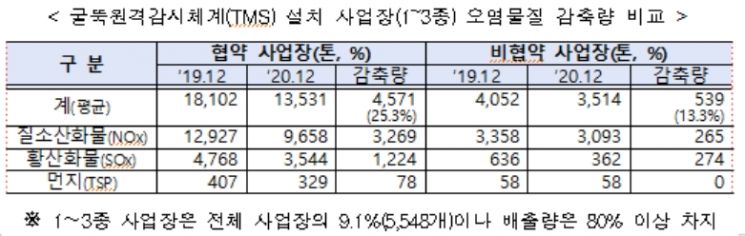
On the 18th, the Ministry of Environment announced that it analyzed the amount of air pollutant emissions for the month of December last year from workplaces participating in voluntary agreements to reduce fine dust during the seasonal management period, and found a reduction of 25.3% (about 4,500 tons) compared to the same month of the previous year.
The agreement workplaces total 324, including 111 workplaces participating since the first seasonal management system in 2019, 44 workplaces newly participating in the second seasonal management system, and 169 workplaces under agreements with watershed and local environmental offices.
This reduction is based on the December emission analysis of 137 large emission workplaces (Types 1 to 3) equipped with the Remote Stack Monitoring System (TMS) among the 324 workplaces.
The reduction rate was nearly twice as high as the 13.3% reduction rate of pollutants during the same period at 458 TMS-installed workplaces that did not participate in the agreement.
In particular, three workplaces in coal power generation, steelmaking, and cement sectors achieved high reduction rates for major air pollutants such as nitrogen oxides (NOx), sulfur oxides (SOx), and total suspended particulates (TSP) by applying strengthened emission standards.
The Ministry of Environment and the industrial sector signed a voluntary agreement (September to November 2020) to strengthen emission reduction and management during periods of high fine dust concentration.
The industrial sector strengthens pollutant reduction and management by setting and operating strengthened emission standards, optimizing operation of prevention facilities such as adding catalysts, and implementing reduction measures and emission measurements when emergency reduction measures are issued.
The Ministry of Environment provides incentives for voluntary reductions, such as reductions in basic charges under the Atmospheric Environment Conservation Act and adjustments to self-measurement intervals, by evaluating the emission reduction performance of agreement workplaces.
The Ministry of Environment will continuously monitor the emissions of agreement workplaces until March, when the second seasonal management system ends, and plans to announce comprehensive fine dust reduction achievements of all participating workplaces in the future.
Kim Seung-hee, Director of Air Environment Policy at the Ministry of Environment, stated, "We will continue to promote fine dust reduction measures with the industry until the end of the second seasonal management period, and strengthen support such as government awards for companies or workplaces with excellent reduction performance."
© The Asia Business Daily(www.asiae.co.kr). All rights reserved.
![Clutching a Stolen Dior Bag, Saying "I Hate Being Poor but Real"... The Grotesque Con of a "Human Knockoff" [Slate]](https://cwcontent.asiae.co.kr/asiaresize/183/2026021902243444107_1771435474.jpg)












