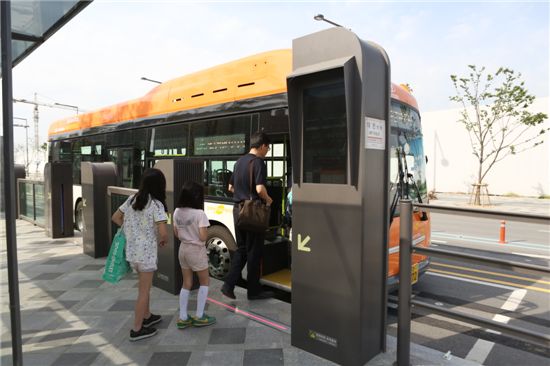
 Sejong City Bus Rapid Transit (BRT)
[Asia Economy Reporter Lee Chun-hee] By 2026, a 'subway on the road' Bus Rapid Transit (BRT) system will be established in seven locations nationwide.
The Ministry of Land, Infrastructure and Transport's Metropolitan Transport Committee announced on the 18th that BRT systems are being built in seven major cities across the country, including Incheon, Bucheon and Seongnam in Gyeonggi Province within the metropolitan area, as well as Busan, Sejong, Daejeon, and Changwon in Gyeongnam.
BRT is a public transportation system that incorporates the advantages of railway systems into bus operations, significantly improving bus service in terms of travel speed, punctuality, and transport capacity to the level of urban rail. It operates with systematic facilities such as dedicated lanes, exclusive intersections, and bus stops, along with dedicated vehicles. Currently, BRT is operating in Sejong and Busan, and is being piloted in Incheon.
In January last year, the Metropolitan Transport Committee received applications from local governments for the Super-BRT (S-BRT) project to expand the public transportation system through BRT construction. S-BRT is a premium BRT with subway-level speed and punctuality. The committee selected five projects as S-BRT pilot projects: Incheon Gyeyang to Bucheon Daejang, Incheon, Seongnam in Gyeonggi Province, Changwon in Gyeongnam, and Sejong BRT. Additionally, two BRT projects in Busan and one in Daejeon are being pursued respectively.
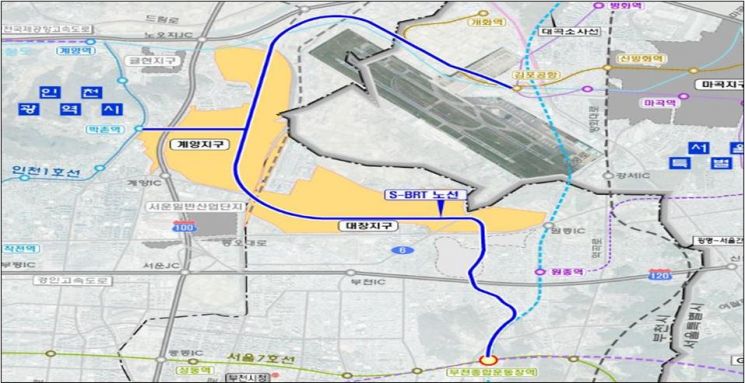 Incheon Gyeyang-Bucheon Daejang S-BRT Route Plan (Provided by Ministry of Land, Infrastructure and Transport Metropolitan Area Transport Committee)
The Incheon Gyeyang-Bucheon Daejang S-BRT, part of the transportation measures for the 3rd New Towns, will be constructed over a 16.7 km section from Bucheon Sports Complex to Daejang District, Gyeyang District, and Gimpo Airport Station. This route is scheduled to open in line with the 2026 3rd New Town occupancy plan.
S-BRT will also be established in Incheon and Seongnam, Gyeonggi Province. In Incheon, the target section is 9.4 km from Inha University to Luwon City Intersection, with development plans being formulated from this year through 2022, and the project is aimed to open in 2026 after going through project promotion procedures. In Seongnam, the total section is 10.2 km from Namhansanseong to Dandae Intersection, Moran Station Intersection, and Bokjeong Station Intersection. Among these, the 2.8 km section from Dandae Intersection to Moran Station Intersection will be prioritized for construction, with development plans and procedures to be established after this year, aiming for opening in 2025.
Changwon, recently designated as a special city with a population exceeding one million, will have the Changwon S-BRT constructed over an 18.0 km section along Wonidae-ro, from Gaeumjeong Intersection to Dogye Square and Yukho Square. The 9.3 km section connecting Gaeumjeong Intersection and Dogye Square will be built first, targeting opening in 2023.
Sejong is advancing a project to upgrade the existing 22.9 km BRT circular route. This includes installing advanced BRT stops, introducing electric articulated buses with a maximum capacity of 84 passengers, and implementing BRT priority signals, with the project scheduled to be completed in 2022. Four large-capacity electric articulated buses, each capable of carrying up to 84 passengers, began operation this month, with eight more to be added next month. After test runs in March, full operation is planned. Additionally, advanced BRT stops will be installed at a total of 34 locations, including six stops currently being modified to accommodate the three-door electric articulated buses and an additional stop in front of Sejong Chungnam National University Hospital, with 12 more stops to be added by 2022.
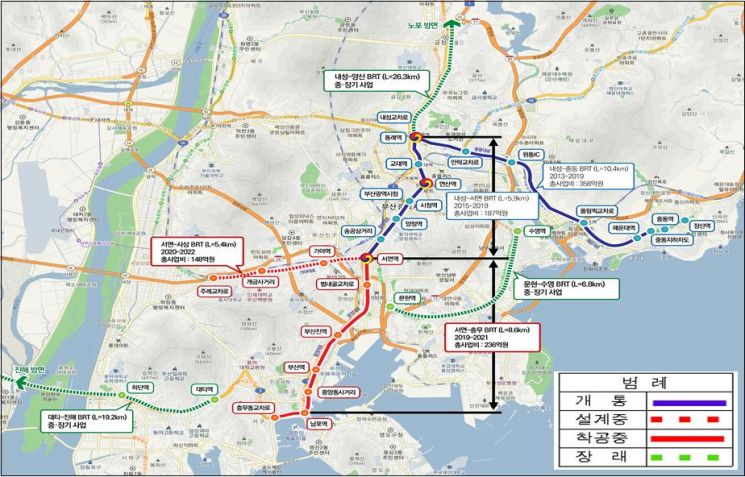 Busan BRT Plan (Provided by Ministry of Land, Infrastructure and Transport Metropolitan Area Transport Committee)
Busan is promoting two BRT projects connecting with the existing BRT (Seomyeon to Naeseong, Naeseong to Jungdong) opened in 2019: Seomyeon to Sasang and Seomyeon to Chungmu. Since the opening of the existing 16.3 km BRT section, the average bus travel time has been reduced by about 19%, and travel speed has increased by about 23%, with citizens reportedly feeling the effects of traffic improvement.
A Busan city official stated, "User satisfaction with BRT was high at 72%, and 52.6% of private car users, who experienced increased travel speeds due to reduced roadside parking after the project, expressed satisfaction with the BRT opening. Based on the effects experienced in the already opened projects, we believe there will be no difficulties in the normal progress of the two BRT projects currently in design and construction: the 5.4 km Seomyeon to Sasang and the 7.9 km Seomyeon to Chungmu."
In Daejeon, a BRT project is underway on the 6.6 km section from Banseok Station to Yuseong Complex Terminal, scheduled to open in 2022.
The project costs for the BRT projects being promoted are borne by the project implementers such as Korea Land and Housing Corporation (LH) for BRTs implemented as part of metropolitan transportation improvement measures like the 3rd New Towns (Incheon Gyeyang to Bucheon Daejang, Sejong BRT). For metropolitan BRTs connecting cities in different metropolitan jurisdictions (Seongnam BRT), the government subsidizes 50% of the project cost. For other urban BRTs, the government subsidizes 25% for metropolitan area projects (Incheon BRT) and 50% for non-metropolitan area projects (Busan BRT, Changwon BRT, Daejeon BRT).
Choi Ki-joo, Chairman of the Ministry of Land, Infrastructure and Transport's Metropolitan Transport Committee, said, "By separating private cars, which occupy most urban roads, from the public transportation system BRT, installing dedicated BRT lanes, and providing premium transportation means such as eco-friendly electric articulated buses, we can achieve a twofold effect of revitalizing public transportation and solving environmental problems. We plan to continuously promote BRT projects in major cities nationwide, including the metropolitan area.”
© The Asia Business Daily(www.asiae.co.kr). All rights reserved.


















