[Asia Economy Reporter Yuri Kim] Last year, the proportion of villa transactions, including townhouses and multi-family houses, in Seoul's housing market increased significantly. As soaring apartment prices and loan regulations coincided, buyers appeared to turn their attention to relatively affordable villas. Additionally, there is an analysis that the expectation for public redevelopment, promoted as part of the government's August 4 supply plan last year, also increased demand for villa investments.
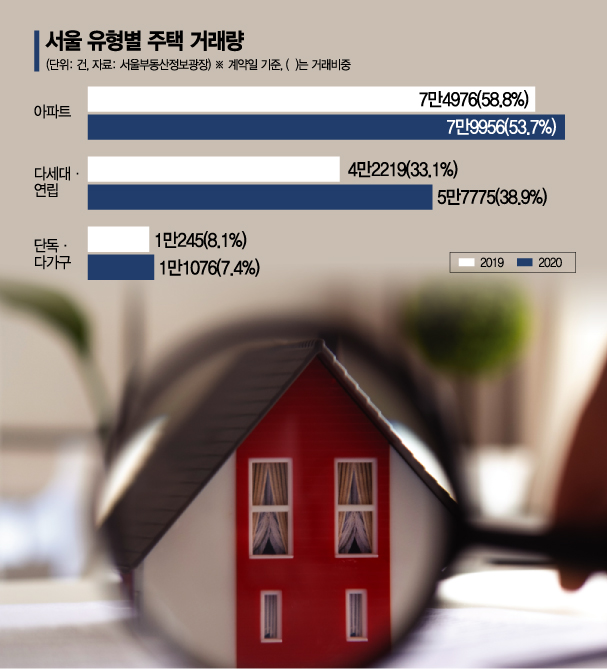
According to the Seoul Real Estate Information Plaza on the 18th, the number of townhouse and multi-family house transactions in Seoul last year (based on contract date) was 57,775 households, a sharp increase of 36.8% compared to 42,219 households the previous year. During the same period, apartment transactions in Seoul were 79,956 cases, a slight increase of 6.6% compared to 74,976 cases the previous year. This contrasts with single-family and detached house transactions, which were 11,076 cases last year, similar to 10,245 cases the previous year. In April, September, and October of last year, townhouse and multi-family house transactions even surpassed apartment transactions.
The share of villas in total housing transactions also increased significantly compared to the previous year. The proportion of townhouse and multi-family house transactions, which was about 33.1% of total housing transactions in 2019, rose by 5.8 percentage points to 38.9% last year. Conversely, the share of apartment transactions decreased by 5.1 percentage points from 58.8% in 2019 to 53.7% last year. Single-family and detached houses also saw a decrease in transaction share from 8.1% to 7.4%.
Experts cite the causes of this increased interest as △ soaring apartment prices, △ government loan and tax regulations, and △ intensified rental difficulties due to the two rental laws including the right to request contract renewal and the rent ceiling system. With house prices rising sharply centered on apartments over several years and loan-to-value ratios (LTV) restricted by housing price brackets, real buyers found it difficult to engage in 'Yeongkkeul' (excessive borrowing using all possible loan methods) to purchase homes, turning their attention to the relatively affordable villa market. Many tenants who could not afford the soaring rent and deposit prices also started to buy homes, which is pointed out as a background for the expansion of villa demand. Mr. A, residing in Seongnam, Gyeonggi Province, said, "Since the rent deposit prices rose by 100 million to 200 million won in a short period, there were very few options. I think it’s better to buy a home than to borrow more to find a rental." Furthermore, as the government’s selection of public redevelopment candidate sites accelerated in the second half of last year, some investors flocked to villas, which also influenced this trend.
Ham Young-jin, head of the Zigbang Big Data Lab, said, "Since apartment prices are very high and rental price instability remains, there is a possibility that transactions of newly built townhouses and multi-family houses with lower price burdens will increase again this year."
© The Asia Business Daily(www.asiae.co.kr). All rights reserved.
![Clutching a Stolen Dior Bag, Saying "I Hate Being Poor but Real"... The Grotesque Con of a "Human Knockoff" [Slate]](https://cwcontent.asiae.co.kr/asiaresize/183/2026021902243444107_1771435474.jpg)
















