Domestic Duty-Free Market Size Fell 35% to 16 Trillion Won Last Year Due to COVID-19
Airport Duty-Free Sales Plummeted, City Duty-Free Stores Performed Well Thanks to Chinese Daigou
Rising Daigou Dependence Led to Overcompetition and Profitability Decline
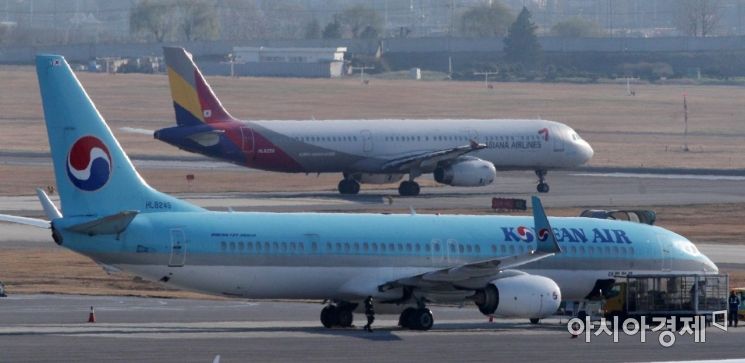 As the court's decision on Korean Air's acquisition of Asiana Airlines approaches, on the 30th, Korean Air and Asiana Airlines passenger planes were moving toward the runway at Gimpo Airport apron in Gangseo-gu, Seoul. The Seoul Central District Court is expected to deliver a ruling today or tomorrow on the injunction request filed by the activist private equity fund KCGI against Hanjin KAL to prohibit the issuance of new shares. If the court dismisses the injunction request, the acquisition process will accelerate, but if the injunction is granted, the acquisition is likely to be canceled. Photo by Kim Hyun-min kimhyun81@
[Asia Economy Reporter Lim Hye-seon] Last year, the domestic duty-free market in South Korea was hit hard by the prolonged impact of the COVID-19 pandemic. With a sharp decline in both overseas travelers and businesspeople on overseas business trips, the size of the domestic duty-free market shrank by more than 35% compared to 2019, down to approximately 16 trillion won.
Although airport duty-free store sales plummeted by over 90%, downtown duty-free shops, which continued to attract Chinese peddlers (ttaigong), performed relatively well. However, as dependence on ttaigong increased, profitability deteriorated due to excessive competition. This article examines the structural problems of the "hollow" duty-free market.
Dependence on Ttaigong Nears 90%... Could Collapse at Any Moment
From January to November last year, domestic duty-free store sales totaled 14.321 trillion won, a 42% decrease compared to the same period the previous year. Including December sales, the total is expected to reach 16 trillion won. The number of foreign customers dropped sharply by 85% year-on-year, but the sales decline was relatively smaller. Monthly sales to foreign customers at domestic duty-free stores hit a low of 966.4 billion won in April this year and have increased every month since. In November, sales reached 1.3483 trillion won, recovering to the January level before the COVID-19 outbreak (1.7017 trillion won). The average spending per foreign customer, which was 980,000 won before the pandemic, exceeded 20 million won from September onward.
Looking at sales composition by country, China accounted for 93-95%, Korea 3%, and Japan 1%. Over the past four years, China's share of the duty-free market sales has steadily increased. For Lotte Duty Free, China's sales share was 66% in 2017, 75% in 2018, 82% in 2019, and 93% in 2020. Japan's share decreased from 3% to 1%. In 2017, the deployment of THAAD (Terminal High Altitude Area Defense) led to China's retaliatory restrictions on Korean culture (Hallyu ban), causing a crisis in the duty-free industry as group tourists (yukeo) from China, who accounted for most of the Chinese sales, stopped visiting. The gap left by yukeo was filled by ttaigong. With the growth of online trading markets in China, mobile sellers (weishang) increased, and ttaigong, who received orders from them, began visiting Korean duty-free stores. Korean duty-free companies benefited from ttaigong and set record-high sales every year. Consequently, their dependence on ttaigong grew even higher. In 2019, ttaigong sales accounted for about 80% of total sales, soaring to the 90% range last year. An industry insider said, "With both domestic and foreign customers absent, ttaigong was the only lifeline," adding, "Last year's duty-free company sales were essentially ttaigong sales."
Due to the sales concentration on ttaigong, the proportion of cosmetics sales in the domestic duty-free market has also surged. The cosmetics share, which was around 50% in 2015, rose to 68% in 2019. According to KB Securities analysis, cosmetics sales within duty-free stores were expected to decrease by 10% last year compared to the previous year, but their share of total duty-free sales reached 94%. Non-cosmetics sales are estimated to have plummeted by 89%. Korean duty-free prices for cosmetics are more than 40% cheaper than local prices.
As competition to attract ttaigong intensified, companies' profitability worsened. Last year, operating profit margins were negative. Lotte Duty Free's operating profit margin, which was 9.9% in 2014, recorded -5.1% from January to November last year. Shilla Duty Free and Shinsegae Duty Free faced similar situations, with cumulative deficits of 110.7 billion won and 89.8 billion won, respectively. Nearly half of their sales revenue was spent on attracting ttaigong. Duty-free stores pay a referral commission (based on purchase sales) to Chinese travel agencies for bringing ttaigong customers. They also offer direct product discounts to ttaigong. The total commission rate, including referral fees and product discounts, rose from 35-38% at the beginning of last year to 43-46% after September. This structure inevitably reduces profits even when duty-free stores sell products.
The sales structure heavily concentrated on ttaigong reveals the vulnerability of South Korea's duty-free industry. An industry insider said, "The Chinese government is intensifying crackdowns on ttaigong while promoting duty-free policies," adding, "If ttaigong visits suddenly decrease in the currently distorted duty-free market, duty-free companies' profits will plummet."
Growth of China's Duty-Free Market... Urgent Need for Structural and Institutional Improvements
While South Korea hesitated, China surged ahead. Benefiting from the Chinese government's duty-free promotion policies, the duty-free market on Hainan Island, a representative Chinese resort island, has rapidly grown. The sales volume of Hainan's duty-free industry, which was 13.6 billion yuan in 2019, is expected to reach about 32 billion yuan last year. Despite a decrease of 3.84 million in the number of duty-free buyers compared to the previous year, totaling 3.4 million, sales more than doubled.
Last year, the Chinese government raised the duty-free purchase limit for domestic and international tourists departing from Hainan from 10,000 yuan (1.71 million won) to 30,000 yuan (5.14 million won) and allowed domestic visitors to purchase duty-free goods online for 180 days. From July 1, the Chinese government tripled the overseas duty-free shopping limit in Hainan to 100,000 yuan (17 million won) per person annually. The number of duty-free product categories increased from 38 to 45. The individual product duty-free limit of 8,000 yuan (1.36 million won) was also abolished.
To prevent foreign currency outflow to countries like South Korea, crackdowns on ttaigong were strengthened. In fact, earlier this year, the Chinese government reportedly conducted intensive crackdowns on the Mingtong Market located in the Huaqiangbei commercial district of Shenzhen, where Korean duty-free products are traded. The large-scale crackdown on Mingtong Market is analyzed as part of the Chinese government's strategy to promote duty-free policies this year.
Until 2019, the global duty-free store rankings were Dufry, Lotte Duty Free, and Shilla Duty Free, but with China's rise, the rankings changed last year. According to the duty-free industry magazine Moody David Report in September, China Duty Free Group (CDFG) recorded sales of $2.855 billion (about 3.3 trillion won) in the first half of this year, surpassing Switzerland and South Korea to become the first Chinese company to rank first. Half of CDFG's sales come from Hainan alone.
Professor Lee Hoon of Hanyang University said, "The tourism distribution industry requires experience, know-how, business history, and domestic and international networks, so once it collapses, it takes a lot of time and cost to recover," adding, "The government should actively support the duty-free industry ecosystem (personnel and structure) to maintain it."
For heads of domestic duty-free companies, "China" remains a difficult challenge. Improving profits and structural reform are the biggest tasks this year. Yoo Shin-yeol, CEO of Shinsegae Duty Free, urged employees, "We should take this as an opportunity to reestablish the essence of the business and focus on improving operational efficiency," emphasizing, "We need to enhance our capabilities and expertise." Shinsegae Duty Free aims to make Korea the top tourist destination that visitors must visit.
Lotte Duty Free has turned its eyes overseas to strengthen international competitiveness. Lee Gap, CEO of Lotte Duty Free, recently stated, "We need to look five years ahead," and "We will diversify our portfolio by exploring overseas markets." Starting with the additional opening of the Kansai Airport duty-free store in Japan this year, Lotte Duty Free plans to open stores in downtown Da Nang and Hanoi in Vietnam, as well as downtown Sydney in Australia. Duty-free stores are also introducing domestic and international easy payment services and diversifying sales channels such as live broadcasts to respond to the non-face-to-face market.
© The Asia Business Daily(www.asiae.co.kr). All rights reserved.

















