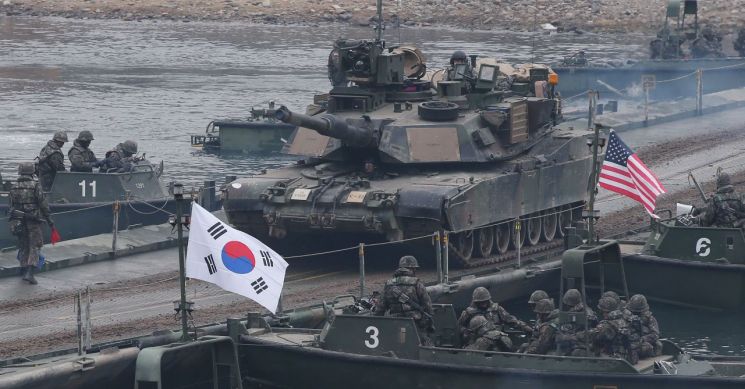
[Asia Economy Yang Nak-gyu, Military Specialist Reporter] At the center of the variables that will determine the direction of North Korea-US and inter-Korean relations is the South Korea-US military alliance, including joint military exercises. How the Biden administration strategically manages this and what kind of hard and soft strategies it will implement are expected to have a profound impact on the security landscape of the Korean Peninsula.
Although the regime changed from the Republican to the Democratic Party and the conflict between the new and old administrations was severe enough to push for impeachment at the last moment, it is certain that the Trump administration’s ‘Indo-Pacific Strategy’ will be succeeded by the Biden administration. Within this broad framework, the Biden administration is expected to embark on reshaping plans such as the repositioning of US Forces Korea, the transfer of wartime operational control (OPCON), and the schedule of South Korea-US joint exercises.
The issue of redeployment of US Forces Korea under the Biden administration is virtually a foreseen matter. The strategic flexibility pursued by the US is based on the concept of ‘Dynamic Force Employment (DFE).’ This concept involves rotating US forces deployed worldwide between the mainland and overseas deployments flexibly. DFE is an evolution of the ‘Global Defense Posture Review (GDPR)’ concept introduced by the George W. Bush administration in 2004. It involves withdrawing forward-deployed military forces in Europe and other regions back to the US mainland and operating forces globally through rotational deployment and strategic flexibility.
As a first step, the Trump administration reduced about 12,000 troops by redeploying 5,600 US troops stationed in Germany to other parts of Europe and returning 6,400 troops to the US. The removal of the phrase ‘maintaining the current level of US Forces Korea’ from the joint statement of the South Korea-US Security Consultative Meeting (SCM) last year also aligns with this context.
In this situation, although President-elect Biden has pledged to strengthen alliances so far, the possibility of relocating some US Forces Korea troops to other regions in the Indo-Pacific as part of pressure and containment against China cannot be ruled out.
Kang Seok-yul, Senior Researcher at the Korea Institute for Defense Analyses (KIDA), said, "The DFE concept, emphasized since the Trump administration, is expected to be reflected in the Biden administration’s defense and military strategy. If the dynamic operation of US military power is actively promoted within the South Korea-US alliance, the possibility of flexible operation of US Forces Korea will increase."
Shin Jong-woo, Senior Research Fellow at the Korea Defense and Security Forum (KODEF), said, "This year, the US multiple launch rocket system unit stationed in Germany moved to Estonia, close to Russia, and conducted its first live-fire exercise, indicating that the operation of US forces is shifting toward a more pressure-oriented concept. Since US Forces Korea is also a unit with high potential for strategic flexibility, it is highly likely to be transformed into a concept responding to threats in the Asia-Pacific region."
The South Korean government’s plan for ‘conditional transfer of wartime operational control’ is also expected to face difficulties with the Biden administration, which emphasizes procedures and processes. The South Korean military insists that joint exercises must be conducted to transfer OPCON during the Moon Jae-in administration, but variables such as the COVID-19 pandemic and North Korean provocations remain. If COVID-19 is not contained, the schedule for joint exercises will inevitably become uncertain again. In this case, South Korea and the US may negotiate to reduce the scale of joint exercises. However, the US side may express reluctance toward OPCON transfer, citing that the reduced scale of exercises made it impossible to conduct verification evaluations for the transfer, causing side effects.
The situation could also change if North Korea, seeking to assert its presence at the time of the US administration change, provokes. North Korea indirectly revealed its intention to develop long-range rockets in December last year. If North Korea conducts military demonstrations such as test launches of medium- and long-range ballistic missiles as pressure against the Biden administration, the Biden administration may push forward with South Korea-US joint exercises and continue a tough North Korea policy stance in its early term.
Kim Dong-yeop, Professor at the Far East Institute of Gyeongnam National University, predicted, "To promote OPCON transfer, South Korea-US joint exercises must be conducted, but North Korea may use this as a pretext to carry out military provocations in the first half of this year. Ultimately, South Korea and the US will have to make difficult decisions amid the dilemma of OPCON transfer versus preventing provocations."
© The Asia Business Daily(www.asiae.co.kr). All rights reserved.
![Clutching a Stolen Dior Bag, Saying "I Hate Being Poor but Real"... The Grotesque Con of a "Human Knockoff" [Slate]](https://cwcontent.asiae.co.kr/asiaresize/183/2026021902243444107_1771435474.jpg)
















