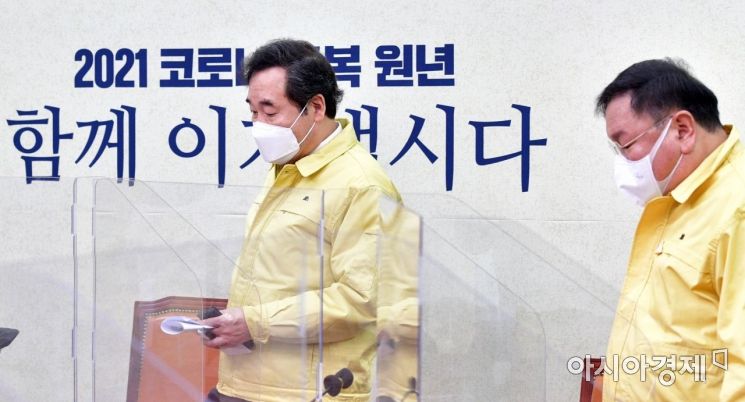
 Lee Nak-yeon, leader of the Democratic Party of Korea, and Kim Tae-nyeon, floor leader, are attending the Supreme Council meeting held at the National Assembly on the 15th. Photo by Yoon Dong-joo doso7@
[Asia Economy Reporter Park Cheol-eung] Early last year, ahead of the general election in the Jongno district of Seoul, Lee Nak-yeon, leader of the Democratic Party of Korea, used the initials 'NY.' At the time, he was considered the strongest presidential contender across party lines, and it is possible that he wanted to establish himself as a prominent politician known by initials, like former President Kim Dae-jung (DJ), who brought him into politics. However, it is well known that the 'NY' initials did not catch on.
This year, rather than rising, Lee appears to be fading. After consistently ranking first in various polls, he has fallen to a two-way race with Gyeonggi Province Governor Lee Jae-myung, then to a three-way race including Prosecutor General Yoon Seok-youl, and recently dropped to third place, unable to join the two-way race between Lee and Yoon.
The former president pardon proposal that emerged with the new year was truly a bombshell statement. Although it was called "a key to national unity," it was soon as if the key was put back into the pocket. On the 14th, right after the Supreme Court's final ruling on former President Park Geun-hye, Lee told reporters, "I have said that I would propose a pardon at an appropriate time. The party has concluded that public consensus and the reflection of the person involved are important, and I respect that conclusion."
During his tenure as Prime Minister, Lee's stable governance and his unique rhetoric in responding to opposition attacks formed the basis of his support. However, since becoming party leader, stability along with decisiveness and action have been required. Nevertheless, his cautious attitude earned him the nickname "Strict Nak-yeon."
It was even more surprising that Lee, who carefully chooses every word, triggered a megaton-level issue like the pardon. There was speculation that with the new year, Lee was taking the initiative to lead the issue. The problem was that it came out in an underdeveloped, half-baked state. There was a large gap with public opinion. According to a Gallup Korea poll conducted from the 5th to the 7th, 54% opposed the pardon, far exceeding the 37% in favor, and 75% of Democratic Party supporters opposed it.
Above all, Lee's unilateral announcement without coordinating opinions within the Democratic Party dealt a certain blow to his leadership. It became a case of "announcement first, discussion later." A Democratic Party official said, "It was regrettable to discuss such a serious issue connected to the party's approval rating, like a pardon, without a discussion process. Although the party later set a policy and agreed to follow it, Lee's leadership was somewhat damaged in the process."
Since Lee had used the phrase "at an appropriate time" from the start when raising the pardon issue, the clarity was diminished. It can be seen as raising the topic while leaving a way out.
On the 11th, Lee shook the world again by introducing the COVID-19 profit-sharing system card. The day before, he visited sites of cosmetics franchise stores and large corporation cooperation models, and on the afternoon of the 15th, he will preside over the first meeting of the 'Post-COVID Inequality Resolution' task force.
He emphasized social responsibility, saying, "COVID-19 is painful, but some places are enjoying a boom." However, this too was expected to reflexively lead to a 'socialism' debate. Lee said that voluntary participation by the private sector is the principle. Although this was a device to minimize controversy, there are criticisms within the party that it will be difficult to translate into actual effects.
Representative Lee Sang-min, a five-term senior member of the Democratic Party, is a typical example. On the 14th, he wrote on Facebook, "Voluntary participation does not guarantee effectiveness," and said, "A wealth tax or social solidarity tax method is better." Representative Lee Yong-woo, included in the task force, also said, "The name should be changed to Social Solidarity Fund. Although voluntary participation is emphasized in the profit-sharing system, it is doubtful whether it will actually happen. It only amplifies controversy."
A Democratic Party official said, "While we are promoting business compensation for small business owners and self-employed people who are suffering the most, there is skepticism about how much benefit voluntary profit-sharing will bring. Various opinions will emerge during the task force activities."
From Lee's perspective, whether it is the pardon or the COVID-19 profit-sharing system, he has taken a method of leaving room for discussion without making definitive statements. However, critically viewed, this can be seen as avoiding a direct confrontation. This contrasts with Governor Lee Jae-myung, who consistently advocates universal disaster relief funds and basic income despite some criticism of being a populist.
On the 14th, during party-government consultations, Lee confirmed that not only vaccines but also treatments should be provided free of charge, mentioning "the simple wish of the people to have herd immunity by November, but whether it can be brought forward, and whether they can freely enjoy autumn foliage." Regarding the detection of radioactive tritium in groundwater at the Wolseong nuclear power plant site, he strongly said, "It must be clearly revealed whether there was concealment by someone or collusion with the so-called nuclear mafia as suspected by the public." These remarks appear to emphasize his presence and clarity as the ruling party leader.
The stronger the image of Lee as less reformist becomes, the greater the momentum in the so-called 'pro-Roh' and 'pro-Moon' camps to promote a third candidate. Depending on the Blue House's stance on the pardon, Lee may be seen as having braved criticism by speaking out first, but it does not seem likely that the Blue House will make a progressive decision immediately after the Supreme Court ruling. Former President Park has claimed innocence by not attending the trial, saying, "Trust in the judiciary no longer has meaning."
© The Asia Business Daily(www.asiae.co.kr). All rights reserved.

















