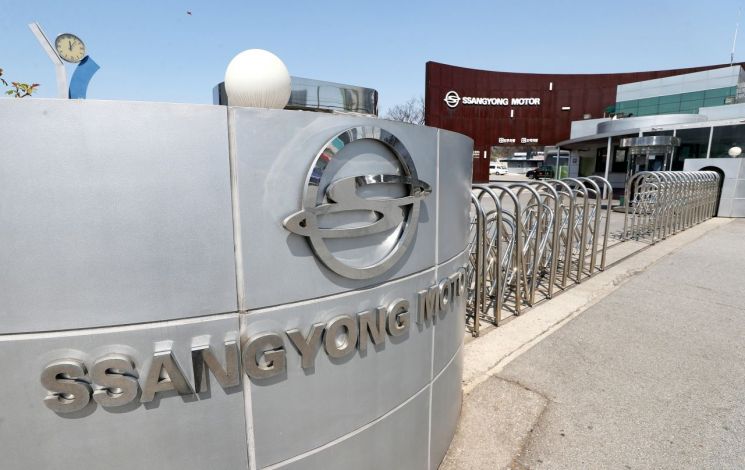
[Asia Economy Reporter Kiho Sung] As Lee Dong-geol, chairman of the Korea Development Bank, mentioned the possibility of 'conditional' financial support for Ssangyong Motor, the reaction of the Ssangyong Motor labor union is drawing attention. In particular, extending the collective bargaining period to 3 years requires a special agreement between labor and management under current law. The Ssangyong Motor’s primary union, the Corporate Union, views this as a sensitive issue affecting the union’s survival and is gathering opinions from its members. However, since Ssangyong Motor’s revival is impossible without the bank’s support, it is expected that the union will find it difficult to completely reject the bank’s demands.
According to the industry on the 16th, Chairman Lee held an online press conference on the 12th and presented two preconditions regarding support for Ssangyong Motor: "Until a profit is generated, all strike actions must be suspended, and the collective agreement period should be extended from one year to three years."
Chairman Lee’s remarks immediately sparked controversy. The Metal Workers’ Union of the Korean Confederation of Trade Unions (KCTU) issued a statement right after his remarks, protesting that he "revealed an anti-constitutional awareness."
The most controversial part of Chairman Lee’s remarks is the '3-year collective agreement' proposal. This is because it is pointed out that it is impossible under current law. According to Article 32, Paragraph 1 of the Labor Union and Labor Relations Adjustment Act, the validity period of a collective agreement cannot exceed two years.
At the end of last year, the National Assembly passed an amendment to the Labor Union Act allowing the validity period of collective agreements to be set up to a total of 3 years, but the amendment will take effect in July. Therefore, Ssangyong Motor, which signed a collective agreement with a 2-year validity period last year, is not subject to this.
However, there is also an interpretation that if the union agrees, a similar agreement can be reached. Professor Heesung Kim of Kangwon National University Law School explained, "Under current law, it is difficult to maintain a collective agreement for 3 years. Therefore, labor and management must conclude a new agreement equivalent to a collective agreement. Also, this special collective agreement can only be possible if both labor and management agree to the clause that it will be implemented from July this year."
In any case, the union’s consent is required, but it is a difficult decision for the union to make easily. An industry insider explained, "If Ssangyong Motor proceeds with restructuring, there will be personnel reductions, wage cuts, and welfare reductions. If the 'no strike and 3-year collective agreement' proposal is accepted, there is concern that the union could be left defenseless in such a situation."
© The Asia Business Daily(www.asiae.co.kr). All rights reserved.

















