[Asia Economy Reporter Hyunju Lee] Sungkyunkwan University announced on the 15th that a research team led by Professor Donggyu Cho from the College of Pharmacy has published new research results applicable to the prevention and treatment of Alzheimer's dementia.
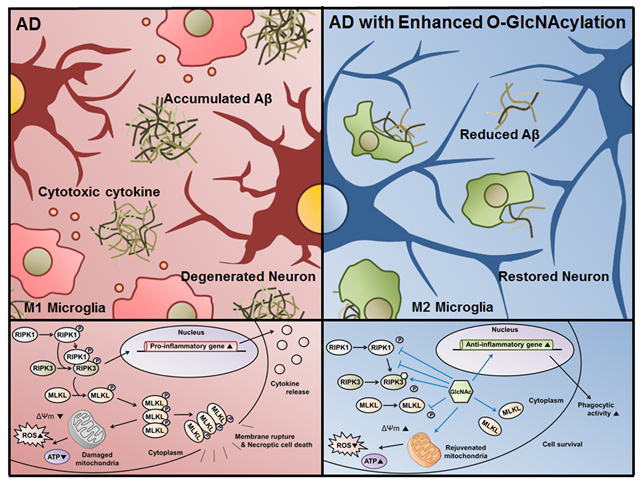
The research team identified a new mechanism that suppresses neuronal necrosis, amyloid accumulation, brain inflammation, and cognitive impairment occurring in Alzheimer's dementia through a protein modification called O-GlcNAcylation.
Focusing on the correlation between the degree of O-GlcNAcylation and the progression of Alzheimer's symptoms, the team was the first to prove that restoring reduced O-GlcNAcylation inhibits the neuronal necrosis program (necroptosis) and suppresses various dementia symptoms.
In the brains of Alzheimer's dementia patients and dementia animal models, proteins related to neuronal necrosis are activated. These proteins aggregate and destroy the cell membrane, causing neuronal cell death. O-GlcNAcylation specifically acts directly on RIPK3, a key protein in the cell necrosis pathway, to inhibit the necrosis program. Additionally, increased O-GlcNAcylation promotes the ability of microglia, brain immune cells, to remove amyloid-beta and effectively suppresses various dementia pathologies such as brain inflammatory responses, nitration stress, and abnormal mitochondrial accumulation. Based on this evidence, the research team proposed that regulating O-GlcNAcylation is a new target mechanism to overcome Alzheimer's dementia.
This research result was published on the 14th in the world-renowned journal 'Science Advances.'
© The Asia Business Daily(www.asiae.co.kr). All rights reserved.

















