Announcement of Preliminary Consulting Results for Public Reconstruction in 7 Locations
Average Floor Area Ratio Up 182%p, Number of Households Up 58%, Contribution Fee Down 37%
However, Large Complexes with Over 1000 Households Are Not Included
According to 'Simulated' Analysis, Profitability Increases Up to 27%p
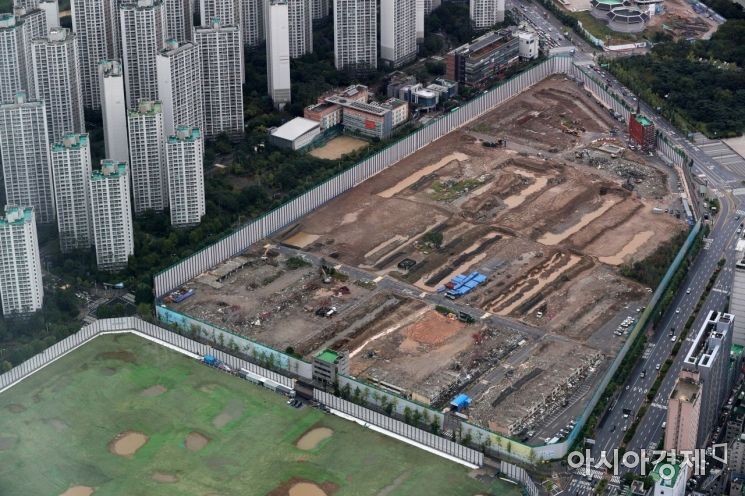
[Asia Economy Reporter Lee Chun-hee] The actual effects of the public reconstruction project have become clear. While the floor area ratio and housing supply numbers have significantly increased, the burden on association members is expected to decrease. The project’s profitability is also anticipated to improve substantially.
The Public Maintenance Integrated Support Center, jointly operated by Korea Land and Housing Corporation (LH), Seoul Housing and Communities Corporation (SH Corporation), and Korea Real Estate Board, announced the results of the public reconstruction preliminary consulting on the 15th.
A total of seven complexes participated in this preliminary consulting: ▲ Sinbanpo 19th Complex in Seocho-gu ▲ Mangwoo 1 District in Jungnang-gu ▲ Junggok Apartment in Gwangjin-gu ▲ Singil 13 District in Yeongdeungpo-gu ▲ Miseong Geonyeong in Gwanak-gu ▲ Gangbyeon and Gangseo in Yongsan-gu. One complex requested confidentiality. The Integrated Support Center plans to send the results to the associations on the 15th.
Public reconstruction is a project promoted under last year’s August 4th real estate measures (housing supply plan for the Seoul area). It is a project where the public sector participates in reconstruction, providing public support such as zoning upgrades and procedural assistance.
This preliminary consulting has been conducted since September to activate participation in public reconstruction. Although 15 complexes applied for consulting, many large complexes such as Eunma in Gangnam-gu (4,424 households), Jamsil Jugong 5 Complex in Songpa-gu (3,930 households), and Cheongnyangni Miju in Dongdaemun-gu (1,089 households) withdrew their participation. Excluding complexes that did not meet reconstruction conditions such as failing safety inspections, a total of seven complexes received the consulting results.
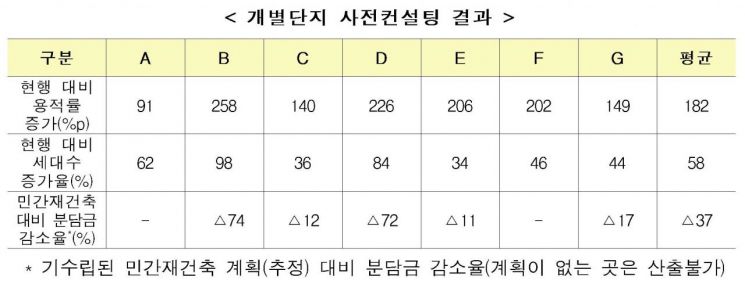 Public Reconstruction Individual Complex Preliminary Consulting Results (Provided by Public Reconstruction Integrated Support Center)
As a result of the preliminary consulting, all seven complexes received zoning upgrades. Areas designated as Type 2 General Residential were upgraded to Type 3 General Residential, and Type 3 General Residential areas were upgraded to Semi-Residential zones. Consequently, the floor area ratio increased by an average of 182 percentage points compared to the current status, and by an average of 96 percentage points compared to the associations’ standalone reconstruction plans. Among them, Complex B saw an increase of as much as 258 percentage points in floor area ratio when opting for public reconstruction instead of proceeding alone.
The number of households also increased significantly. Applying the relaxation of the non-residential facility ratio within semi-residential zones (from 10% to 5%) resulted in an average increase of 58% compared to the current status and 19% compared to the associations’ standalone reconstruction plans. Complex B, which had the largest increase in floor area ratio, also saw a 98% increase in the number of households.
Thanks to the regulatory relaxation effects, the Integrated Support Center analyzed that project profitability is expected to improve. Although public reconstruction increases donated rental and pre-sale units, the absolute supply of general sale units also increases, significantly boosting sales revenue and reducing the burden on association members by an average of 37% compared to existing plans. In the complex with the greatest increase, the burden decreased by up to 74%.
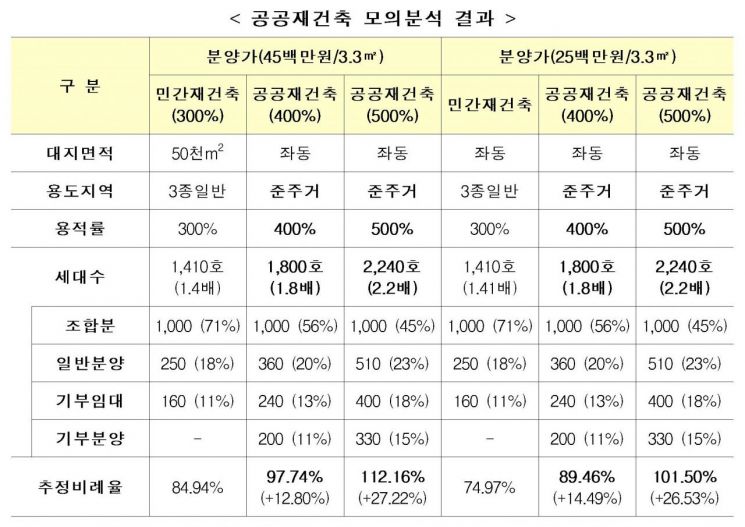 Simulation Results of Large-Scale Public Reconstruction Projects with Over 1,000 Households (Provided by the Public Reconstruction Integrated Support Center)
The Integrated Support Center separately disclosed a simulation analysis result for large complexes with over 1,000 households, as many such complexes either did not apply or withdrew their applications. The analysis assumed an existing scale of 1,000 households, zoning upgrade from Type 3 Residential to Semi-Residential, and a 50% donation of land and facilities. It showed that project profitability would significantly improve under public reconstruction.
Assuming an average sale price of 45 million KRW per 3.3㎡, the planned supply volume under the existing floor area ratio of 300% was 1,410 households (▲1,000 association units ▲250 general sale units ▲160 rental units). Under a 400% floor area ratio assumption, this increased to 1,800 households, and under 500%, to 2,240 households. At 500%, donated units increased to 400 rental units and 330 public sale units, a maximum increase of 33%, but general sale units also more than doubled to 510 units.
The estimated proportional rate also rose from the existing 84.9% to 112.1%, an increase of 27.2 percentage points. The proportional rate is an indicator representing the profitability of redevelopment projects, and a rate above 100% is generally considered profitable. Under a 400% floor area ratio, a proportional rate of 97.7% was expected.
Notably, this improvement effect is largely driven by the floor area ratio increase due to public reconstruction, regardless of the sale price. Even if the average sale price per 3.3㎡ drops significantly to 25 million KRW, the proportional rate is estimated at 89.5% for 400% floor area ratio and 101.5% for 500% floor area ratio.
The Integrated Support Center particularly analyzed that since the scale of floor area ratio increase and project profitability improvement are directly proportional, complexes currently zoned as Type 3 Residential, which can be upgraded to Semi-Residential, show greater resident burden reduction effects from public reconstruction than those in Type 2 Residential zones.
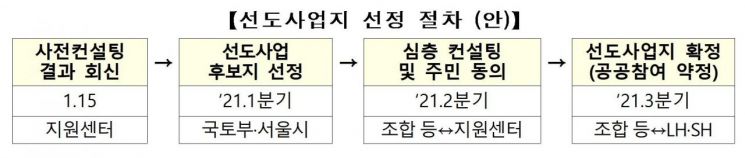
The Integrated Support Center plans to provide support such as explanatory meetings when sending the preliminary consulting results to each association. Considering the spread of the novel coronavirus infection (COVID-19), these will be conducted in small groups or non-face-to-face formats if necessary.
Subsequently, if associations apply for designation as pilot project sites by submitting consent from more than 10% of landowners by the first quarter of this year, the sites will be selected as pilot project candidates. Once selected, the Integrated Support Center will proceed with in-depth consulting procedures, including preparing detailed maintenance plans based on the preliminary maintenance and architectural plans presented during consulting. Finally, if the resident consent rate required for designation of a public implementer is secured, the association, LH, and SH will sign a project implementation agreement, officially confirming the site as a public reconstruction pilot project.
The Integrated Support Center plans to launch a second round of public reconstruction preliminary consulting applications next month to enable more complexes to consider whether to pursue public reconstruction.
An official from the Integrated Support Center said, "The results of this preliminary consulting are significant as they were prepared through discussions with the Ministry of Land, Infrastructure and Transport and the Seoul Metropolitan Government. We will closely cooperate with residents to ensure the projects are confirmed as pilot projects, and based on the expertise of public implementers and cooperation from administrative agencies, we will expedite project procedures to quickly realize housing supply effects."
© The Asia Business Daily(www.asiae.co.kr). All rights reserved.
![Clutching a Stolen Dior Bag, Saying "I Hate Being Poor but Real"... The Grotesque Con of a "Human Knockoff" [Slate]](https://cwcontent.asiae.co.kr/asiaresize/183/2026021902243444107_1771435474.jpg)


















