Results of the Bank of Korea Monetary Policy Committee on the 15th... Base Rate Held Steady at 0.50%
Prioritizing COVID-19 Economic Recovery... Concerns Over Asset Overheating Also Considered
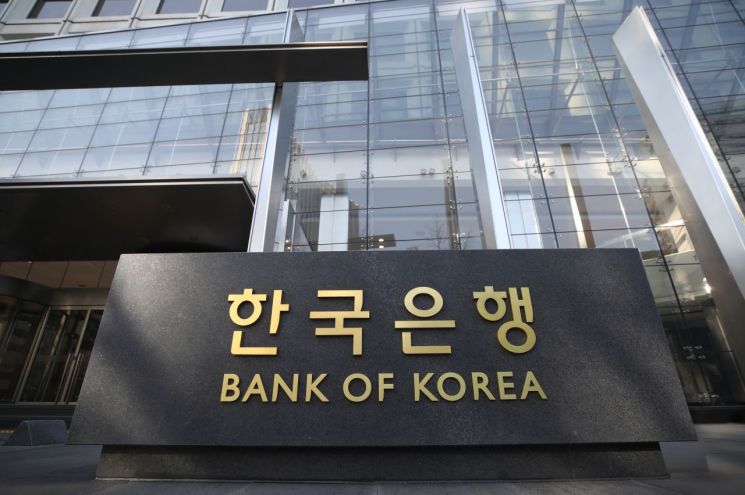
[Asia Economy Reporter Jang Sehee] The Bank of Korea decided to keep the benchmark interest rate at 0.5% per annum during the Monetary Policy Committee meeting held on the 15th. While maintaining the monetary easing stance to support economic recovery, the decision appears to consider side effects of low interest rates such as the increase in household debt and overheating of the real estate market. Additionally, the Federal Reserve's (Fed) monetary policy of maintaining near-zero interest rates was also evaluated as a factor behind the rate freeze.
On the same day, the Bank of Korea held the Monetary Policy Committee meeting at its headquarters and kept the benchmark interest rate at a record low of 0.50%. This marks the eighth consecutive month of holding the rate steady after a 0.25 percentage point cut in May.
To respond to the economic crisis caused by the spread of the novel coronavirus infection (COVID-19), the Bank of Korea lowered the benchmark interest rate from 1.25% at the beginning of this year by 0.50 percentage points in March and 0.25 percentage points in May, bringing it down to a historic low of 0.50% per annum.
This outcome aligns with market expectations. According to a survey conducted by the Korea Financial Investment Association from the 4th to the 7th among 200 bond industry workers, all 100 respondents (100%) anticipated the benchmark interest rate to remain unchanged this month. The analysis suggests that, like other major countries, the Bank of Korea will continue the rate freeze to support the economic recovery trend.
With the benchmark interest rate lowered, liquidity in the market remains abundant. According to "Money and Liquidity in November 2020," the money supply (M2) in November was 3,178.4 trillion won, an increase of 27.9 trillion won compared to the previous month (3,150.5 trillion won). The released liquidity is evaluated to have significantly contributed to raising asset prices such as real estate.
Since the Bank of Korea previously stated it would maintain an accommodative monetary policy until the COVID-19 situation improves and economic recovery is observed, the current ultra-low interest rate stance is expected to continue through the end of the year.
Regarding this, Professor Kim Soyoung of Seoul National University’s Department of Economics said, "With a large amount of liquidity flowing into the market, asset prices have risen excessively," adding, "It seems that interest rates can be raised only when it is possible to judge that the economy is recovering."
© The Asia Business Daily(www.asiae.co.kr). All rights reserved.
![Clutching a Stolen Dior Bag, Saying "I Hate Being Poor but Real"... The Grotesque Con of a "Human Knockoff" [Slate]](https://cwcontent.asiae.co.kr/asiaresize/183/2026021902243444107_1771435474.jpg)
















