Confirmed Cases Decrease Leads to Increased Weekend Mobility
Concerns Over Resurgence as Vigilance Eases
Health Authorities: "Too Early to Let Guard Down... Must Not Become Complacent"
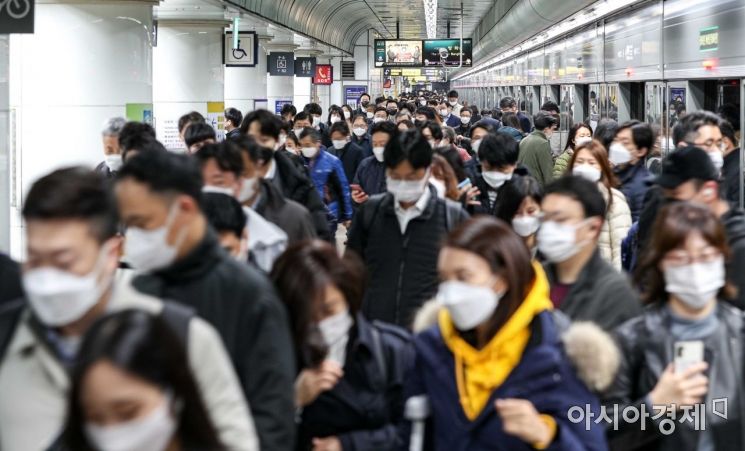 On the 13th, when mandatory mask-wearing began in multi-use facilities such as public transportation, medical institutions, entertainment bars, and general restaurants, citizens are seen wearing masks at Gwanghwamun Station on Subway Line 5 in Jongno-gu, Seoul. Photo by Jin-Hyung Kang aymsdream@
[Asia Economy Reporter Kim Young-eun] As the daily new confirmed cases of the novel coronavirus infection (COVID-19) in South Korea peaked around one thousand and then recently began to decline, weekend movement in the Seoul metropolitan area has increased again. Some believe that the sense of caution has diminished, leading to various gatherings, raising concerns about a resurgence.
According to the Central Disease Control Headquarters, as of midnight on the 14th, the number of new COVID-19 cases in South Korea was 524, a decrease of 37 from the previous day (561), marking three consecutive days in the 500s. Until the end of last month, the number of new cases exceeded 1,000, fluctuated between 600 and 800 in early this month, and recently has remained in the 500s. This current wave, which began in mid-November and has lasted for two months, appears to be gradually entering a declining phase in the new year.
Although the daily new cases have decreased, cluster infections continue in nursing facilities, public transportation workers, and restaurants throughout the metropolitan area. However, some citizens seem to have relaxed their vigilance due to the slowdown in case numbers and are holding private gatherings again.
According to the Central Disaster and Safety Countermeasures Headquarters (CDSCH) and Statistics Korea on the 13th, analysis of citizens' mobile phone movement showed that weekend movement in the metropolitan area on the 9th and 10th of this month increased by 801,000 cases (3.6%) compared to the previous week, totaling 23,168,000 cases. This is the first increase in metropolitan area movement in five weeks since social distancing was raised to level 2.5 on the 8th of last month.
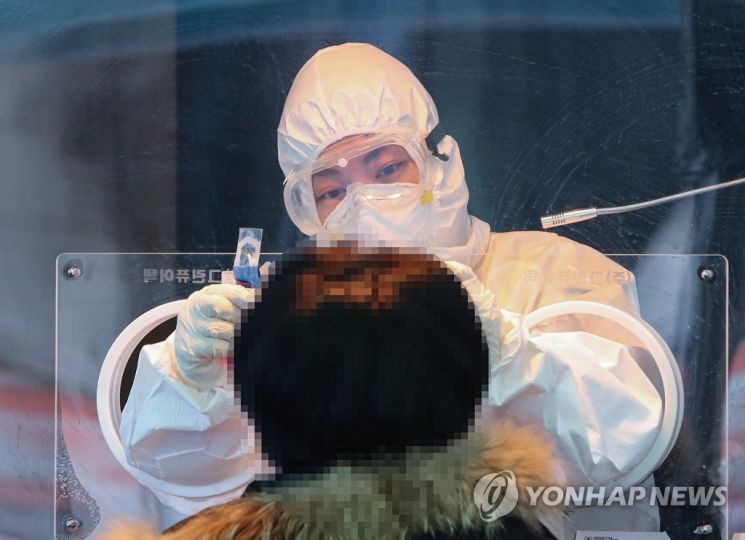 On the morning of the 14th, a citizen is being tested at the COVID-19 screening clinic at Seoul Station in Jung-gu, Seoul. Photo by Yonhap News Agency
Consequently, concerns continue that a resurgence may begin due to some citizens loosening their vigilance and continuing gatherings without adhering to social distancing.
A 27-year-old office worker, Mr. A, said, "It has been really tough until now, but I feel drained knowing that weekend movement increased because people couldn't hold back. The situation is not yet stable, and the cases have only dropped from the 1,000s to the 500s, so I hope people do not become complacent." He added, "I still think it is quite risky. I just hope this vicious cycle does not repeat and that it ends soon if we endure a little longer."
The health authorities urged that the vigilance should not be relaxed yet. Yoon Tae-ho, head of the Central Disease Control Headquarters' quarantine team, said at a regular COVID-19 briefing held at the Government Sejong Complex on the morning of the 13th, "The current reversal trend is thanks to the active participation of the public in social distancing, and we deeply appreciate the efforts of the people. Since it is not yet a situation to let down our guard, please maintain a little more tension and continue your efforts."
Prime Minister Chung Sye-kyun also emphasized at the Central Disaster and Safety Countermeasures Headquarters meeting on the 12th, "We must be cautious against complacency," adding, "Whether we move toward a definite stabilization or fall into a resurgence due to a loss of vigilance will be decided this week." He continued, "We have painfully experienced what happens when social vigilance weakens."
Experts advised refraining from outings to places with infection risks but recommended light exercise outings for health.
Professor Kim Woo-joo, an infectious disease specialist at Korea University Guro Hospital, said, "Traveling using public transportation such as KTX should be avoided, but rather than staying at home all the time, light activities like walking, jogging, or trekking are necessary."
Professor Kim added, "Because people refrain from going out to prevent infection, there is an increase in health deterioration and depression due to lack of exercise. While avoiding movement to densely populated indoor places is essential, going to places that are not crowded by car for a change of mood can also help protect health from depression and other issues."
Meanwhile, the health authorities are applying social distancing level 2.5 in the metropolitan area until the 17th and implementing special quarantine policies such as banning gatherings of five or more people. Although the third wave has passed its peak, the decline is not accelerating, and since it is still in the early stage of decrease, many risk factors remain. Therefore, it is expected that the extension of social distancing and the ban on gatherings of five or more people will be emphasized.
© The Asia Business Daily(www.asiae.co.kr). All rights reserved.


















