Discovered on Sulawesi Island, Indonesia
Theory Claiming Artistic Ability Originated in Europe Refuted
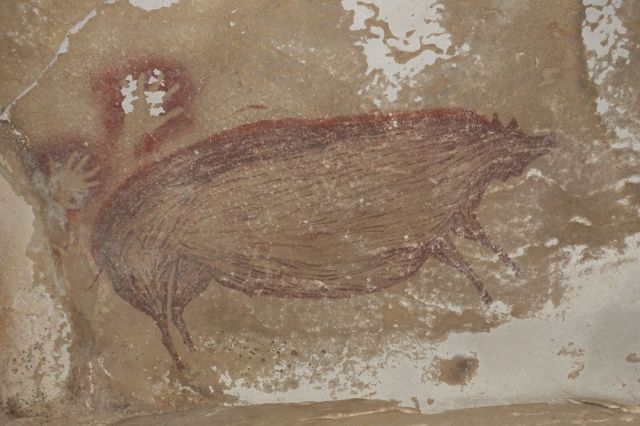 A research team led by Professor Adam Brumm from Griffith University in Australia discovered cave paintings on Sulawesi Island, Indonesia, estimated to have been drawn 45,500 years ago.
 [Image source=EPA Yonhap News]
[Asia Economy Reporter Gong Byung-sun] The world's oldest cave painting created by modern humans has been discovered in Indonesia. Dating results estimate that the painting was created at least 45,500 years ago during the Paleolithic era. This finding is expected to have a significant impact on academia as it is older than the European cave paintings, previously known as the birthplace of early art.
On the 13th (local time), according to the British newspaper The Guardian, Professor Adam Brumm and his research team from Griffith University in Australia announced in the international academic journal Science Advances that they discovered a life-sized cave painting of a wild boar on Sulawesi Island, Indonesia.
The cave painting depicts one fully drawn pig, two partially preserved pigs, and human hand stencils. Professor Adam Brumm of Griffith University explained, "It appears that they observed fights or interactions among the pigs and then painted them." The cave painting was created using red ochre pigment.
The research team stated that dating results estimate the newly discovered cave painting to be at least 45,500 years old. This is about 1,000 years older than the previously known oldest cave paintings. Professor Maxim Aubert of Griffith University said, "We analyzed the limestone deposits over the painting using uranium-series isotope dating," adding, "The calcite layer extracted from the painting is estimated to be at least 45,500 years old." The calcite layer forms as water seeps over the painting, so it is commonly used to date cave paintings.
The researchers explained that this discovery could refute the previous claim that human artistic ability originated in Europe. Paleolithic cave paintings have mainly been excavated in Europe, such as southern France and Spain. Consequently, archaeology once claimed Europe as the birthplace of art. However, since the discovery of 40,000-year-old cave paintings on Sulawesi Island, Indonesia, in 2014, and the announcement in 2019 of cave paintings dated to 43,900 years ago in the same location, the Europe-centered theory has begun to be challenged.
This cave painting is also expected to aid research on the migration of Homo sapiens. Professor Paul Pettitt of Durham University in the UK stated in an interview with the science magazine New Scientist, "It suggests the possibility that early humans left Africa, passed through the islands of Indonesia, and arrived in Australia 65,000 years ago," adding, "However, due to insufficient fossil evidence of humans, it is also possible that other humans, such as Neanderthals, created the paintings."
© The Asia Business Daily(www.asiae.co.kr). All rights reserved.

















