Mapo 'Prestige Xi' 84㎡
"Actual transaction price of occupancy rights in the 2 billion KRW range"
Even Dobong-gu, which had no '84㎡ 1 billion KRW club',
soared up to 950 million KRW
Seoul's Buyer Dominance Index also at 114.4
As the metropolitan area and provinces stagnate, demand returns to Seoul
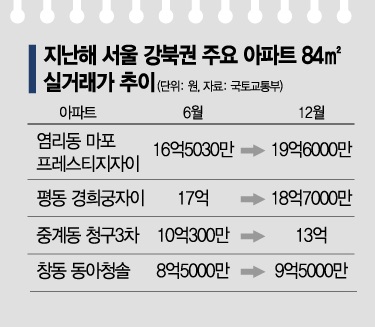
[Asia Economy Reporters Chunhee Lee, Yuri Kim] In northern Seoul, transactions exceeding 1 billion KRW and 2 billion KRW, once considered the 'price hurdles' for housing, are occurring frequently. As the government expanded regulated areas nationwide, there is criticism that market demand has instead refocused on Seoul, causing a 'regression phenomenon' leading to rising housing prices.
According to the Ministry of Land, Infrastructure and Transport's real transaction price disclosure system on the 11th, the occupancy rights for an 84㎡ (exclusive area) unit at 'Prestige Xi' in Yeomni-dong, Mapo-gu, Seoul, were traded for 1.96 billion KRW on the 26th of last month, approaching 2 billion KRW. Considering that the general sale price for this size was in the 900 million KRW range at the time of sale, the price has more than doubled in three years. This complex is continuing its price rise ahead of its scheduled move-in in March.
In the local brokerage industry, there are already reports of actual transactions exceeding 2 billion KRW. The head of nearby A Real Estate Agency said, "Although not yet registered, actual transactions exceeding 2 billion KRW have taken place," adding, "As redevelopment in the area is nearing completion, prices are rising consecutively."
Currently, no 84㎡ unit in the Gangbuk area has surpassed 2 billion KRW in actual transaction price. Since the 84㎡ unit at 'Acro River Heim' in Heukseok-dong, Dongjak-gu, surpassed 2 billion KRW last September as the first general apartment in non-Gangnam areas to do so, attention is focused on whether the upward trend will extend to Gangbuk. Currently, actual transaction prices for 'Sinchon Grand Xi' in Daehyeong-dong, Mapo-gu, and 'Gyeonghuigung Xi' in Pyeong-dong, Jongno-gu, are approaching 2 billion KRW.
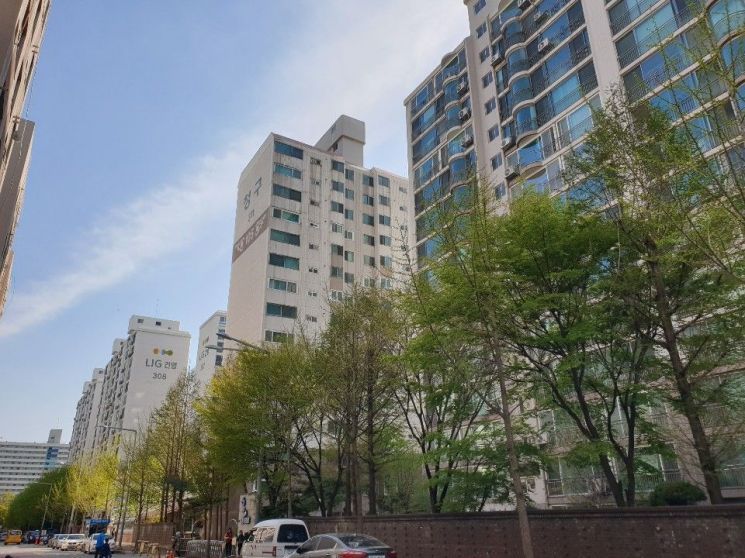 Cheonggu 3rd and Geonyeong 3rd in Junggye-dong, Nowon-gu, Seoul. Last year, these apartments were recognized as leading the rise in housing prices in Nowon-gu, with the actual transaction price of 84㎡ exceeding 1 billion won for the first time. (Photo by Kim Hyunjung)
The housing price rise continues not only in the central urban areas known as 'Mayongseong' (Mapo, Yongsan, Seongdong districts) but also in the outskirts called 'Nodogang' (Nowon, Dobong, Gangbuk districts). In Dobong-gu, the actual transaction price for an 84㎡ unit at 'Donga Cheongsol' apartment in Chang-dong surged to 950 million KRW last month, nearing 1 billion KRW. Compared to about 800 million KRW a year ago, this is a 150 million KRW increase.
Last year, 84㎡ homes in Nowon-gu and Gangbuk-gu each recorded new highs exceeding 1 billion KRW, leaving Dobong-gu as the only one among Seoul's 25 autonomous districts without an '84㎡ 1 billion KRW club' complex. A representative from nearby C Real Estate said, "Prices are still relatively low compared to other areas in Seoul, so there are more inquiries from buyers," adding, "Prices are steadily rising due to positive factors like 'Seoul Arena' and efforts to match price levels." Additionally, in Nowon-gu, for the first time, 115㎡ units at 'Cheonggu, Life, Shindonga' in Junggye-dong were traded at 1.57 billion KRW, surpassing the ultra-high price threshold of 1.5 billion KRW, which is the 'loan prohibition line.'
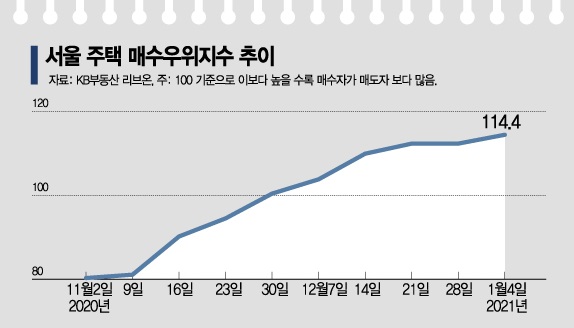
This trend is also confirmed by indicators. Seoul's buyer dominance index has risen to levels seen during the 'panic buying' peak in August last year. According to KB Real Estate Live On, Seoul's buyer dominance index in the first week of January was 114.4, the highest since the second week of August last year (116.3). The index is based on 100, with values above indicating more buyers than sellers in the market.
From June to August last year, as the government's successive real estate regulations froze the metropolitan and provincial markets, a sharp rise centered on mid-to-low priced properties in Seoul occurred, and the index has now reached a similar level.
Price increases are continuing as well. According to Real Estate 114's data for the first week of January, among Seoul's 25 autonomous districts, six districts recorded apartment price increases exceeding 0.2% in one week. These include major Seoul areas such as Songpa-gu (0.21%), Yongsan-gu (0.21%), Seongdong-gu (0.21%), as well as outer districts like Dobong-gu (0.22%).
Ahn Myung-sook, head of the Real Estate Investment Support Center at Woori Bank, predicted, "The ultra-high-end housing market, which had relatively low growth last year, will likely see an increased rise this year due to expectations for reconstruction."
© The Asia Business Daily(www.asiae.co.kr). All rights reserved.
![Clutching a Stolen Dior Bag, Saying "I Hate Being Poor but Real"... The Grotesque Con of a "Human Knockoff" [Slate]](https://cwcontent.asiae.co.kr/asiaresize/183/2026021902243444107_1771435474.jpg)













