January 15 Bank of Korea's First Monetary Policy Meeting of the New Year
Maintains Easing Monetary Policy Amid COVID-19 Resurgence
Difficult to Lower Interest Rates Further Due to Side Effects of Asset Market Concentration
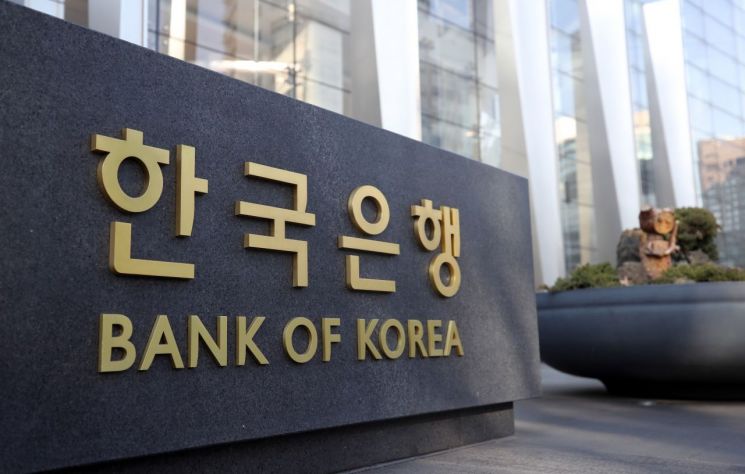
[Asia Economy Reporter Kim Eunbyeol] The Bank of Korea is expected to keep the base interest rate unchanged at its first Monetary Policy Committee (MPC) meeting of the new year. Although the resurgence of COVID-19 requires maintaining an accommodative monetary policy, the growing concentration of assets in the stock and real estate markets makes it impossible to lower the interest rate further.
On the 11th (local time), Trading Economics, a global macroeconomic indicator analysis agency, forecasted that the Bank of Korea would maintain the base interest rate at the current level of 0.50% per annum until the end of this year. It predicted that the rate would remain steady throughout this year and then gradually rise to 1.25% next year. The 1.25% rate was the Bank of Korea’s base interest rate before the COVID-19 outbreak last year. This forecast assumes that the base rate can only be restored next year or later, provided that COVID-19 is completely eradicated and the economy normalizes.
In March last year, when the global financial markets were shaken by the COVID-19 pandemic, the Bank of Korea held an emergency MPC meeting and sharply cut the base interest rate from 1.25% to 0.50%. In May last year, it further lowered the rate to a historic low of 0.50%. Since then, the MPC has consecutively kept the base interest rate unchanged in four meetings.
The reason the Bank of Korea cannot readily adjust the interest rate is clear. First, the COVID-19 resurgence continues, and the economic shock is significant, so raising the rate is not an option. Many households, companies, and self-employed individuals already rely heavily on loans, so increasing interest rates would increase their burden.
However, lowering the interest rate further to stimulate the economy is also difficult. The decoupling phenomenon between the real economy and finance is intensifying due to the prolonged low-interest-rate environment. With more than 3,000 trillion won of liquidity circulating in the market, money without a clear destination is flowing into stocks and real estate, causing asset prices to soar. The KOSPI index has even surpassed 3,100 points.
MPC members have also expressed concerns about the asset price concentration phenomenon. According to the minutes of the MPC regular meeting held on December 24 last year, released by the Bank of Korea on the 8th, MPC members emphasized the need to clearly issue warning signals about financial imbalances. One MPC member stated, "Since household and corporate credit is rapidly increasing and pressure on asset price rises is intensifying, the risk of worsening financial imbalances has grown, so it is necessary to clearly deliver early warning messages." Concerns were also raised about the 'debt investment' phenomenon, where young people borrow money to invest in stocks.
Bank of Korea Governor Lee Ju-yeol also issued warnings about the concentration of funds in the asset market. In his New Year's speech at the 'Financial Sector New Year Meeting' on the 5th, Governor Lee diagnosed, "There are many issues to resolve, such as debt problems left over from the COVID crisis and the concentration of funds in the asset market." He expressed concern that with high debt levels and a large gap between finance and the real economy, even a small shock could cause significant market instability.
Meanwhile, as predicted by Trading Economics, economic experts expect discussions on normalizing monetary policy to begin only next year or later. Even if herd immunity is established through COVID-19 vaccines and the economy rebounds rapidly, it is anticipated that considerations for monetary policy normalization will only be possible in the second half of this year. The Bank of Korea forecasts Korea’s economic growth rate at 3.0% this year, the Ministry of Economy and Finance at 3.2%, the Korea Development Institute (KDI) at 3.1%, and the Organisation for Economic Co-operation and Development (OECD) at 2.8%. Although employment recovery is slow and domestic consumption is sluggish, growth is expected to continue this year, driven mainly by exports such as semiconductors and automobiles.
© The Asia Business Daily(www.asiae.co.kr). All rights reserved.
![Clutching a Stolen Dior Bag, Saying "I Hate Being Poor but Real"... The Grotesque Con of a "Human Knockoff" [Slate]](https://cwcontent.asiae.co.kr/asiaresize/183/2026021902243444107_1771435474.jpg)
















