[Asia Economy Reporter Suyeon Woo] According to a survey conducted by the Korea Employers Federation targeting domestic economic experts, the domestic economic growth rate this year is expected to reach only 2.4%. Furthermore, the perceived economic impact of the novel coronavirus infection (COVID-19) is at a level similar to the IMF foreign exchange crisis, and the future economy is predicted to recover at a gradual pace.
On the 10th, the Korea Employers Federation conducted the '2021 Economic Outlook and Major Economic Issues Expert Opinion Survey' targeting 241 professors from domestic four-year university departments of economics or business administration. The average forecasted domestic economic growth rate for this year by respondents was 2.4%. This is lower than the forecasts of major domestic institutions such as the Bank of Korea (3.0%), KDI (3.1%), and OECD (2.8%).
In this survey, 55% of respondents predicted that the economy would show a 'Nike-shaped recovery,' recovering at a gradual pace. The forecast that the economy would head toward a long-term L-shaped recession accounted for 17.8%, while only 13.6% chose a 'V-shaped rebound,' which is a rapid recovery after a temporary shock.
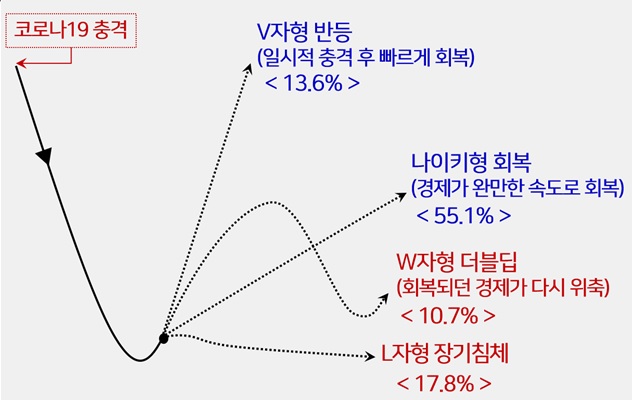
Experts diagnosed that the crisis caused by COVID-19 is delivering an economic shock at a level comparable to the 1997 IMF foreign exchange crisis, and assessed that the perceived impact is about 30% lower than that of the 2008 global financial crisis.
Regarding the fiscal management stance of the 21st National Assembly, nearly half of the respondents, 48.1%, answered that 'fiscal expansion is necessary but should be kept to a minimum,' which was the highest response. Those who answered that a more aggressive expansionary policy than the recent trend is needed accounted for 21.5%.
Regarding the direction of industrial restructuring, 49.3% of respondents answered that 'government intervention should be minimized and the market should be entrusted.' Next, 36.6% of respondents answered that 'the government should proactively support restructuring only for companies or industries facing critical situations.' The Korea Employers Federation explained, "Experts seem to recognize that private-led restructuring is necessary for fundamental improvement of the industry’s structure beyond corporate rehabilitation."
Regarding tax issues such as inheritance tax and corporate tax, 55.9% of respondents answered that 'it is necessary to lower the highest inheritance tax rate for the sustainability of corporate management,' and 46% answered that 'it is necessary to lower the highest corporate tax rate to secure international competitiveness.'
© The Asia Business Daily(www.asiae.co.kr). All rights reserved.

















