Landlords Calculate Comprehensive Real Estate Tax Based on 'Lease Start Date'
If Registered Value Was 600 Million KRW or Less, Tax Is '0'
Lee Jae-myung: "No Reason to Grant Tax Benefits"
Gyeonggi Province Proposes Annual Base Price Changes to Ministry of Economy and Finance
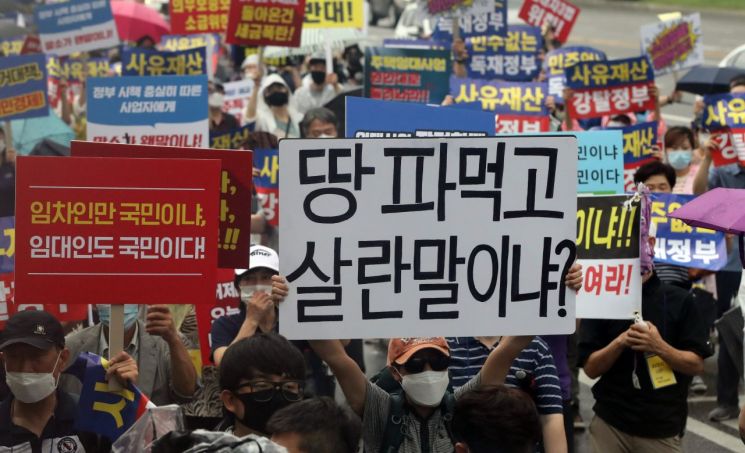 Last August in Yeouido, Seoul, members of real estate-related organizations such as the 617 Regulation Retroactive Application Victims' Association and the Lease Business Association Approval Committee held a rally opposing the government's real estate regulations, shouting slogans against the Three Lease Laws.
 [Image source=Yonhap News]
[Asia Economy Reporter Lee Chun-hee] #Mr. A is a multi-homeowner with 26 houses nationwide. Among them, 19 houses had a publicly announced housing price exceeding 600 million KRW last year. According to this, Mr. A should be subject to a comprehensive real estate holding tax (종합부동산세) of about 260 million KRW. However, he does not pay a single won of this tax because he is registered as a rental business operator and thus receives the 'exclusion from aggregation' benefit for the comprehensive real estate holding tax.
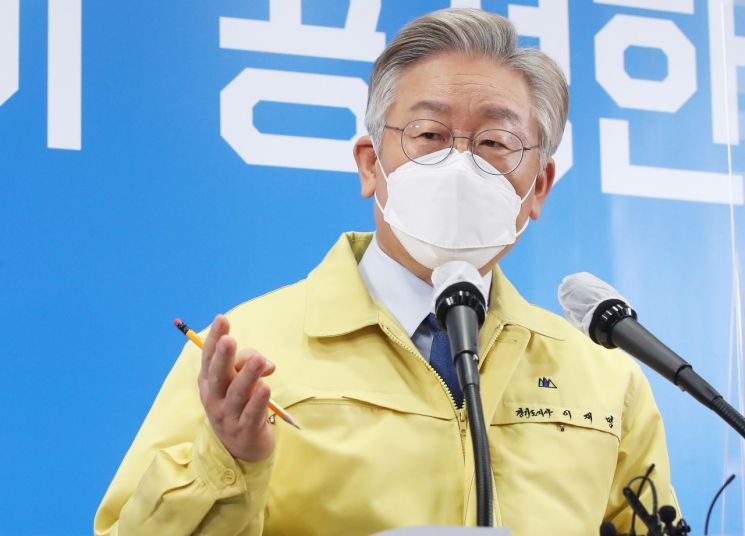
On the 6th, Gyeonggi Province proposed a 'Comprehensive Real Estate Holding Tax Act Enforcement Decree Amendment Proposal' to the Ministry of Economy and Finance, requesting a reduction in the tax exemption benefits for housing rental business operators and strengthening taxation. The case of Mr. A was one of the examples presented by Governor Lee Jae-myung of Gyeonggi Province when making this proposal.
The amendment includes a request to change the 'standard price of aggregated-excluded rental housing' among the exemption conditions for rental business operators from the 'rental start date or the tax base date of the first aggregated exclusion report year' to the 'annual tax base date (June 1st)'.
Under the current comprehensive real estate holding tax law, if the total publicly announced price of houses owned as of June 1st each year exceeds 600 million KRW (900 million KRW for a single household with one house), the owner becomes subject to the tax. However, rental business operators can avoid paying any tax regardless of how much house prices rise. This is because the publicly announced price at the year the rental started is used as the standard; if the price was below 600 million KRW at that time, they do not have to pay the tax.
Mr. A also owns 19 houses whose publicly announced prices have already exceeded 600 million KRW, but since the prices of these houses were all below 600 million KRW when rental started between 2016 and 2018, he does not have to pay the tax as long as the current system remains. The total publicly announced price of these houses was 9.2 billion KRW at the rental start date and reached 14.8 billion KRW last year.
Governor Lee Jae-myung stated on his Facebook post, "There is absolutely no reason to give tax benefits to rental purpose houses owned by housing rental business operators over a single house for actual residence," and "I have officially requested the Ministry of Economy and Finance to tax the comprehensive real estate holding tax based on the value at the taxation point according to general tax principles." He also demanded a swift institutional change, saying that strengthening regulations is possible through enforcement decree amendments without revising the law.
The problem is that this exclusion from aggregation policy was newly introduced under the current government. In 2017, led by Kim Soo-hyun, then Senior Secretary for Social Affairs at the Blue House, the government offered various 'carrots' to bring multi-homeowners’ rental businesses into the system. Capital gains tax was reduced by 70%, and property tax was also reduced. The exclusion from aggregation for the comprehensive real estate holding tax was one of these incentives.
However, as housing prices surged, the government’s stance completely reversed. The following year, the government reinstated the heavy capital gains tax, and last year, by excluding apartments from rental business registration, it effectively rendered the system meaningless. Additionally, through the contract renewal request system and rent ceiling system, the benefits for rental business operators were significantly reduced.
From the landlords’ perspective, complaints are inevitable. Landlord Mr. A raised his voice, saying, "A few years ago, they offered various benefits and urged us to register as rental business operators, but now they are not only abolishing the system but also taking away the benefits they gave us. Who would trust the government’s real estate policies going forward?" Another landlord, Mr. B, also lamented, "The government is shifting its mistakes onto rental business operators. It is unreasonable to demand unilateral damage only from rental business operators due to political issues."
© The Asia Business Daily(www.asiae.co.kr). All rights reserved.


















