Expansion of Orders for Eco-Friendly Car Parts Including Electric Vehicle Transmissions
Selected for Government Project Restructuring, Receiving 'R&D and Funding' Support
Performance and Financial Structure Hit Bottom and Begin Improvement 'Start'
Global leading electric vehicle company Tesla's supply chain includes so-called 'Tesla companies' that are attracting attention in the stock market. As Tesla searches for production partners for its affordable electric vehicle 'Model 3,' not only battery and module companies but also motor, chassis, transmission, liquid crystal display (LCD), and wiring companies are buzzing. Some parts manufacturers, who had to worry about survival due to the global decline in automobile production, have succeeded in transforming into 'future car parts' companies and have gained a chance for revival. We take a look at the order and management status of Myungshin Industry and DIC, which have recently attracted attention for receiving parts orders from Tesla, and gauge their future growth potential.
[Asia Economy Reporter Lim Jeong-su] DIC, a KOSDAQ-listed automotive parts company, has fired the starting signal for structural improvement by receiving parts orders from Tesla, the global leader in electric vehicles. Until last year, the company struggled to escape the quagmire of capital erosion due to declining sales and consecutive losses, but recently, as orders for electric vehicle parts from Hyundai-Kia Motors, GM (General Motors), and others have increased, expectations for performance recovery have grown.
◇Shrinking Sales... Losses Widening for 3 Consecutive Years= DIC's performance has deteriorated for three consecutive years. Orders in its core automotive parts sector plummeted, and orders for heavy equipment and motorcycle parts also showed a declining trend. As global automobile sales decreased, DIC, which manufactures parts, was also hit. By the end of the third quarter last year, cumulative sales amounted to 345.9 billion KRW, a 19.3% decrease from the cumulative sales of 428.7 billion KRW in the third quarter of 2019. Sales shrank by about 10-20% annually over the past three years.
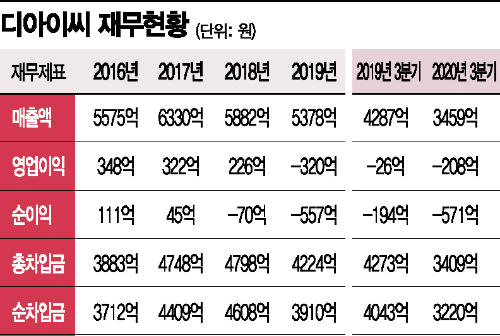
Due to the decline in sales, the cost ratio increased, worsening profitability. The cost of sales ratio rose from the mid-to-high 80% range until 2018 to about 98% recently. Considering the selling and administrative expenses of approximately 45 billion KRW annually with a cost ratio close to 100%, losses were inevitable. Operating losses of 32 billion KRW in 2019 and 20.8 billion KRW by the end of the third quarter last year were recorded. Net losses continued over the three years of declining sales, with cumulative net losses approaching 120 billion KRW during this period. Due to consecutive net losses, equity capital, which exceeded 200 billion KRW, shrank to about 130 billion KRW, resulting in a partial capital erosion state.
Although large-scale investments were made by raising external funds to supply Beijing Hyundai in China, the worsening local situation forced the company to endure deteriorating performance and financial conditions. A DIC official said, "In recent years, the situation of Beijing Hyundai in China has worsened, making the China parts business, which accounts for a large portion of sales, extremely difficult," adding, "This year, as orders for electric vehicle-related transmission parts increase, performance is expected to recover rapidly."
◇Order Expansion from Hyundai-Kia Motors, GM, etc., Expected Sales of 800 Billion KRW= According to DIC, after supplying 200,000 units of detachable electric vehicle (EV) transmissions to Hyundai-Kia Motors last year, the company plans to supply an additional 300,000 units of integrated EV transmissions this year. This means an annual supply of 500,000 units to electric vehicle models produced by Hyundai-Kia Motors alone. Additionally, the company continuously supplies related parts to U.S. GM and domestic LG Electronics, with volumes on the rise.
Last year, DIC succeeded in domesticating the electronic shift-by-wire (SBW) system, an electronic transmission control system, replacing the entire volume that Hyundai-Kia Motors had been importing from Japan's Denso with domestic products. The company plans to supply 450,000 units this year and increase the supply volume to 1 million units in the future. It also expects an increase in orders for dual-clutch transmissions (DCT) from Beijing Hyundai Transys.
The possibility of orders from Tesla is also attracting attention. DIC reportedly received orders worth 10 billion KRW from Tesla last year, drawing attention in the stock market. A DIC official said, "Due to a confidentiality agreement, we cannot disclose specific details about Tesla orders," but added, "We have received orders worth several tens of billions of KRW from Tesla, and the possibility of continued order growth is high."
Being selected recently as a target for government business structure reorganization support is also considered an achievement. The government plans to support about 2,100 research and development (R&D) personnel over the next five years and execute new investments totaling 3.1 trillion KRW for 23 companies selected for the 4th industrial business restructuring. DIC was selected as a supported company in the transmission and SBW sectors.
Supported by the expansion of orders related to eco-friendly vehicles, DIC expects a sharp performance improvement this year. A company official said, "Currently, DIC parts are supplied to 30% of electric vehicles produced worldwide," adding, "As order volumes increase, sales this year are expected to reach 500 billion KRW on a standalone basis and 800 billion KRW on a consolidated basis including affiliates."
◇Escaping the Worst Financial Situation= The financial structure also appears to be escaping the worst situation. DIC undertook financial improvement measures last year. It repaid most of the matured convertible bonds (CB) by selling real estate and repaid part of the borrowings through issuing bonds with warrants (BW) and asset securitization. The 31.6 billion KRW in borrowings held by DIC and DIC Global were extended to maturity in January this year.
Despite some financial improvements, the burden of repaying or refinancing short-term borrowings remains significant. About 314 billion KRW of the total borrowings must be repaid within one year, including short-term borrowings and current portion of long-term debt. A DIC official said, "Most of the marketable borrowings such as CBs were repaid last year, and currently, bank borrowings that can be refinanced, such as trade finance, remain," adding, "As performance improves this year, the financial situation is expected to gradually improve."
© The Asia Business Daily(www.asiae.co.kr). All rights reserved.


















