First Trial Court Rules in Favor of Plaintiff
"Extreme Suffering from Inhumane Acts
Japan Ordered to Pay 100 Million Won per Plaintiff"
Japan Avoided Lawsuit Claiming It Is Unfounded
Similar Lawsuits Likely to Reach Same Conclusion
Japan-Korea Relations Expected to Worsen Further
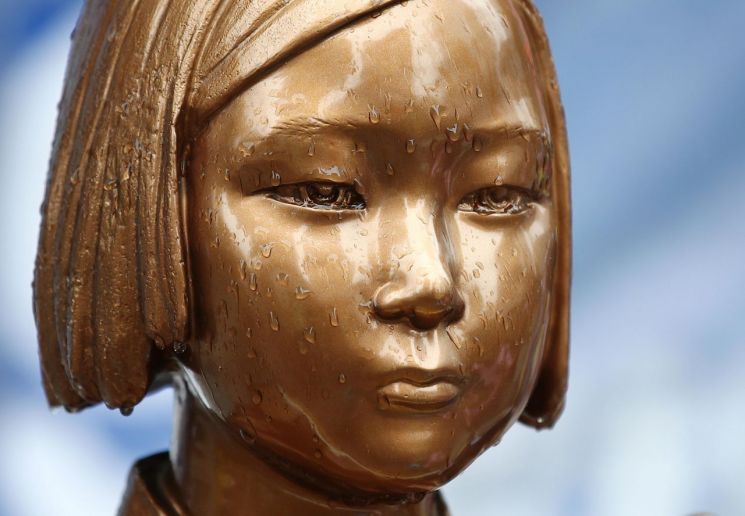
[Asia Economy reporters Seongpil Cho and Chulyoung Lim] Our courts have ruled in favor of the elderly women who were victims of the Japanese military's comfort women system in their lawsuit seeking damages against the Japanese government. This is the conclusion reached by our courts five years after the case was formally brought to trial in January 2016. It is also the first judgment on a damages lawsuit filed by comfort women victims.
The Seoul Central District Court Civil Division 34 (Presiding Judge Junggon Kim) ruled in favor of the plaintiffs on the morning of the 8th in the damages lawsuit filed by 12 comfort women victims, including the late Chunhee Bae, against the Japanese government. The court stated, "Due to the Japanese government's inhumane acts, the plaintiffs suffered unimaginable extreme pain," and ordered "the defendant Japanese government to pay 100 million won per person to the plaintiffs."
The key basis for the court's acceptance was the 'exception to sovereign immunity.' The principle of sovereign immunity is an international customary law that "a court of one country cannot try another country as a party to a lawsuit." The Japanese government had so far refused to participate in the lawsuit based on this principle, arguing that "the lawsuit cannot be established, so the plaintiffs' claims should be dismissed." On the other hand, the comfort women victims appealed during the trial to reject the principle of sovereign immunity. They argued that the Japanese military's taking of the victims constituted violations of international law, inhumane illegal acts, and international crimes, and thus sovereign immunity should not apply.
For this part of the trial, the court examined existing legal principles as well as the comfort women victims' applications for registration as recipients of livelihood support and materials rebutting the principle of sovereign immunity under international law. The court is also known to have referred to the Italian Perini case precedent. The Perini case was a 2004 ruling by the Italian Supreme Court recognizing an exception to sovereign immunity and holding Germany liable for damages in a lawsuit filed by Luisa Perini, who was forcibly taken to Germany for forced labor during World War II.
After about eight months of hearings since the first trial in April last year, the court accepted the arguments of the comfort women victims. The court stated, "While the principle of sovereign immunity applies without special restrictions to lawful acts, Japan violated peremptory norms of international law through planned and organized inhumane acts."
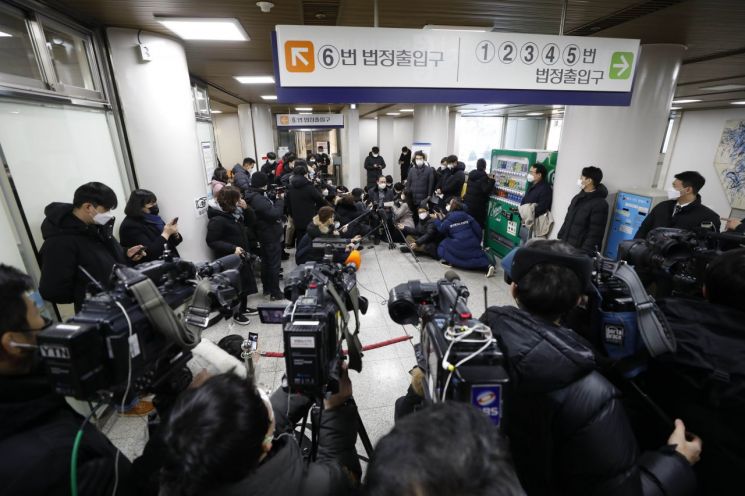 Attorney Kim Kang-won, the legal representative for the grandmother, is answering questions from the press after the trial. [Image source=Yonhap News]
By creating a rationale to override the principle of sovereign immunity, the court has opened the path for the recovery of damages for the comfort women victims. It is highly likely that the same conclusion will be reached in the damages lawsuit filed by other comfort women victims and their families, including grandmothers Yongsu Lee and Wonok Gil, scheduled for the 13th.
The Korea-Japan relationship is expected to become even more strained. The series of bilateral conflicts that have been ongoing since October 2018?including the issue of compensation for forced labor during Japanese colonial rule, export restrictions, and the Korea-Japan General Security of Military Information Agreement (GSOMIA)?have yet to show progress and remain at a standstill. A diplomatic dispute between the two countries' foreign ministries is expected to continue immediately. Although the Ministry of Foreign Affairs states that this is a matter for the judiciary, it has continuously urged Japan to sincerely acknowledge responsibility and apologize for a genuine resolution. In particular, it holds the position that the 2015 Korea-Japan comfort women agreement is unacceptable because the victims' opinions were not sufficiently collected and reflected. In response, Japan has strongly insisted that the Korean government must faithfully implement the 2015 Korea-Japan comfort women agreement, regardless of changes in administration.
Researcher Eunmi Choi of the Asan Institute for Policy Studies analyzed, "Since an appeal would mean acknowledging the trial, it seems unlikely that Japan will appeal," but added, "Considering that Japanese Prime Minister Yoshihide Suga's approval rating is very low, Japan may react more strongly to the comfort women ruling, so Korea-Japan relations are expected to become even more difficult in the future."
© The Asia Business Daily(www.asiae.co.kr). All rights reserved.


















