Collaborating with Citizens to Develop a Citizen-Centered 'Jinju-si Food Plan'
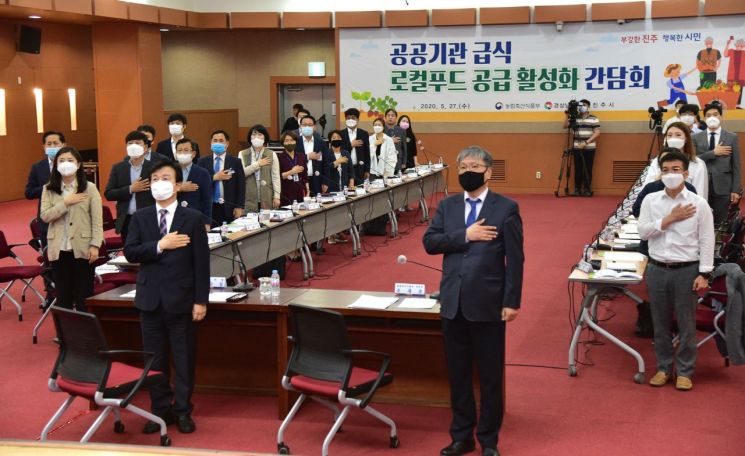 A meeting is being held to promote the supply of local food for public institution meals in Jinju City. (Photo by Jinju City)
[Asia Economy Yeongnam Reporting Headquarters Reporter Choi Soon-kyung] Jinju City, Gyeongnam Province, announced on the 6th that it has signed a written "Food Plan Agreement" with the Ministry of Agriculture, Food and Rural Affairs and Gyeongsangnam-do to establish a virtuous cycle system for food.
Since the 7th local government administration, Jinju City has begun to reconsider existing agricultural policies in response to changes in the agricultural and rural environment such as the decrease in the agricultural population, increase in elderly farmers, and rise in the proportion of small and medium-sized farms, as well as changes in agricultural product consumption patterns such as local food.
Starting with the Food Plan citizen briefing session in March 2019, the city established the citizen-centered "Jinju City Food Plan" by brainstorming and collaborating with citizens through various methods such as academies for citizens and public officials, operation of the promotion committee, and forums.
The installation of the integrated food support center, a pledge of the 7th local government administration, is also becoming visible. To accelerate the systematic implementation of the Food Plan and the construction of the integrated food support center, the Food Support Team was newly established within the Agricultural Product Distribution Division.
The city was selected for the Ministry of Agriculture, Food and Rural Affairs' Food Plan package support project, signed an agreement with the Ministry of Agriculture, Food and Rural Affairs and Gyeongsangnam-do, and plans to invest a total of 23.5 billion KRW over five years, including national and local funds, to promote 14 projects such as △establishing a public meal planning and production system △supporting regional food plan establishment (safety and quality management) △supporting rural resource complex industrialization △supporting comprehensive agricultural product processing technology, thereby building a local food virtuous cycle system. The city will focus all its capabilities on revitalizing the local economy by increasing the income of small and medium-sized farms and creating jobs related to the agricultural industry.
The city plans to invest 9.6 billion KRW by 2022 to build the integrated food support center and is making every effort to secure national and provincial funds.
Jinju Mayor Cho Gyu-il said, "With the construction of the integrated food support center, we will do our best to ensure healthy food for citizens, including schools and public meals, as well as to increase farmers' income through the activation of local food," adding, "We will make Jinju the most exemplary food autonomous community."
© The Asia Business Daily(www.asiae.co.kr). All rights reserved.

















