Male population decreases by 20,000 while female population increases by about 2,900
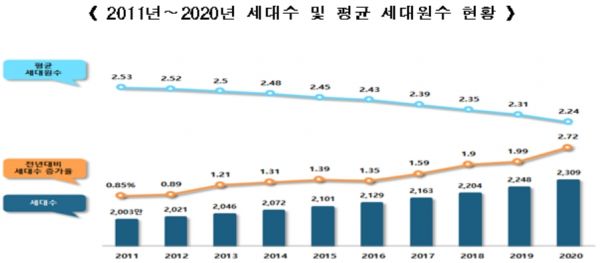
Rapid rise in single-person households... Average household size drops from 2.53 to 2.24 over 10 years
Only 5 out of 17 cities and provinces see population growth... Need to prepare for regional extinction
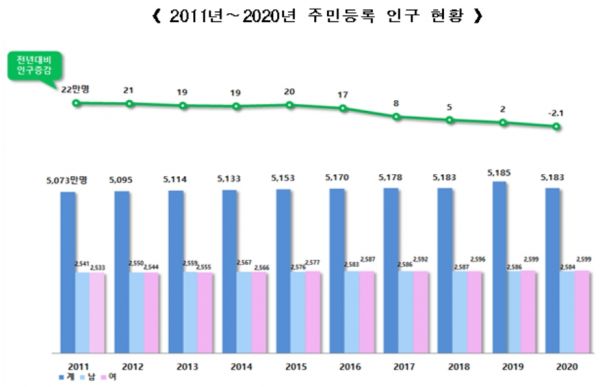
[Asia Economy Reporter Jo In-kyung] Last year, the number of births in South Korea dropped to an all-time low, falling below the number of deaths, resulting in the country's resident registration population decreasing for the first time in history. The phenomenon of 'low birthrate and aging population' is intensifying, with the population under 40 decreasing and those aged 60 and over increasing. Among 226 cities, counties, and districts, 166 experienced population decline, accelerating the trend of regional extinction.
According to the resident registration population statistics announced by the Ministry of the Interior and Safety on the 3rd, as of December 31, 2020, South Korea's resident registration population was counted at 51,829,023. This represents a 0.04% (20,838 people) decrease from 51,849,861 at the end of 2019, marking the first decline since the government began publishing resident registration population statistics in 2008.
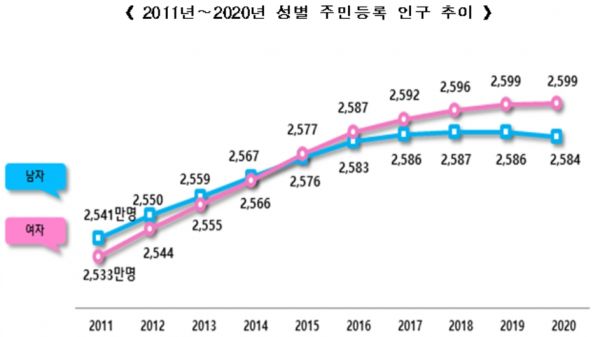
By gender, the male population decreased for two consecutive years, with a 0.01% decrease in 2019 followed by a 0.09% (23,787 people) decrease in 2020. The female population's growth rate also sharply declined from 0.10% to 0.01% (2,949 people). Since the female population surpassed the male population for the first time in 2015, the population gap between females and males widened to a record high of 146,965 last year.
On the other hand, due to the rapid increase in single-person households, the number of households has continuously risen, reaching 23,093,108 nationwide in 2020, a 2.72% (611,642 households) increase from the previous year. The average household size dropped to a record low of 2.24 persons, and single-person households surpassed 9 million for the first time, accounting for 39.2% (9,063,362 households) of all households.
Over the past decade, the proportion of the population aged 40 and under has steadily declined from 69.4% in 2011 to 43.3% in 2020, while the population aged 60 and over increased from 15.8% to 24.0% during the same period.
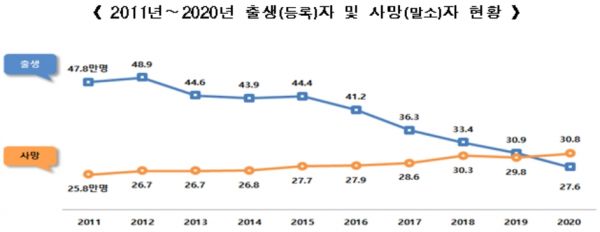
Notably, the number of births (registrations) in 2020 was 275,815, marking an all-time low and falling below the number of deaths (removals), demonstrating a 'population dead cross.'
Regionally, among the 17 metropolitan local governments, 12?including Seoul, Gyeongbuk, Gyeongnam, Busan, Daegu, and Jeonnam?experienced population decline. Among 266 basic cities, counties, and districts, 166?including Gwangmyeong and Anyang in Gyeonggi Province and Bupyeong in Incheon?saw population decreases. The outflow of population from existing large cities is accelerating due to job losses and changes in industrial structure, and regions with weak residential conditions and economic bases, such as education and healthcare, are facing heightened risks of regional extinction.
Seo Seung-woo, Director of Local Administration Policy at the Ministry of the Interior and Safety, stated, "The year 2020 sends us a message that changes are necessary across society and the economy due to the start of population decline, explosive growth of one- and two-person households, and the lowest number of births ever recorded. It shows that existing government policy directions in various fields such as housing, welfare, and environment need to be revised."
© The Asia Business Daily(www.asiae.co.kr). All rights reserved.

![Clutching a Stolen Dior Bag, Saying "I Hate Being Poor but Real"... The Grotesque Con of a "Human Knockoff" [Slate]](https://cwcontent.asiae.co.kr/asiaresize/183/2026021902243444107_1771435474.jpg)

















