Store Owner-Head Office Late-Night Operation Conflict
Store Owner "Customers Dropped at Night Due to COVID-19, Government Quarantine Guidelines Also Contradictory"
Head Office "Contract and Logistics Delivery Disruptions, Public Functions Like Emergency Medicine Also Paralyzed"
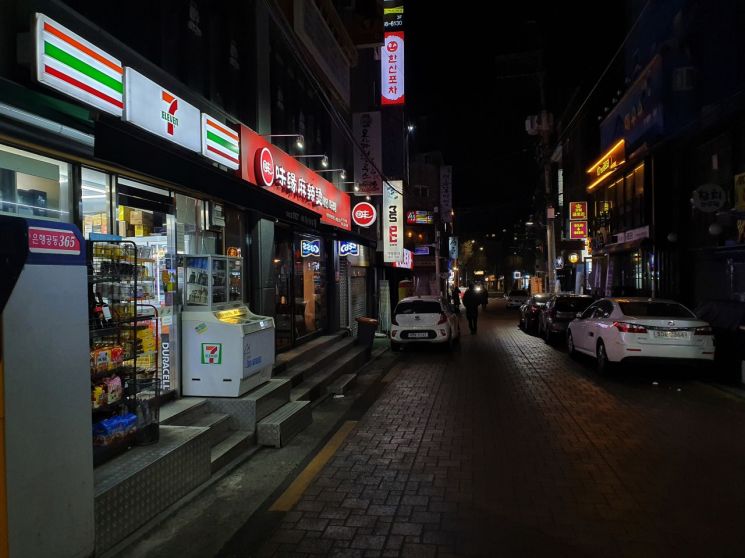 At 9 p.m. on the 30th, near Kyung Hee University in Dongdaemun-gu, Seoul. Following government guidelines, most stores have closed, with only convenience stores remaining open.
[Asia Economy Reporter Seungjin Lee] I stand alone on a street where the lights never went out for 24 hours. The signs that briefly flickered at dusk have now gone dark, and the people have left. On this street with no passersby, I light a lamp alone. The scenes of sharing memories throughout the year and making New Year's resolutions at the end of the year cannot be found this year. The people who used to open doors with loud voices, linking arms in groups of three or five, have disappeared, and those who came to ease their hunger in the early morning have long stopped coming to me. There is no one looking for me or passing by, but I quietly light the fire and wait for someone. My name is the convenience store of 2020.
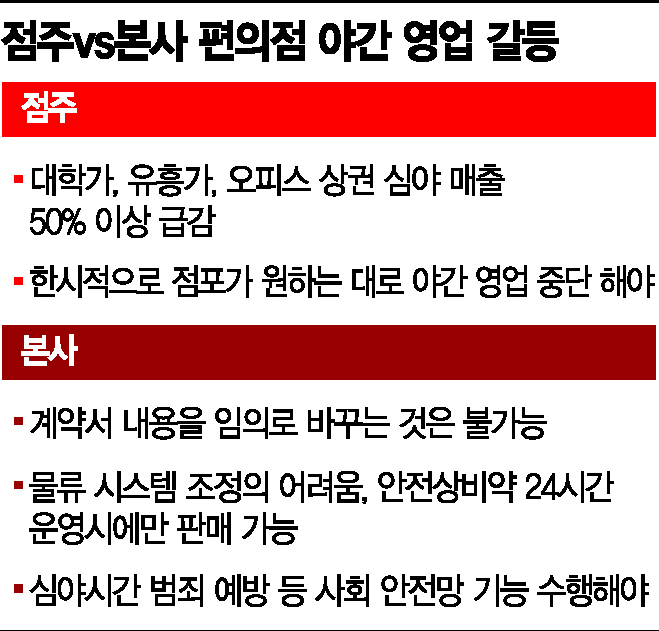
Amid the COVID-19 pandemic and the government’s ban on gatherings of five or more people, conflicts of interest have arisen between franchise owners and headquarters over the operation of convenience stores during late-night hours. Franchise owners argue that the number of customers visiting convenience stores at night has drastically decreased, and operating during these hours results in losses and violates government quarantine guidelines, thus demanding a suspension of late-night operations. Headquarters understands the franchise owners' position but counters that different contract terms exist and the social safety net function of convenience stores cannot be ignored.
"Late-night operations cost more in labor"
On the 30th, Kim Seongjin (a pseudonym), who runs a convenience store in Jonggak’s "Youth Street" in Seoul, fired one night part-timer three months ago and now alternates shifts with his wife during the day and night. Due to the prolonged COVID-19 situation, night sales have dropped to less than half, and recently, the number of customers per day is mostly around five, increasing the burden of labor costs amid losses.
Kim is troubled because he cannot decide to stop night operations on his own, although it might be better not to operate at night. He said, "Most of the commercial area consists of bars, but with the social distancing level raised, no one is seen on the street after 8 p.m. Due to contract issues with headquarters, I cannot stop night operations, so I try to manage labor costs by working both day and night shifts alone."
As cases like Kim’s increase, the Seven Eleven Franchise Owners Association recently requested headquarters to allow flexible store hours temporarily. The owners said, "Due to the spread of COVID-19, strengthened social distancing, online classes, and telecommuting, late-night sales in university areas, entertainment districts, and office districts have plummeted. Considering the special situation, please allow each store to suspend late-night operations as they wish."
The situation is similar for other convenience store chains such as CU and GS25. Stores located in prime 24-hour commercial areas are increasingly burdened by losses from late-night operations, making it a headache.
Convenience Store Headquarters: "Difficult to Reflect Opinions"
The convenience store headquarters maintains that arbitrary suspension of night operations is difficult. The biggest issue is that contract terms differ depending on operating hours. Additionally, the logistics delivery system is set up to distinguish between stores that operate at night and those that do not, making mid-course changes difficult.
According to the current Franchise Business Act, stores that have incurred losses between midnight and 6 a.m. for the past three months are allowed to not operate during those hours under a voluntary agreement. Special commercial area stores such as those in subway stations or inside business premises already do not operate during late-night hours accordingly. Therefore, headquarters’ position is that, apart from this agreement, arbitrary suspension of night operations specified in the contract cannot be permitted.
Furthermore, convenience stores emphasize their public function. Convenience stores nationwide have agreements with the police to be designated as "Women’s Safety Houses," equipped with emergency bells. Considering that pharmacies close during late-night hours and weekends, convenience stores sell safety over-the-counter medicines at 24-hour, year-round stores, which is another reason.
An industry official said, "We fully sympathize with the difficulties franchise owners face during the special situation of COVID-19, but arbitrarily changing contract terms is very difficult. Since the social safety net function of convenience stores is also important, headquarters is exploring ways to support franchise owners separately from contract adjustments."
© The Asia Business Daily(www.asiae.co.kr). All rights reserved.


















