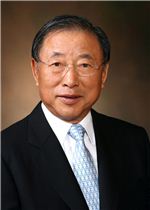
 ▲Cho Seok-rae, Honorary Chairman of Hyosung Group
[Asia Economy Reporter Park So-yeon] Jo Seok-rae, Honorary Chairman of Hyosung Group, who was sentenced to prison in the second trial for evading over 130 billion won in taxes, has avoided imprisonment. The original sentence of 2 years and 6 months in prison with a 3-year probation for his son, Jo Hyun-joon, Chairman of Hyosung, was also confirmed. With much of the legal risk for the owner family resolved, Hyosung Group can now focus on expanding next-generation businesses such as hydrogen and carbon fiber.
◇Jo Seok-rae's 'Embezzlement and Tax Evasion' Partially Overturned and Remanded
The Supreme Court's Third Division (Presiding Justice No Tae-ak) on the 30th overturned and remanded part of the lower court's ruling that found Jo, the honorary chairman, guilty of tax crimes in his appeal trial on charges including violation of the Act on the Aggravated Punishment of Specific Crimes. The original ruling that acquitted him of illegal dividends was sent back with a guilty intent. Jo had been on trial for evading corporate tax by replacing impaired assets with machinery in the accounting books and recording depreciation expenses, as well as embezzling funds raised under the name of technology fees. He was also charged with illegal dividends despite no distributable profits in the 2007-2008 fiscal years. The prosecution's charges amounted to a total of 800 billion won, including 501 billion won in accounting fraud, 150.6 billion won in tax evasion, 69.8 billion won in embezzlement, 23.3 billion won in breach of trust, and 50 billion won in illegal dividends. The first trial recognized only 135.8 billion won of tax evasion and some illegal dividends as guilty, sentencing him to 3 years in prison and a fine of 136.5 billion won. The second trial judged some of Jo's comprehensive income tax evasion as guilty, unlike the first trial. However, it ruled that some assets were difficult to consider as nominee stocks and overturned part of the illegal dividends recognized in the first trial, reducing the fine by about 1.3 billion won. Chairman Jo Hyun-joon was on trial for embezzling 1.6 billion won of company funds and evading about 7 billion won in gift tax by receiving 15.7 billion won of his father's overseas funds under the name of a paper company. The first trial recognized only the embezzlement charge as guilty and sentenced him to 1 year and 6 months in prison with a 3-year probation, and the appellate court upheld the same judgment. Hyosung Group stated, "It is fortunate that it was clearly recognized that no damage was caused to the company and there was no pursuit of private interests," adding, "Since some parts of the original guilty verdict were overturned and remanded by the Supreme Court, we will actively explain the company's position in the remand trial."
◇Will Honorary Chairman Jo Seok-rae Restore His Honor in the Remand Trial?
Analyzing the Supreme Court's recent judgment, it overturned and remanded the lower court's ruling that found guilt on the grounds that the tax evasion crime cannot be established if the tax authority cancels the original tax disposition for reasons other than those for which the prosecution was filed, based on the establishment of tax liability.
With the Supreme Court's judgment, Honorary Chairman Jo can restore his honor in the remand trial. Since the trial began in 2013, Jo's side has argued that Hyosung had no other choice but to comply with the government's demands during the IMF period, that there was no reduction in national tax revenue, and that Jo did not benefit personally. They also claimed that corporate tax was additionally paid due to delayed expense recognition, asserting innocence regarding tax evasion charges. Hyosung stated, "Even the Supreme Court judged the tax evasion part as not guilty following embezzlement and breach of trust. Since it has been revealed that there was no pursuit of private interests, we will actively explain this in the remand trial."
◇169 Trillion Won of IMF Public Funds Injected... Honorary Chairman Jo Appeals His Unfairness for Saving the Company
This case dates back to the IMF era. During the IMF period, the government forced domestic companies to resolve their debts independently to receive IMF support. However, in 1997 and 1998, most companies such as Hanbo Steel, Sammi Group, Jinro Group, Daenong Group, Samlip Food, and Ssangyong Group went bankrupt and entered court receivership. In particular, in June 1998, Lee Hun-jae, Chairman of the Financial Supervisory Commission, held a press conference with Lee Chan-woo, President of Commercial Bank, announcing the liquidation and sale of 55 companies. In 1999, Daewoo Group, which had debts amounting to 65 trillion won, was dismantled despite government treasury support. Most surviving companies also depended on public funds amounting to 169 trillion won. Hyosung also took on 470.3 billion won in debt from Hyosung Corporation through a merger. Due to a financial structure improvement agreement with its main bank requiring a debt ratio below 200%, it could not even treat the debt as such. Hyosung classified this debt as fictitious machinery assets and amortized it over 10 years without relying on government public funds. Considering these circumstances, many point out that the trial is unfair to Honorary Chairman Jo. During the 1997-98 IMF period, even solid domestic groups disappeared overnight. Hyosung's position is that this was a self-help measure to overcome the crisis of group dissolution.
◇Honorary Chairman Jo Seok-rae Likely to Restore Honor
Born in 1935 and elderly, Honorary Chairman Jo Seok-rae underwent his third cancer surgery in July but is expected to actively exercise his right to defense in the remand trial. Having grown Hyosung from Korea's first nylon company to the world's number one spandex company over the past 50 years, he must restore his honor as a lifelong Korean entrepreneur. Jo's side is known to plan to argue in detail during the remand trial that the charges should be viewed in the context of the era and that there was no reduction in national tax revenue. They will actively explain to the court that the government's demands during the IMF period were very strong and that Jo had no other choice. Evidence such as memoirs of Lee Hun-jae, who was then Chairman of the Financial Services Commission and who personally warned Jo that the group would face dissolution if it did not take on Hyosung Corporation's debt, has already been submitted. Furthermore, Hyosung will legally prove that the debt of Hyosung Corporation qualifies as deductible expenses. Accounting-wise, treating deductible items as expenses is not problematic. The National Tax Service even confirmed the fictitious nature of the assets during tax investigations for several years after the IMF, which will also be proven. They also emphasize that no related expenses were processed after the losses were settled in 2008, indicating no intent. Especially regarding tax evasion, they are expected to strongly refute the prosecution's claim that corporate tax was omitted by underreporting profits due to expense recognition. Hyosung will argue that the bank paid more taxes corresponding to the debt amount repaid by Hyosung, that if losses had been immediately recognized as expenses, the government might have borne the cost through tax deductions, and that splitting expense recognition to meet the government's forced 200% debt ratio resulted in neither expense deduction nor additional corporate tax payment.
◇Who is Honorary Chairman Jo Seok-rae?
Jo Seok-rae, Honorary Chairman, played a leading role in building the Dongyang Nylon Ulsan plant, Korea's first nylon factory, in 1966 alongside his father, former Chairman Jo Hong-je, laying the foundation for Hyosung Group's growth. He can be considered the practical first and 1.5 generation founder. In 1973, he established Dongyang Polyester, laying the foundation for the chemical fiber business, and responded to the government's heavy chemical industry promotion policy by domesticating heavy electrical equipment and industrial machinery, establishing mass production systems, and growing the company to an international scale. In 1971, Jo established Korea's first private company 'Technology Research Institute,' leading new technology development in new materials, synthetic fibers, petrochemicals, and heavy electrical equipment. After becoming group chairman in 1981, he grew Hyosung Group to the world's number one market share in spandex, tire cords, and airbag fabrics. From 2007, as chairman of the Federation of Korean Industries, a leader of Korea's business community, he led economic delegations on presidential overseas trips and contributed to private economic diplomacy with various countries, traveling abroad 30 times over 130 days during his tenure, equivalent to circling the globe seven times. Fluent in Japanese and English, Jo was recognized as a 'private economic diplomat,' enhancing Korea's economic status on multilateral international stages and contributing significantly to 'Korea sales.' As president of the Korea-Japan Economic Association, he promoted the Korea-Japan FTA, served as chairman of the Pacific Basin Economic Council (PBEC) with 1,100 multinational companies participating until 2004, and was chairman of the Korea-US Business Council until 2009, raising Korea's global business stature. A business community official said, "He has lived with the lifelong goal of serving the nation through business," adding, "Remembering the IMF period, he saved the company without a single public fund and grew it to number one in the world, which deserves recognition for his entrepreneurial spirit."
© The Asia Business Daily(www.asiae.co.kr). All rights reserved.
















