Future 20-Year Capital Region Development Plan
Maintaining Three Major Zones: Overcrowding Control, Growth Management, and Nature Conservation
Capital Region Concentration Controlled - Linked to Coexistence Development
Large-Scale Development Projects like Housing Sites Reviewed by Capital Region Development Committee
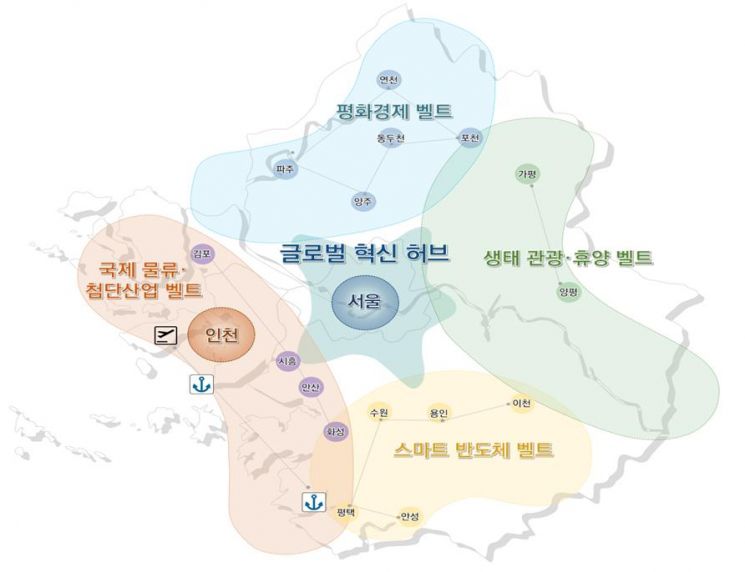 The 4th Metropolitan Area Readjustment Plan Spatial Concept (Provided by the Ministry of Land, Infrastructure and Transport)
[Asia Economy Reporter Lee Chun-hee] A mid- to long-term plan to manage the Seoul Metropolitan Area (SMA) in a way that curbs concentration in the region over the next 20 years has been finalized. The plan aims to suppress overpopulation in the SMA and disperse development demand to pursue balanced growth.
The Ministry of Land, Infrastructure and Transport announced on the 30th that it has finalized and promulgated the "4th SMA Maintenance Plan" after deliberation by the State Council and approval by the President. The SMA Maintenance Plan is a subordinate plan to the National Comprehensive Land Plan and holds the highest-level status among plans within the SMA.
This plan was established considering the still high concentration of population and industry in the SMA, maintaining the overall framework of the current management system while enhancing its operation. It also includes measures to address internal issues within the SMA such as indiscriminate development and regional imbalance.
The basic direction of the plan is linked with the higher-level 5th National Comprehensive Land Plan and presents the SMA as "a livable metropolitan area leading win-win development and global innovative growth through solidarity and cooperation." To achieve this, it is based on four major goals: ▲ balanced development ▲ quality of life for residents ▲ innovative growth ▲ peace economy.
The spatial structure is formed into five specialized belts based on analyses of specialized industry distribution and spatial plans by local governments: ▲ Global Innovation Hub ▲ Peace Economy Belt ▲ International Logistics and Advanced Industry Belt ▲ Smart Semiconductor Belt ▲ Ecotourism and Recreation Belt. This spatial structure concept serves as the basic guideline for spatial and industrial placement when establishing related and subordinate plans and implementing various development plans as the highest-level plan within the SMA.
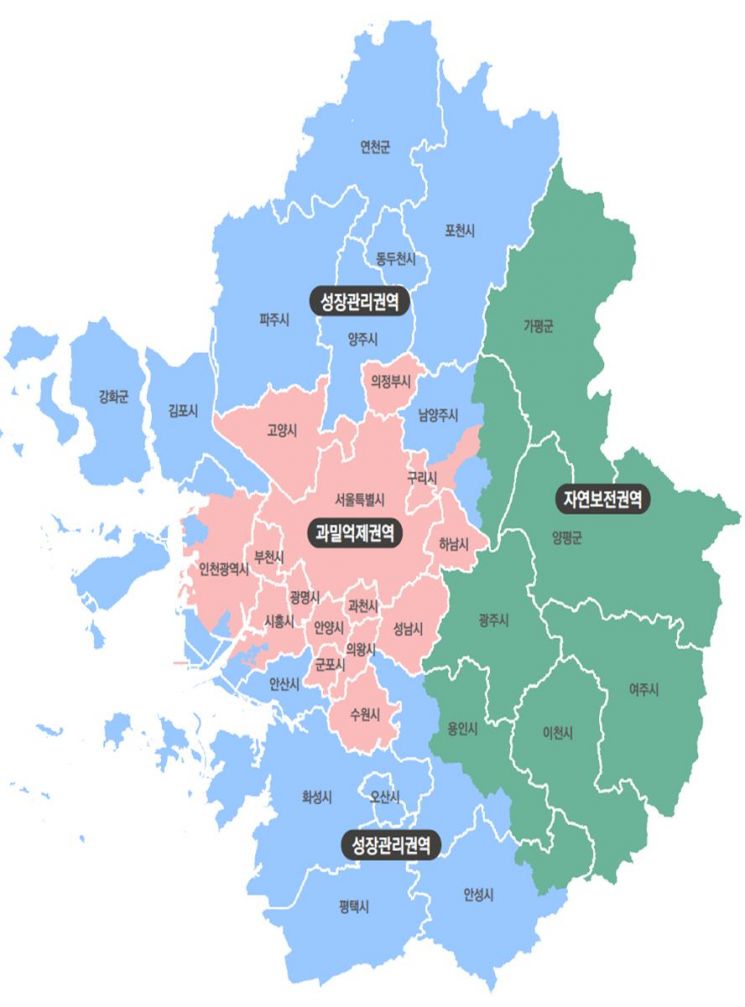 Status of the Seoul Metropolitan Area (Provided by the Ministry of Land, Infrastructure and Transport)
In this plan, the government decided to maintain the three-zone system consisting of the Overpopulation Control Zone, Growth Management Zone, and Natural Conservation Zone. Requests from local governments to change the zone system will be reviewed from a mid- to long-term perspective, considering the visibility of balanced development policy outcomes.
The Overpopulation Control Zone will continue to be managed through measures such as restricting the designation of industrial areas to alleviate persistent overpopulation. Measures to prevent the spread of overpopulation to surrounding areas are also being considered. In particular, Seoul will maintain current management levels, including the collection of overpopulation charges (economic burdens imposed on buildings that induce population concentration) and prohibiting university relocations.
The Growth Management Zone will be promoted in connection with efforts for balanced development, such as operating the "Industrial Area Supply Plan" that guides development demand from the southern to the northern part to prevent indiscriminate development. Currently, the government operates an industrial area management system that limits the development area of industrial complexes in the SMA to no more than 20% of the national total to curb the concentration of manufacturing industries in the SMA.
While expanding the northern share of industrial area supply, the plan specifies "peace economy projects" as a condition for additional supply, and the supply plan includes not only industrial complexes but also industrial areas outside complexes that were previously subject to the factory total quantity system for management.
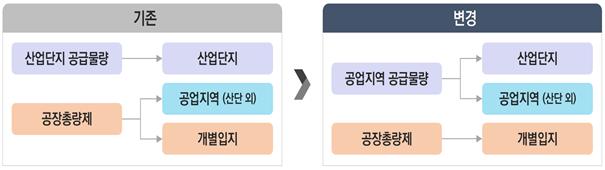 Conceptual Diagram of Growth Management Zone Industrial Area Management Reform (Provided by the Ministry of Land, Infrastructure and Transport)
The Natural Conservation Zone will suppress new individual factory sites through factory total quantity allocation and promote the resolution of indiscriminate development by preparing maintenance inducement measures for existing individual factory sites.
In particular, facilities that induce population concentration such as factories, universities, public offices, training facilities, and large buildings will continue to be managed through total quantity regulation, location regulations by zone and type, and imposition of overpopulation charges. Large-scale development projects such as housing site development and urban development projects will be thoroughly reviewed by the SMA Maintenance Committee to ensure effective management.
For the execution and management of the plan, related agencies will be required to periodically report their respective implementation plans and performance to the Ministry of Land, Infrastructure and Transport, which will evaluate the SMA Maintenance Plan every five years and make changes if necessary.
Park Mu-ik, Director of the Land and Urban Office at the Ministry of Land, Infrastructure and Transport, said, "Along with managing population and industrial concentration in the SMA through the 4th SMA Maintenance Plan, we expect to promote win-win development between the SMA and non-SMA regions by implementing regional development policies such as urban convergence special zones and regional balanced New Deal."
© The Asia Business Daily(www.asiae.co.kr). All rights reserved.



















