[Asia Economy Reporter Bu Aeri] As 'Yogiyo,' the second-largest domestic delivery app valued at 2 trillion won, is put up for sale, industry attention is focused on who the new owner will be.
On the 28th, the Fair Trade Commission conditionally approved Delivery Hero (DH), the German company managing Yogiyo, stating, "If you want to acquire Baedal Minjok, you must sell your stake in Yogiyo within six months." The commission judged that if DH owned both Baemin and Yogiyo, it would effectively create a monopoly. DH has also expressed its willingness to comply.
Potential buyers for 'Yogiyo' include major companies such as Naver, Kakao, and Coupang. In particular, there is interest in whether Naver and Kakao, which operate 'order' services, will acquire Yogiyo to seek business synergies.

Naver operates delivery services such as 'Neighborhood Market Shopping Delivery Service' and 'Smart Order.' Naver has also continuously invested in delivery app companies. Recently, it invested 40 billion won in Insung Data, the parent company of the delivery agency service 'Saenggakdaero,' securing a 10.3% stake. In 2017, Naver invested a total of 59 billion won, including 35 billion won in Woowa Brothers, the operator of Baedal Minjok, and 24 billion won in Mesh Korea, which operates the delivery agency service 'Booroong.' Kakao also operates the 'Order' service within the KakaoTalk app.
However, both Naver and Kakao are currently distancing themselves from acquiring 'Yogiyo.' A Naver official stated, "We are currently not interested in acquisition and have no plans." A Kakao representative also said, "We have not considered acquisition."
The reason why Naver and Kakao find it difficult to hastily acquire 'Yogiyo' seems to be due to the many 'risks' they would have to bear. Delivery apps are not free from social controversies, including issues such as small business commission fees and platform worker problems. For large corporations sensitive to public opinion, this can be a deterrent.
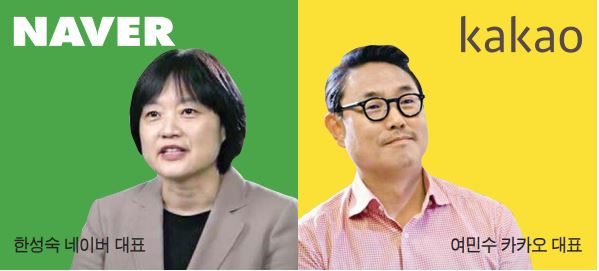
Moreover, if they acquire a delivery app, the heads of the portals are more likely to be summoned to National Assembly audits. These audits are unwelcome occasions for portal companies. Every year during the audits, the National Assembly's standing committees such as the Science, Technology, Information and Broadcasting Committee and the Political Affairs Committee discuss the attendance of Naver and Kakao representatives. Naver CEO Han Seong-sook has attended the audit for four consecutive years. This year, she was questioned about controversies regarding manipulation of Naver's shopping and video search algorithms. Kakao co-CEO Yeo Min-soo also appeared as a witness at last year's audit of the Science and Technology Committee to explain the real-time search term manipulation controversy that arose during the appointment process of Minister of Justice Cho Kuk.
An industry insider said, "Delivery apps are not a business that large corporations sensitive to public opinion can easily enter," adding, "While business synergies make it worth considering, they must also think about the possibility of backlash."
© The Asia Business Daily(www.asiae.co.kr). All rights reserved.


















