Vaccination Plan Starting from February to March Next Year
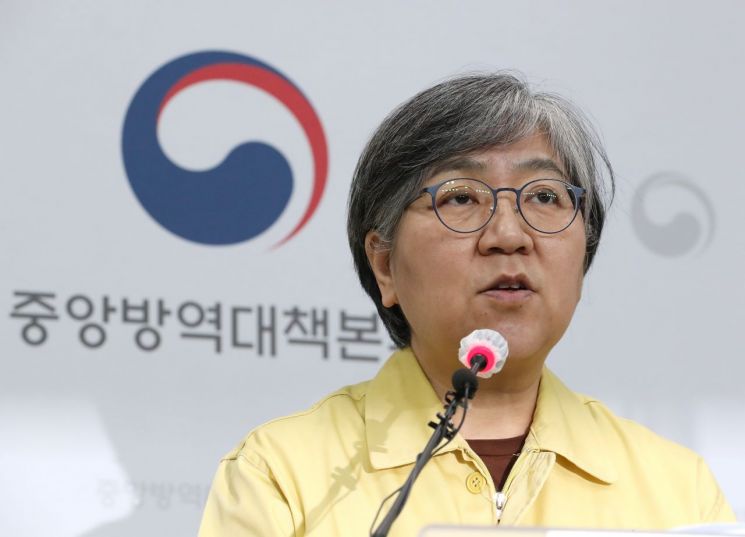 Jung Eun-kyung, head of the Central Disease Control Headquarters, is briefing on the domestic status of COVID-19 cases and vaccine import plans. [Image source=Yonhap News]
[Asia Economy Reporters Heungsun Kim and Hyunui Cho] The novel coronavirus disease (COVID-19) vaccines introduced in South Korea are scheduled to be first administered from February to March next year to about 1 million high-risk individuals, including healthcare workers and residents of nursing hospitals and nursing homes.
Jung Eun-kyung, head of the Central Disease Control Headquarters, stated at a regular briefing on the 28th, "The government plans to enable vaccination as soon as the vaccines are supplied domestically from February to March next year," adding, "Healthcare workers who care for hospitalized or severely ill patients and high-risk groups living in group facilities such as nursing hospitals and nursing homes are being considered as the highest priority for vaccination."
Healthcare workers for hospitalized and severely ill patients
Elderly in high-risk facilities such as nursing hospitals
Approximately 1 million people prioritized for vaccination
The quarantine authorities estimate the highest priority vaccination target to be around 1 million people. Additionally, those aged 65 and older, chronic disease patients aged 19 to 64 with moderate or higher risk, workers and staff at child and youth education and care facilities, first responders to COVID-19, police officers, firefighters, and military personnel are also considered priority groups. Head Jung said, "We have a plan to complete vaccinations for the recommended priority groups before the influenza season (November)."
Our government has secured vaccines for a total of 46 million people through overseas pharmaceutical companies and multinational coalitions. On the 27th of last month, a contract was signed with AstraZeneca for vaccines covering 10 million people, and on the 23rd of this month, supply contracts were completed with Janssen (6 million doses) and Pfizer (10 million doses). A contract for 10 million doses with Moderna is currently under review. An agreement has also been made to receive 10 million doses through the international project for joint vaccine procurement and distribution, the 'COVAX facility,' and specific supply schedules are being negotiated.
Head Jung stated, "Including planned purchases, the 46 million doses procured by the government correspond to 88.8% of South Korea's total population of 51.83 million," adding, "This amount corresponds to 104.3% of the 44.1 million people aged 18 and over who are eligible for vaccination." He further noted, "Considering academic opinions that 60 to 70% of the total population needs to develop antibodies for herd immunity, this is a sufficient quantity to establish herd immunity domestically."
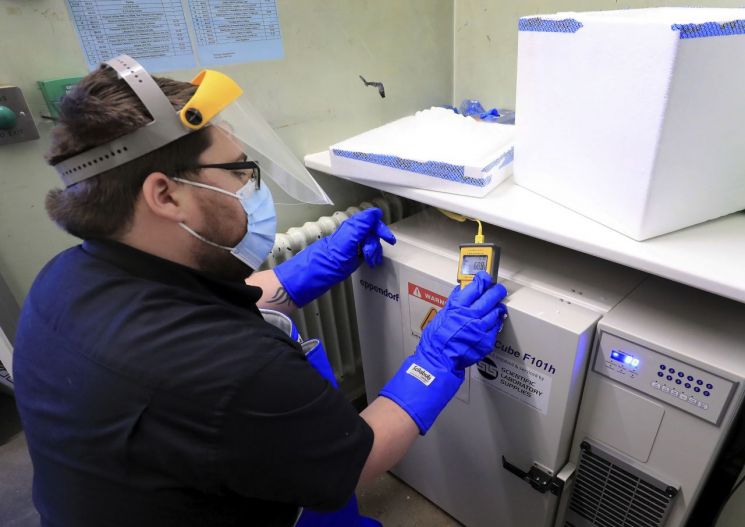 A pharmaceutical officer from the health department of the Croydon Borough in South London, UK, is receiving the first batch of the COVID-19 vaccine jointly developed by Pfizer-BioNTech at Croydon University Hospital and preparing to store it. (London AP=Yonhap News)
Establishment of vaccine management system considering characteristics such as ultra-low temperature distribution and refrigerated storage
Monitoring adverse reactions after vaccination and confirming causality; national compensation in case of damage
COVID-19 vaccination will be conducted in two ways, considering the characteristics of each vaccine type: operating separate vaccination centers and designating entrusted medical institutions. For vaccines like Pfizer's that require ultra-low temperature distribution at -60 to -90 degrees Celsius, about 100 to 250 separate vaccination centers equipped with freezers will be designated and operated. Vaccines such as AstraZeneca and Janssen, which can be stored and distributed refrigerated, will be administered at designated entrusted medical institutions that meet the criteria and have prior experience with vaccinations.
The quarantine authorities are also establishing the 'COVID-19 Vaccination Integrated Management System' to prevent cross-vaccination of COVID-19 vaccines, which generally require two doses. This system will manage vaccine supply and administration separately from the existing national vaccination system and will also register vaccinations and monitor adverse reactions after vaccination.
Furthermore, a joint monitoring system between the Korea Disease Control and Prevention Agency and the Ministry of Food and Drug Safety will be established to monitor possible adverse reactions after vaccination, and a national compensation system will be applied for damages confirmed to be causally related.
Head Jung said, "We are making every effort at the government-wide level to prepare for vaccine introduction and safe vaccination," adding, "We are continuously negotiating with individual pharmaceutical companies to advance the domestic supply schedule and secure additional quantities, and we will announce detailed vaccination plans in January next year."
© The Asia Business Daily(www.asiae.co.kr). All rights reserved.