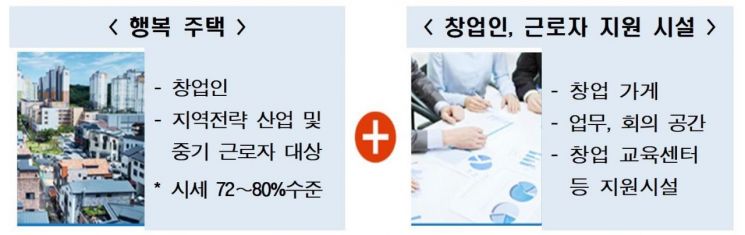
 Conceptual Diagram of Job-Linked Support Housing (Provided by the Ministry of Land, Infrastructure and Transport)
[Asia Economy Reporter Lee Chun-hee] Job-linked support housing, which reduces housing cost burdens by supplying at prices lower than market rates and increases proximity to workplaces, will be provided targeting entrepreneurs and small and medium-sized enterprise (SME) workers.
The Ministry of Land, Infrastructure and Transport announced on the 28th that it has finalized the selection of 2,136 households across nine nationwide candidate sites for the "Second Half of 2020 Job-Linked Support Housing" project. Job-linked support housing is a customized happy housing that supplies affordable housing at about 72-80% of the nearby market price to entrepreneurs, industrial complex workers, and SME workers.
This public contest was divided into three types: ▲Entrepreneur Support Housing ▲Regional Strategic Industry Support Housing ▲SME Worker Support Housing, and was conducted targeting local governments. Through this, two sites with 130 households (▲Incheon 58 households ▲Jeju 72 households) were selected as Entrepreneur Support Housing; five sites with 1,196 households (▲Ulsan 500 households ▲Cheongju, Chungbuk 200 households ▲Miryang, Gyeongnam 400 households ▲Jeonju, Jeonbuk 96 households) were selected as Regional Strategic Industry Support Housing; and two sites with 810 households (▲Hwaseong, Gyeonggi 700 households ▲Gimje, Jeonbuk 110 households) were selected as SME Worker Support Housing.
The Ministry of Land had previously selected 1,918 households across 13 candidate sites for job-linked support housing in the first half of this year. Thus, a total of 4,054 households across 21 sites have been selected this year. The Ministry plans to conduct contests targeting local governments in both the first and second halves of next year to discover more candidates.
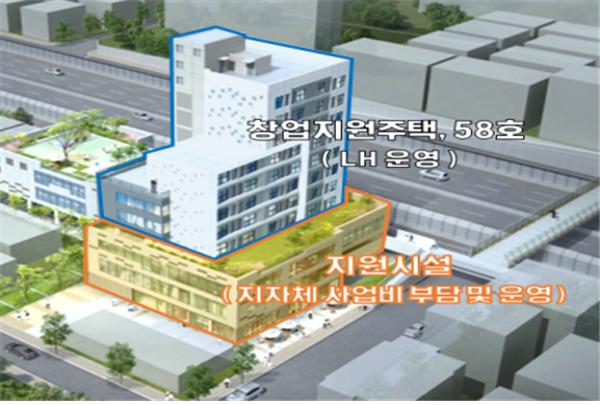 Incheon Seoknam District Startup Support Housing Bird's-eye View (Provided by the Ministry of Land, Infrastructure and Transport)
Among the newly selected Entrepreneur Support Housing, Incheon Seoknam (58 households) is evaluated to have excellent entrepreneurial conditions and convenient transportation, with seven universities and three industrial complexes located within 5 km, and an entrepreneurship support facility operated by the local government is expected to move in. Jeju Seogwipo district (72 households) is also expected to be very helpful to local entrepreneurs and prospective entrepreneurs, as Jeju City independently operates an incubation center.
Regional Strategic Industry Support Housing is evaluated to have close proximity to industrial complexes. Ulsan High-Tech district (500 households) is located in the Ulsan High-Tech Valley industrial complex, Miryang Nano district (300 households) in the Miryang Convergence Nano National Industrial Complex, and Cheongju Ochang district (200 households) in the Ochang Science Industrial Complex. It is expected to provide stable housing for industrial complex workers in connection with regional strategic industries and help revitalize the industrial complexes.
Housing linked to local cultural industries (intangible cultural heritage) will also be supplied. Jeonju Dongseohak district (96 households) plans to provide a training center for intangible cultural heritage transmission support, as well as spaces for performances and creative activities. Miryang Sammun district (100 households) is expected to contribute to the revitalization of traditional culture and local tourism in the future, together with the nearby Arirang Intangible Cultural Campus.
Hwaseong Dongtan 2 district (700 households) and Gimje Jipyeongseon district (110 households), selected as SME Worker Support Housing, are also expected to help alleviate housing burdens by providing residential spaces for SME workers.
Kim Jeong-hee, Director of Housing Welfare Policy at the Ministry of Land, said, "If local governments promote job support housing together for entrepreneurship, industrial complex revitalization, and regional strategic industry development, it is expected to help secure excellent talent through housing stability for workers and early activation of the relevant industries." She added, "We plan to continuously discover and expand specialized models for entrepreneurs and workers, such as housing, culture, and job complex models, so we ask for active participation from local governments."
© The Asia Business Daily(www.asiae.co.kr). All rights reserved.