Extension of Social Distancing: Level 2.5 in Seoul Metropolitan Area and Level 2 in Non-Metropolitan Areas Until January 3 Next Year
Key Indicators Diverge... Difficult to Predict This Week's Situation
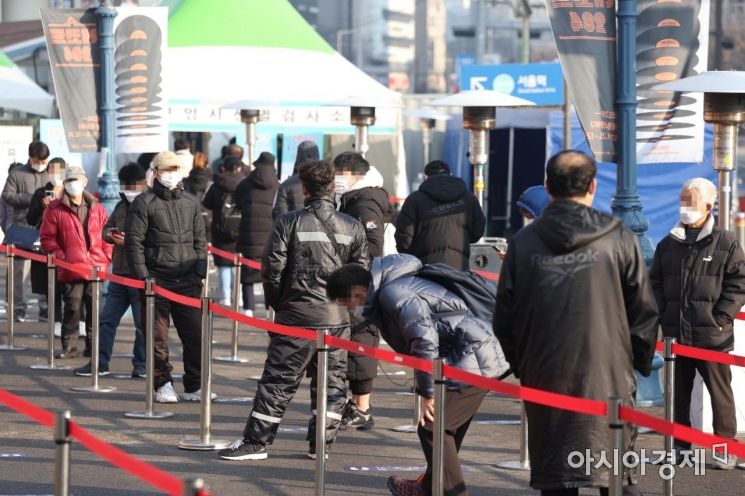 Citizens are waiting to get tested at a temporary screening clinic for COVID-19 set up at Seoul Station Plaza. Photo by Mun Ho-nam munonam@
[Asia Economy Reporter Kim Heung-soon] This week, the positivity rate and the infection reproduction number, which can gauge the trend of new domestic COVID-19 cases, are showing conflicting signals. Although the government decided not to escalate social distancing to Level 3 and to maintain Level 2.5 in the metropolitan area and Level 2 in non-metropolitan areas until January 3 next year, it remains difficult to predict whether the spread will continue or turn into a decline.
According to the Central Disease Control Headquarters (CDCH) on the 28th, the number of domestic COVID-19 diagnostic tests conducted the previous day was 31,895, and the number of new confirmed cases as of midnight was 808. The positivity rate, calculated as confirmed cases relative to the number of tests, was recorded at 2.53%.
The positivity rate is an indicator that estimates how many of those suspected of having COVID-19 are actually confirmed positive, serving as a reference to predict the trend of new confirmed cases in the coming days. Comparing with the previous weekend, the positivity rate was 2.98% (1,097 out of 36,847 tests) on the 20th, 3.01% (926 out of 30,767 tests) on the 21st, and on the later part of the week, the 25th saw a record high of 1,241 new confirmed cases.
In the recent three days, the positivity rates were 3.77% (1,104 out of 30,058 tests) on the 26th, 2.62% (970 out of 36,997 tests) on the 27th, and remained around 3% on the 28th, indicating a high level that could lead to new confirmed cases exceeding 1,000 again in the latter part of the week. Jeong Eun-kyung, head of the CDCH, recently stated, "The positivity rate among suspected patients has exceeded 2%, indicating a very high risk of community infection."
On the other hand, since the infection reproduction number has decreased compared to before, the government and health authorities are hopeful that the spread can be reversed. The infection reproduction number is a statistic indicating how many additional people one confirmed case infects; if the number is above '1', it means further transmission continues.
According to Kwon Deok-cheol, 1st Deputy Head of the Central Disaster and Safety Countermeasure Headquarters (CDSCH) and Minister of Health and Welfare, the infection reproduction number in the metropolitan area was 1.07 as of the 27th, down from 1.27 on the 21st a week earlier. Although it still exceeds 1, the government expects to lower this figure further through the effects of the 'Year-end and New Year Enhanced Quarantine Measures,' which include bans on gatherings of five or more people.
Prime Minister Chung Sye-kyun emphasized at the CDSCH meeting on the same day, "This week will be a critical turning point to determine whether the spread will escalate or subside," adding, "To curb the spread, quarantine measures at workplaces, social activities, and homes are extremely important."
© The Asia Business Daily(www.asiae.co.kr). All rights reserved.

















