Kwonikwi Announces '2020 Corruption Perception Survey Results'
Polarization in Corruption Perception Between Citizens and Public Officials Continues This Year
Citizens Rate Politicians, Public Officials Rate Media as Corrupt
One in Three Citizens Perceive Public Officials as Corrupt... Only One in One Hundred Public Officials Agree
[Asia Economy Reporter Moon Chaeseok] 'Ashitabi (我是他非).' Intellectuals in our society evaluated Korea in 2020 as 'I am right, others are wrong.' It is similar to the so-called expression 'Naeronambul' (when I do it, it's romance; when others do it, it's an affair). This phrase often emerges amid extreme social polarization, policy failures such as real estate issues, and controversies over multiple home ownership among high-ranking public officials.
On the 28th, such corruption perception results were released. Half of the citizens evaluated our society as 'corrupt,' but among public officials, fewer than one in ten said 'corrupt.' The survey was conducted in June and from October to November, targeting a total of 4,530 people, including 1,400 general citizens, 700 businesspeople, 630 experts, 400 foreigners, and 1,400 public officials.
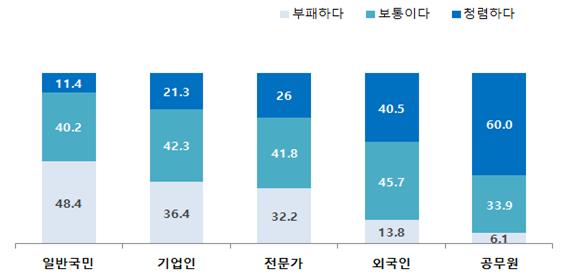 Perception of Corruption Levels in Our Society. (Data from the Anti-Corruption and Civil Rights Commission)
According to the '2020 Corruption Perception Index' results announced by the Anti-Corruption and Civil Rights Commission, the proportion of respondents who answered 'corrupt' when asked about the overall level of corruption in our society was 48.4% for general citizens, 36.4% for businesspeople, 32.2% for experts, 13.8% for foreigners, and 6.1% for public officials. Although the overall percentage of those who answered 'corrupt' decreased, the 'polarization in corruption perception' remained. Last year, the order was general citizens (63%), businesspeople (45.9%), experts (45.6%), foreigners (21%), and public officials (13.3%).
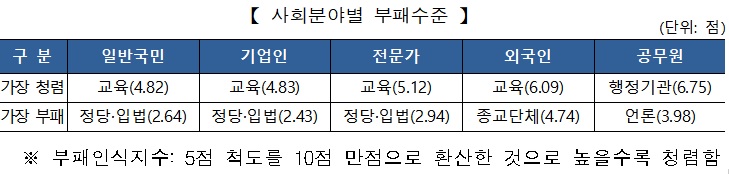
Perspectives on why society is corrupt also varied. General citizens, businesspeople, and experts answered that 'political parties and legislature' were the most corrupt, but foreigners evaluated 'religious organizations' as the most corrupt, and public officials rated 'media' as the most corrupt. In particular, the score given by general citizens to the integrity of political parties and legislature was the lowest at 2.64 out of 10.
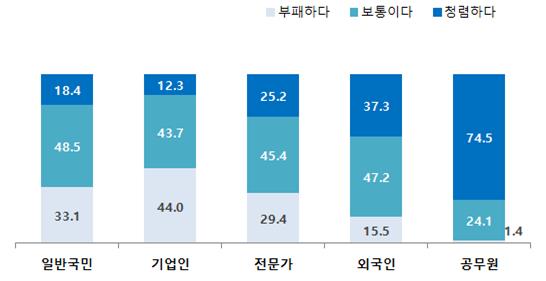 Perception of Corruption Levels in the Public Sector. (Data from the Anti-Corruption and Civil Rights Commission)
Perceptions of corruption among public officials were extremely divided. 33.1% of general citizens answered that 'public officials are corrupt.' The proportion of public officials who admitted to being corrupt themselves was only 1.4%.
At least regarding the government's anti-corruption efforts, many responded that there was some effect. However, even here, there was a large gap: 52.4% of public officials themselves answered 'effective,' while only 28.8% of general citizens did.
© The Asia Business Daily(www.asiae.co.kr). All rights reserved.
![User Who Sold Erroneously Deposited Bitcoins to Repay Debt and Fund Entertainment... What Did the Supreme Court Decide in 2021? [Legal Issue Check]](https://cwcontent.asiae.co.kr/asiaresize/183/2026020910431234020_1770601391.png)