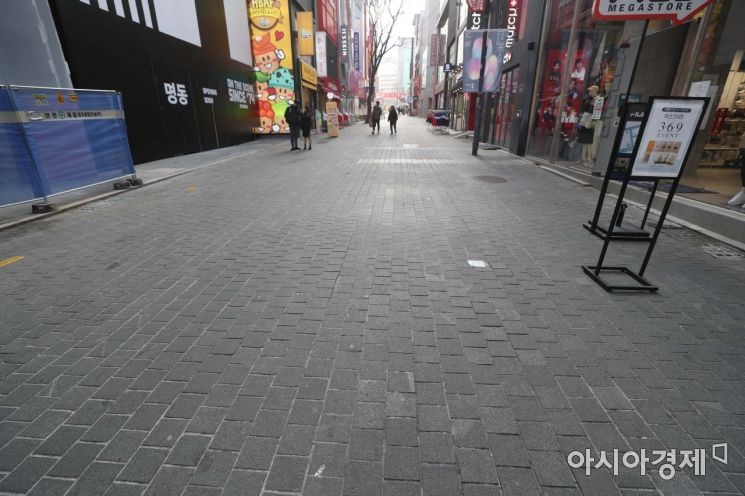
 On the last day of the Christmas holiday, the 27th, Myeongdong Street in Jung-gu, Seoul is quiet due to the impact of the novel coronavirus infection (COVID-19). Photo by Moon Honam munonam@
[Asia Economy Reporter Kim Heung-soon] As the third wave of the novel coronavirus infection (COVID-19) in South Korea results in around 1,000 confirmed cases per day, the recent weekend mobility of citizens in the metropolitan area has dropped to the lowest level since the outbreak of COVID-19.
According to the Central Disaster and Safety Countermeasure Headquarters (CDSCH) on the 27th, the weekend mobile phone movement in the metropolitan area was recorded at 24.49 million on December 12-13 and 24.43 million on December 19-20. This is even lower than the lowest weekend mobility in the metropolitan area (24.51 million) during the first wave centered around Daegu and Gyeongbuk on December 2-3.
The government and quarantine authorities have set up temporary screening clinics in the metropolitan area and are expanding diagnostic testing to curb the spread of the third wave. This is to detect hidden transmissions in the community early, including asymptomatic infections. As of today, 151 temporary screening clinics (63 in Seoul, 76 in Gyeonggi, and 12 in Incheon) have been operating since December 14, conducting a total of 479,835 diagnostic tests and identifying 1,252 confirmed cases.
Hospital beds and residential treatment centers have also been expanded. Available beds, excluding those currently in use, increased from 2,548 on December 12 to 5,813 as of the 26th, an increase of 3,265 beds. Accordingly, the number of patients waiting more than one day in the metropolitan area decreased from 595 on the 17th to 96 as of today.
The goal was to secure a total of 10,000 beds over three weeks, and 9,954 beds have been secured by the second week. Among these, 7,760 beds in residential treatment centers have been secured, exceeding the three-week target of 7,000 beds. Intensive care unit beds for severe patients have also reached 451, achieving 150.3% of the three-week target of 300 beds.
According to the CDSCH, as of the 26th, immediately available beds nationwide include 6,163 in residential treatment centers, 1,529 in infectious disease-dedicated hospitals, and 164 intensive care unit beds. In the metropolitan area, there are 5,316 residential treatment center beds, 417 infectious disease-dedicated hospital beds, and 80 intensive care unit beds available.
Considering this quarantine response system, the CDSCH decided not to raise social distancing to level 3 but to extend the metropolitan area’s level 2.5 social distancing and the non-metropolitan area’s level 2 measures, which were scheduled to end on the 28th, for six days until January 3, 2021, coinciding with the year-end and New Year’s special quarantine reinforcement period (December 24, 2020 ? January 3, 2021).
Kwon Deok-cheol, the first deputy head of the CDSCH (Minister of Health and Welfare), explained, "Currently, the capacity of the quarantine and medical system is maintainable, and it is necessary to observe the effects of reducing contact through the year-end and New Year’s special quarantine measures, including strengthening quarantine in high-risk facilities and reducing gatherings and travel."
The CDSCH stated that it plans to comprehensively review the social distancing level after January 3, 2021, when the year-end and New Year’s special quarantine measures end, while monitoring patient trends and medical system capacity through this week. It also plans to strengthen inspections and management of high-risk facilities such as nursing hospitals and nursing homes.
© The Asia Business Daily(www.asiae.co.kr). All rights reserved.