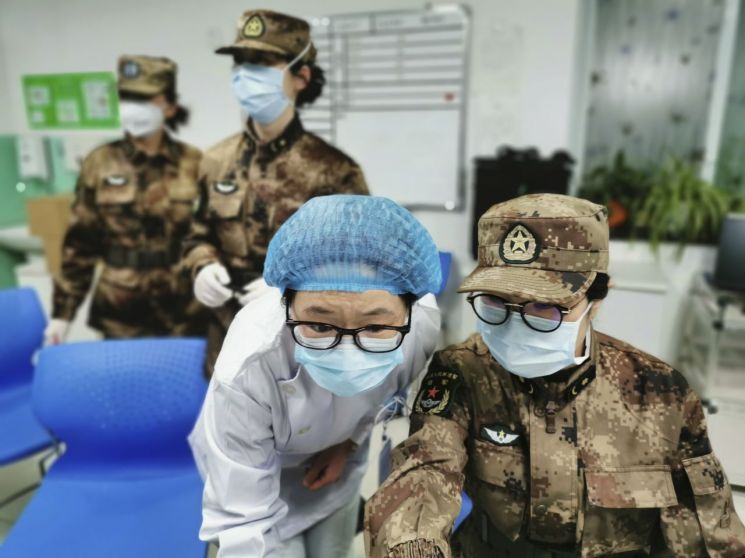
 Medical personnel belonging to the Chinese People's Liberation Army deployed and working at Jinyintan Hospital in Wuhan, Hubei Province. [Image source=Yonhap News]
[Asia Economy Reporter Choi Eun-young] There is a Chinese writer who made a confession of conscience, saying, "A society lacking common sense, objectivity, and accuracy kills countless people," regarding the novel coronavirus infection (COVID-19) that first emerged in Hubei Province, China, last December and has since plunged the world into pandemic fear.
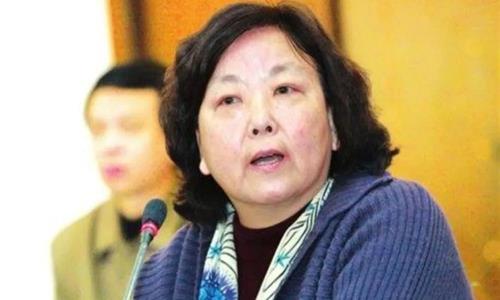
On November 24th, the British BBC selected Fang Fang (方方, real name Wang Fang), a Chinese writer who published the Wuhan Diary (武漢日記), as one of the '100 Women of the Year.'
Known as "China's representative writer of new realism," Fang Fang began documenting the horrors of Wuhan, the Chinese government's concealment and distortion of the truth, the complacent response of officials, and the citizens' cries in detail from the third day of Wuhan's lockdown, posting them daily on her SNS. There were a total of 60 entries until the lockdown was lifted on March 24th, after 62 days.
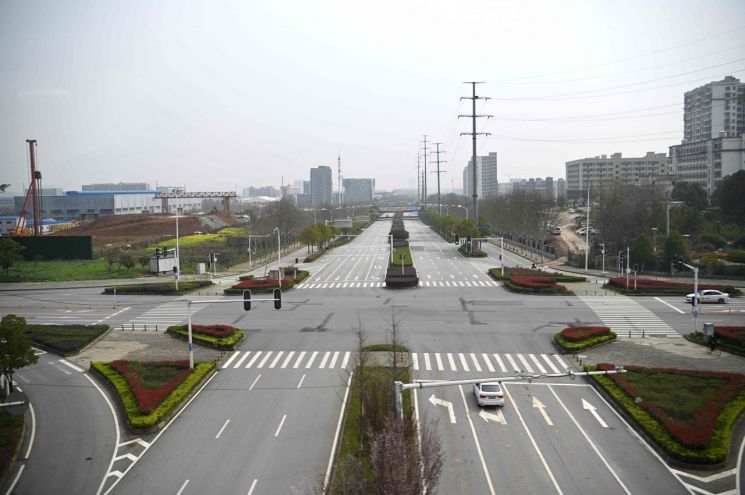 The streets of Wuhan City, Hubei Province, China, the origin of the novel coronavirus disease (COVID-19), were empty on March 10. Chinese President Xi Jinping visited Wuhan City for the first time in three months since the outbreak of COVID-19. [Image source=Yonhap News]
The Wuhan Diary is a book compiling all these records written by Fang Fang. It has been published in 15 countries but, as expected, has never seen the light of day in China. In South Korea, Munhakdongne published it with translation by Jo Yuri.
Fang Fang's writings, which revealed the reality of Wuhan in real time, shocked not only inside China but also countries around the world. The Chinese government immediately censored and blocked her writings, but Chinese netizens resisted by creating a 'comment relay,' completing her original text through comments, creating a remarkable scene.
The value of Fang Fang's records lies in her risking her life to consistently hold officials accountable and in her unwavering commitment to revealing the 'truth' despite severe government repression and harsh threats from pro-government supporters.
Above all, she repeatedly pointed out that in a society where common sense disappears and governments and authorities lead with lies and propaganda, tragedies like the COVID-19 crisis can recur at any time.
She delivered a pointed criticism, saying, "A society lacking common sense, objectivity, and accuracy does not just kill people in words but truly kills people, even countless people."
While live-broadcasting the horrors of Wuhan that the Chinese government was eager to conceal, Fang Fang also focused on the lives of ordinary people harmed by the government's lies. She reported on realities that no one paid attention to: a child with cerebral palsy who starved to death at home after both parents were quarantined, people unable to receive treatment despite symptoms, and countless bodies wrapped in plastic and loaded onto cargo trucks without funerals.
At that time, Chinese authorities, aiming not to spoil the atmosphere of the biggest holiday, the Lunar New Year, neither properly informed nor responded to the COVID-19 outbreak that occurred in December last year. They failed to adequately inform their citizens and other countries about the contagiousness and severity of symptoms in the early stages, and from December last year to February this year, a massive number of Chinese people poured out to South Korea, Japan, the United States, Europe, and worldwide, causing the virus to spiral out of control.
Late in the response, Chinese authorities completely locked down the massive city of over 10 million people, and citizens were trapped at home, trembling in fear.
At the same time, Chinese 'conscience' doctor Li Wenliang was suppressed after openly criticizing the Chinese government, which claimed, "COVID-19 is not transmitted between people. It can be prevented and controlled."
The Chinese government also suppressed not only Li but Fang Fang and even scholars who supported Fang Fang's Wuhan Diary. Scholars who supported the Wuhan Diary were taken by authorities for investigation and suffered hardships, and Fang Fang was also sued.
Nonetheless, the hopeful aspect is that the 'courage' supporting their conscience still lives on. Chinese literary figure Yan Lianke sent a contribution to Daesan Culture in March, criticizing the Chinese authorities for controlling the media and public opinion rather than COVID-19 itself, and actively defending Fang Fang and Li Wenliang. Regarding the Wuhan Diary, he said, "We should thank Fang Fang for raising the fallen faces of writers and literature from the ground."
Novelist Kim Hoon wrote a recommendation, saying, "The government did not control the virus but controlled the talk about the infectious disease. Fang Fang concluded that this hell of COVID-19 originated from 'lies.'"
© The Asia Business Daily(www.asiae.co.kr). All rights reserved.



















