2019 Fiscal Year General Government and Public Sector Debt Calculation Results
Both D2 and D3 surged by 2.2%P compared to the previous year
"Impact of deteriorating fiscal revenue conditions due to economic slowdown and increased expenditure for economic response"
Ministry of Economy and Finance: "Debt ratio favorable compared to major countries"
[Asia Economy, Reporter Joo Sang-don] Last year, public sector debt, including central and local governments and non-financial public enterprises, increased by nearly 55 trillion won, reaching the 1,100 trillion won level for the first time. The ratio to Gross Domestic Product (GDP) also approached 60%.
On the 24th, the Ministry of Economy and Finance announced the "2019 Fiscal Year General Government and Public Sector Debt Calculation Results" containing these details. The debt statistics calculated and managed by the government are divided into national debt (D1), general government debt (D2), and public sector debt (D3). To systematically manage the entire public sector debt, since the 2011 fiscal year, the previous year's actual figures for D2 and D3 have been disclosed annually at the end of the year according to international standards.
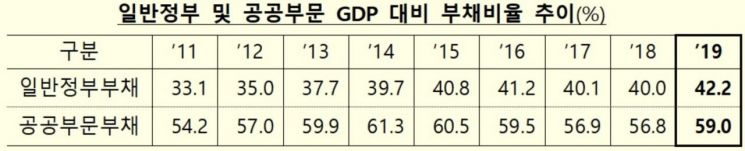
According to this, D3, which sums the debts of the government, non-profit public institutions, and non-financial public enterprises, totaled 1,132.6 trillion won, an increase of 54.6 trillion won from the previous year (1,078 trillion won). The increase is the largest since 2014 (58.6 trillion won). The ratio to GDP also rose to 59.0% from 56.8% the previous year, an increase of 2.2 percentage points. This marks a shift from a declining trend that lasted three consecutive years from 2016 to 2018 to an upward trend. The rate of increase itself also rose by 2.8 percentage points in one year, the steepest since 2012.
Last year, D2 stood at 810.7 trillion won, up 6.7% (51 trillion won) from a year earlier. The growth rate is the highest since 2015 (9.0%), and the increase amount is the largest since 2015 (55.6 trillion won). The D2 ratio to GDP recorded 42.2%, the highest since statistics began in 2011. Kang Mi-ja, Director of Fiscal Soundness at the Ministry of Economy and Finance, explained, "Unlike 2017 and 2018, when fiscal revenue conditions were favorable, in 2019, fiscal revenue conditions deteriorated due to the economic slowdown. In addition, increased expenditure for economic response led to an increase in government bond issuance." In fact, government revenue growth rates were 7.2% in 2017, 8.1% in 2018, and 1.7% in 2019. Expenditure growth rates during the same period were 5.6%, 6.8%, and 11.7%, respectively.
The Ministry of Economy and Finance holds the view that Korea's debt ratio is at a low level compared to major countries. Korea's D2 (810.7 trillion won) ratio (42.2%) is less than half of the Organisation for Economic Co-operation and Development (OECD) debt ratio (110.0%) and ranks 6th among 33 countries. The D3 to GDP ratio (1,132.6 trillion won) is 59.0%, ranking 2nd among the seven OECD countries that calculate D3. However, since only seven countries calculate D3, there are limitations in making international comparisons of D3.
© The Asia Business Daily(www.asiae.co.kr). All rights reserved.
![User Who Sold Erroneously Deposited Bitcoins to Repay Debt and Fund Entertainment... What Did the Supreme Court Decide in 2021? [Legal Issue Check]](https://cwcontent.asiae.co.kr/asiaresize/183/2026020910431234020_1770601391.png)
















