Leading the 'Green New Deal' Era: ZEB (Zero Energy Building)
Government to Invest 13.2 Trillion Won Next Year in Green New Deal... 'Green Remodeling' Also Accelerates
Seoul City Implements Greenhouse Gas Cap on Public Buildings... Subsidies for Renovating Old Houses
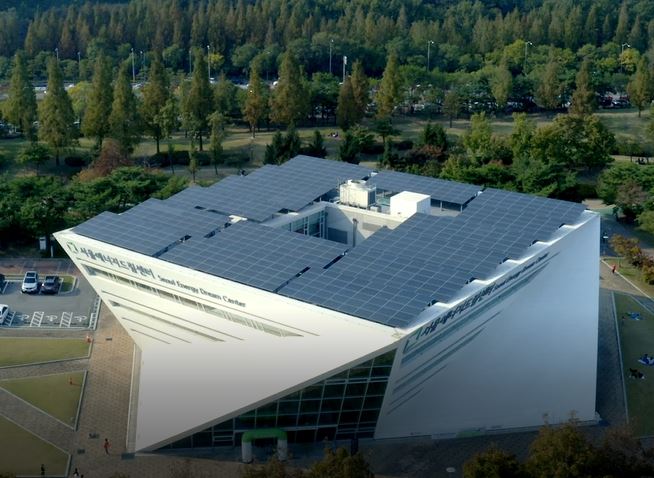 Seoul Energy Dream Center generates the electricity it needs by using solar panels installed on the building's rooftop, and sells the surplus power to Korea Electric Power Corporation.
[Asia Economy Reporter Jo In-kyung] #Seoul Mapo-gu Sangam-dong's 'Seoul Energy Dream Center' was established in 2012 as the country's first Zero Energy Building (ZEB) and operates as a facility educating students and citizens about the necessity of renewable energy dissemination and climate change issues. The building's wall insulation, roof insulation, glass windows, window systems, and architectural design are all designed to minimize energy consumption, and it generates and uses the required electricity through geothermal and solar panel power generation. The center's 272 kWh-class solar power facility produced approximately 358,500 kWh of electricity last year, used 239,800 kWh, and sold the remainder to Korea Electric Power Corporation, earning about 17.98 million KRW in revenue. From January to October this year, the amount earned from selling surplus electricity produced and used internally exceeded 13.37 million KRW.
The government has decided to invest a total of 13.2 trillion KRW next year for the 'Green New Deal,' which aims to transition to a low-carbon and eco-friendly economy. With large-scale policy projects announced to reduce carbon emissions across industry, economy, and society, key initiatives such as 'Zero Energy Buildings' and 'Green Remodeling'?essential for advancing carbon-neutral cities?are gaining momentum.
The government has previously provided incentives to promote zero energy buildings, such as relaxing building standards upon obtaining 'Zero Energy Building Certification,' tax benefits, financial support, subsidies for renewable energy installations, and funding for energy use rationalization. To date, 22 buildings nationwide have received full certification for zero energy buildings, and 543 have preliminary certification. Moving forward, policies and incentives related to improving energy efficiency in buildings?such as remodeling aging public rental housing, enhancing energy performance in public buildings used by vulnerable groups like daycare centers, and establishing Green Smart Schools?will be expanded to minimize carbon emissions.
For example, in announcing next year's economic policy direction related to the Green New Deal, the government plans to expand the 9% separate taxation benefit on dividend income for public offering REITs or real estate funds that build and supply rental housing as zero energy buildings, increasing the investment limit from 50 million KRW to 200 million KRW. Additional support for these zero energy rental housing projects includes relaxing floor area ratios by more than 11% and raising the Housing and Urban Fund loan limit by 20%.
Seoul City also announced the 'Seoul-type Green New Deal' policy in July this year, presenting 'Green Buildings' as the first step toward 'carbon emission zero.' The goal is to convert all newly built or remodeled buildings into low-carbon zero energy buildings. Old public buildings such as senior centers, daycare centers, and health centers are undergoing 'Green Remodeling' to improve energy efficiency, and the 'Seoul Beautiful Housing Project,' which supports private sector aging home repairs, provides assistance for improving insulation performance and replacing windows and boilers.
Starting next year, Seoul will introduce the 'Building Greenhouse Gas Total Emission System' to limit greenhouse gas emissions from city-owned public buildings with a total floor area of 1,000㎡ or more, and from 2022, this will be expanded to private sectors such as energy-intensive business sites. The mandatory 'Zero Energy Building' requirement for new private buildings will begin in 2023, two years ahead of the government's roadmap. The 'Building Energy Efficiency Project (BRP)' is also underway, providing long-term, low-interest loans (fixed interest rate of 0.9% per annum for up to 8 years) covering up to 2 billion KRW for building energy efficiency improvements and up to 4 billion KRW for zero energy buildings.
Jo Wan-seok, Director of Seoul City's Climate Change Response Division, said, "To proactively reduce emissions from the building sector, which is considered a major greenhouse gas emitter in Seoul, we plan to improve building energy efficiency. We will first lead the transition of aging public buildings to zero energy buildings that minimize energy consumption and encourage expansion to private buildings through various guideline improvements, including revising the 'Seoul Green Design Standards.'"
© The Asia Business Daily(www.asiae.co.kr). All rights reserved.
![User Who Sold Erroneously Deposited Bitcoins to Repay Debt and Fund Entertainment... What Did the Supreme Court Decide in 2021? [Legal Issue Check]](https://cwcontent.asiae.co.kr/asiaresize/183/2026020910431234020_1770601391.png)