Ministry of Industry Holds Working-Level Meeting of the 'Carbon Neutral Industrial Transition Committee'
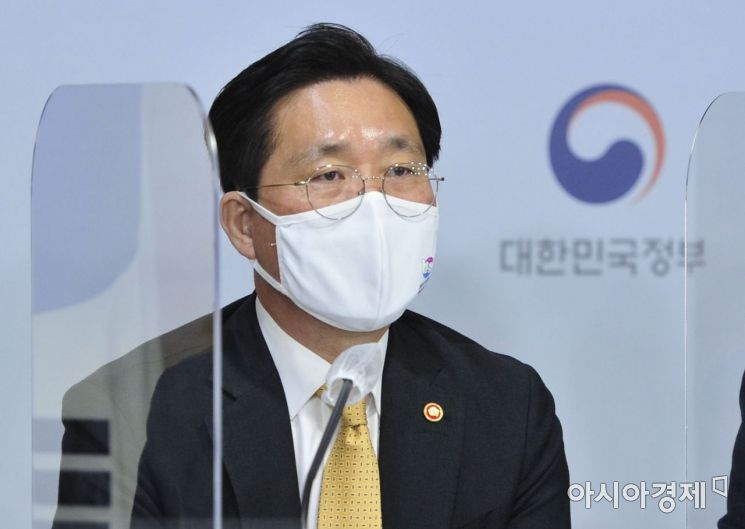 Sung Yun-mo, Minister of Trade, Industry and Energy, is holding a joint briefing on the 'Government 2050 Carbon Neutrality Promotion Strategy' on the morning of the 7th at the briefing room of the Government Seoul Office in Jongno-gu, Seoul. Photo by Kang Jin-hyung aymsdream@
[Asia Economy Reporter Moon Chae-seok] The government announced that it will hold a working-level meeting of the 'Carbon Neutral Industrial Transition Committee' on the 22nd to prepare the 'Carbon Neutral Industrial Great Transition Promotion Strategy' (Manufacturing Renaissance 2.0) by the end of next year.
As of last year, the manufacturing sector's share of South Korea's Gross Domestic Product (GDP) was 28.4%, higher than Japan's 20.3%, the European Union's (EU) 16.4%, and the United States' 11%. Close communication with the industrial sector is essential in the process of achieving carbon neutrality.
The government has established a public-private joint system, including the 'Carbon Neutral Industrial Transition Promotion Committee' and the 'Industry-specific Carbon Neutral Consultative Council,' to continuously communicate with the industrial sector and expand consensus.
The basic directions for carbon neutrality in the industrial sector include securing industrial competitiveness, industrial transformation, new industry creation, incentive methods, and consensus building.
The Ministry of Industry plans to support the transition costs for carbon neutrality, such as technology development, so that they do not undermine industrial competitiveness. Efforts will be made to expand the support base through incentive methods to encourage corporate participation.
The Ministry of Industry announced that it plans to present the vision and detailed strategies for carbon neutrality in the industrial sector by preparing Manufacturing Renaissance 2.0 by the end of next year.
It will focus on large-scale, privately led 'breakthrough-type' innovative technology development. Innovative technologies will be developed for each stage of the manufacturing value chain and by industry, linking research and development (R&D) with demonstration to secure carbon-neutral implementation technologies.
Energy efficiency will be improved by substituting low-carbon and zero-carbon raw materials and adopting decarbonized innovative processes. The industrial structure will be transformed mainly around eco-friendly promising products such as electric and hydrogen vehicles, eco-friendly ships, low-power semiconductors, and ultra-lightweight, high-strength zero-carbon steel.
It will foster 'low-carbon new industries' such as mobility and bio, 'climate industries' such as carbon capture, utilization, and storage (CCUS), and 'green energy industries' such as hydrogen and renewable energy.
© The Asia Business Daily(www.asiae.co.kr). All rights reserved.
![User Who Sold Erroneously Deposited Bitcoins to Repay Debt and Fund Entertainment... What Did the Supreme Court Decide in 2021? [Legal Issue Check]](https://cwcontent.asiae.co.kr/asiaresize/183/2026020910431234020_1770601391.png)















