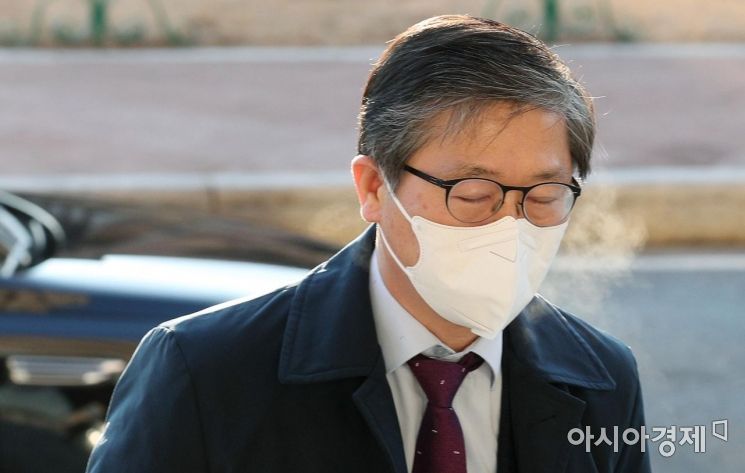
 Minister of Land, Infrastructure and Transport nominee Byeon Chang-heum is arriving at the hearing preparation office set up at the Seoul Regional Land Management Office in the Government Complex Gwacheon, Gyeonggi Province on the 21st. / Gwacheon - Photo by Kim Hyun-min kimhyun81@
[Asia Economy Reporter Lee Chun-hee] Byun Chang-heum, the nominee for Minister of Land, Infrastructure and Transport, expressed a negative perception of redevelopment and reconstruction projects. Although these projects have a public interest purpose, they are excessively used as investment targets, and he argued that capital gains should be recovered or public participation is necessary.
In response to lawmakers' questions regarding redevelopment and reconstruction regulations in the written answers submitted to the National Assembly on the 21st, nominee Byun stated, "Redevelopment and reconstruction are not simply investment development projects but projects with the public interest purpose of improving residential environments."
Nominee Byun asserted that "although maintenance projects are strongly public-oriented projects such as urban planning and residential environment, appropriate regulation is necessary as they have been excessively used as investment targets." Accordingly, he explained that appropriate housing supply, infrastructure expansion, and support for original residents such as low-income groups and tenants should be considered together within the overall framework of urban planning.
He acknowledged that such maintenance projects "have contributed to expanding housing supply," but also expressed the perception that "huge capital gains and unearned income have occurred, leading speculative demand to flow into the housing market and widening the asset gap between classes." He also responded that "as the private sector leads the projects, redevelopment and reconstruction are used as investment targets, and corruption related to construction rights has occurred, causing side effects."
Nominee Byun argued that capital gains from maintenance projects should be recovered to prevent these side effects. He emphasized, "Although these are projects with strong public interest, appropriate recovery mechanisms have not been established, and they have been perceived as investment development projects. To prevent this, a certain level of regulation is necessary."
He expressed his ambition, saying, "If appointed as minister, I will establish public maintenance projects to manage them transparently and resolve the side effects of the projects by returning development profits to the public." Specifically, he explained, "For projects led by the private sector, mechanisms to recover capital gains should be in place, while incentives should be provided on the premise of public participation, such as in public redevelopment and reconstruction, to enable supply within urban areas."
© The Asia Business Daily(www.asiae.co.kr). All rights reserved.
![User Who Sold Erroneously Deposited Bitcoins to Repay Debt and Fund Entertainment... What Did the Supreme Court Decide in 2021? [Legal Issue Check]](https://cwcontent.asiae.co.kr/asiaresize/183/2026020910431234020_1770601391.png)















