Landlords Registered Before October 23 Last Year Protest
Cannot Set Initial Rent Due to New Lease Law
Landlords Benefit Only If Tenants Do Not Renew Contracts
Tenant-Landlord Conflicts and Lawsuits Inevitable
"Precedent Needed"... Government's Official Interpretation Faces Backlash
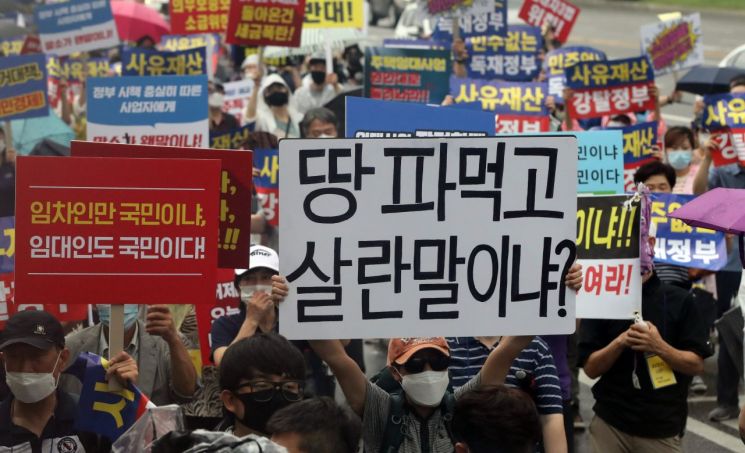 On August 1st, members of real estate-related organizations such as the 617 Regulation Retroactive Application Victims' Group and the Lease Business Association Approval Committee held a rally in Yeouido, Seoul, protesting the government's real estate regulations and shouting slogans opposing the Three Lease Laws. (Photo by Yonhap News)
[Asia Economy Reporter Moon Jiwon] Since the new lease law, which includes the rent ceiling system for jeonse and monthly rent and the right to request contract renewal, was implemented at the end of July, dissatisfaction has been growing among landlords. One of the main issues is the 'initial rent.' Under the previous law, landlords could set the initial rent freely, but after the new lease law came into effect, some landlords who can no longer do so are showing signs of filing legal lawsuits.
Currently, according to the government's official interpretation, landlords can set the initial rent only if the existing tenant does not exercise the right to request contract renewal, leading to criticism that the policy is fueling conflicts between tenants and landlords.
According to the real estate industry on the 21st, landlords who registered before October 23 of last year could set the initial rent freely after the existing lease contract at the time of registration expired. This interpretation is based on the "Special Act on Private Rental Housing" (hereinafter referred to as the Private Rental Act). Although the Private Rental Act was amended to stipulate that when a house with an existing tenant is registered as rental housing, the rent agreed upon with that tenant is considered the initial rent, this amendment does not apply to landlords who registered before October 23 of last year, before the amendment took effect.
However, the situation changed with the enforcement of the "Housing Lease Protection Act" (hereinafter referred to as the Housing Lease Act), which includes the contract renewal request right and the jeonse/monthly rent ceiling system, at the end of July this year. According to the new Housing Lease Act, all current tenants can request contract renewal from landlords, and landlords can only raise the rent by up to 5% at that time. Under the Private Rental Act, landlords who registered before October 23 of last year could set the initial rent freely, but under the Housing Lease Act, even they can only raise it by up to 5%.
At the beginning of the new lease law's enforcement, there was an opinion that landlords would not be subject to the 5% cap on initial rent since they fall under the Private Rental Act, but the Ministry of Land, Infrastructure and Transport confirmed through a guidebook that "even tenants under the Private Rental Act are not exempt from the contract renewal request right under the Housing Lease Act," and "if the tenant exercises the contract renewal request right, the 5% cap (on initial rent) applies."

As a result, dissatisfaction is emerging among landlords who initially expected to set the initial rent freely when registering. Unlike general landlords, registered landlords are subject to the 5% cap even for new lease contracts, so the initial rent significantly affects the profitability over the rental registration period (up to 8 years). One landlord said, "I registered as a landlord after setting the jeonse lower than the market price, expecting to set the initial rent freely," and added, "The government's flip-flopping is absurd."
The problem is that landlords can set the initial rent only if the tenant does not exercise the contract renewal request right. Since landlords want tenants not to exercise this right to increase profitability, related disputes are increasing. In fact, many online posts ask about ways to evict tenants, negotiation methods, and litigation strategies. Kim Seongho, a legal advisor at the Korea Landlord Association and a lawyer at the Asset Law Office, said, "More than 90% of legal consultations are about the initial rent issue," adding, "The difficulties are especially severe for landlords of apartments where jeonse prices have surged recently."
Landlords who fail to negotiate with tenants are even willing to go to court. This is because some analyses argue that the Ministry of Land's interpretation that the new Housing Lease Act takes precedence over the Private Rental Act is incorrect. Lawyer Kim said, "It is absurd to interpret that landlords can only raise the initial rent by 5% due to the amendment of the Housing Lease Act when it was previously stated that landlords could set the initial rent freely according to market prices," and added, "Since this is a matter of legal interpretation, it needs to be judged by the judiciary."
The industry expresses concerns that until a clear precedent is established, various conflicts and lawsuits over the initial rent will continue, increasing unnecessary social costs. A Ministry of Land official responded to criticisms that the government's interpretation might be wrong by saying, "The interpretation was agreed upon by the Ministry of Land and the Ministry of Justice," and added, "There is no room for further review at the government level."
© The Asia Business Daily(www.asiae.co.kr). All rights reserved.

![User Who Sold Erroneously Deposited Bitcoins to Repay Debt and Fund Entertainment... What Did the Supreme Court Decide in 2021? [Legal Issue Check]](https://cwcontent.asiae.co.kr/asiaresize/183/2026020910431234020_1770601391.png)















