Over 460,000 Licensed Real Estate Agents Nationwide... The "People's License" Stigma
Should Gradually Reduce Licensed Real Estate Agents by Switching to Relative Evaluation
Public Opinion Divided... Service Quality May Decline if Numbers Decrease
Ministry of Land Also Favors Absolute Evaluation Considering Competitiveness and Examinees
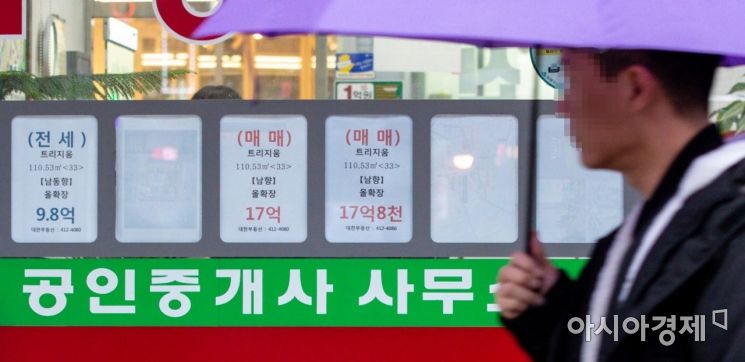 A price list is posted at a real estate agency office in Songpa-gu, Seoul. Photo by Jin-Hyung Kang aymsdream@
[Asia Economy Reporter Moon Jiwon] As a bill proposing to change the certified real estate agent exam from an absolute evaluation system to a relative evaluation system was introduced, controversy over pros and cons within the industry is growing. The Korea Association of Certified Real Estate Agents holds the position that since the real estate brokerage market is currently saturated, the exam should be changed to a relative evaluation system to gradually reduce the number of successful candidates.
However, if the number of certified real estate agents decreases, competition to lower brokerage fees may diminish and service quality could decline, leading most consumers to oppose the change. The Ministry of Land, Infrastructure and Transport, the relevant government department, has also shown somewhat negative reactions, making it unlikely that the bill will pass easily.
From Absolute Evaluation to Relative Evaluation... Association's Long-standing Task
According to the National Assembly and real estate industry on the 19th, Ha Young-je, a member of the People Power Party, recently introduced the "Partial Amendment to the Certified Real Estate Agent Act," which proposes switching the certified real estate agent selection exam to a relative evaluation system. The bill was co-sponsored by nine members of the People Power Party, including Ha, and Moon Jin-seok of the Democratic Party of Korea.
The Korea Association of Certified Real Estate Agents has long argued for changing the exam from absolute to relative evaluation. They believe that there are excessively many certified real estate agents in South Korea, leading to intense competition and high social costs.
According to the association, as of this year, about 466,500 people hold certified real estate agent licenses, of whom approximately 106,000 are active as independent certified real estate agents. Around 14,000 are employed as affiliated certified real estate agents. This means that most license holders are not actively working in the field.
Above all, the large number of certified real estate agents has led to the license being called a "national license," diminishing its value. There are many criticisms that due to intense competition and low income, unnecessary openings and closures of businesses are repeated.
Exams 5 to 9 Conducted with Relative Evaluation... Number of Successful Candidates Significantly Reduced
The association believes that if the number of successful candidates is set annually and the exam is conducted under a relative evaluation system, supply and demand can be controlled. There is also precedent for the certified real estate agent exam being conducted under relative evaluation. From 1990 to 1997, during the 5th to 9th exams held biennially, a relative evaluation system was introduced, producing an average of 2,396 agents per year. The final number of successful candidates by year was 3,524 for the 5th exam, 1,798 for the 6th, 2,090 for the 7th, 1,102 for the 8th, and 3,469 for the 9th.
In contrast, recently the number of successful candidates has reached 10,000 to 20,000 annually, making comparison with the relative evaluation period difficult due to the large difference. The 30th exam held last year had 27,078 successful candidates, and this year there are 16,554. Under a relative evaluation system, the number of successful candidates is set each year, and those with the highest scores pass, making supply and demand control easier.
The association explained, "In the case of assistant housing managers, the system has been switched from absolute to relative evaluation since 2020," adding, "If the real estate agent exam is also changed to relative evaluation, it can reduce the harms of illegal business caused by excessive competition and improve professional expertise in the occupation."
 Comprehensive education company Eduwill hosted the "2020 31st Certified Real Estate Agent Online Passers' Meeting" on the 16th at Camp One Studio in Haseong-myeon, Gimpo-si, Gyeonggi-do. Final passers who pre-registered from across the country celebrated by shouting "Fighting" and interacting through online communication. Approximately 3,000 people attended the online meeting that day.
 (Photo by Yonhap News)
Public Opinion Negative... Should Lower Fees Instead of Protecting Their Own Interests
However, there are many negative opinions in the market. Recently, as house prices surged nationwide, brokerage fees linked to them also rose significantly. There are criticisms that trying to reduce the number of real estate agents is an excessive attempt to "protect their own interests."
Currently, in Seoul, the brokerage fee rates for sales transactions are as follows based on transaction amount: ▲ under 50 million KRW 0.6% (up to 250,000 KRW) ▲ 50 million to 200 million KRW 0.5% (up to 800,000 KRW) ▲ 200 million to 600 million KRW 0.4% ▲ 600 million to 900 million KRW 0.5% ▲ over 900 million KRW up to 0.9%.
If a certified real estate agent concludes a sales contract for a 1 billion KRW house, applying the highest rate, the brokerage fee received from both buyer and seller sides amounts to 18 million KRW. Even if the rate is lowered through negotiation, buyers and sellers inevitably face additional costs of several million KRW. Since sales and lease prices have risen significantly not only in Seoul and the metropolitan area but nationwide, consumers complain about the heavy brokerage fee burden.
A netizen on a real estate online community pointed out, "Instead of a bill to change the exam to relative evaluation, a bill to lower brokerage fees should be introduced." Another netizen said, "The exam difficulty has already increased a lot, and it takes an average of two years to obtain the license. If it becomes relative evaluation, only young people without strong commitment to the profession will get the license."
Examinees preparing for the certified real estate agent exam are also opposing the bill. One examinee said, "This bill looks like collective selfishness," adding, "They do not think about leading to higher service and customer response through hard work and competition but want to reduce the number of agents to protect their own interests." Another examinee said, "From the examinee's perspective, the association's reaction is shocking."
Ministry of Land Prefers 'Absolute Evaluation'... Consensus Yet to be Formed
The Ministry of Land, Infrastructure and Transport maintains its existing stance that the absolute evaluation system should be retained rather than switching to relative evaluation. A ministry official said, "Relative evaluation means deciding the number of successful candidates in advance, but there will be conflicting interests between the brokerage industry and examinees on this point," adding, "Consumers who want better services are unlikely to view this positively."
The official explained, "I understand the bill was proposed with the purpose of protecting the market, but expanding brokerage services into comprehensive services should also be considered."
It is also known that no agreement has yet been reached between the ruling and opposition parties in the National Assembly. A staff member from Ha Young-je's office said, "Discussions with the Ministry of Land or the ruling party about the bill have not yet progressed," adding, "The bill was introduced to raise public awareness about problems arising from the excessive number of certified real estate agents, and since there may be detailed disagreements, further opinion gathering is necessary."
© The Asia Business Daily(www.asiae.co.kr). All rights reserved.


















